The Southern Theatre of Gafsa, 1972–1992: from “Jha” to “The Locusts”
This dossier is also available: اقرأ بالعربية Lire en français
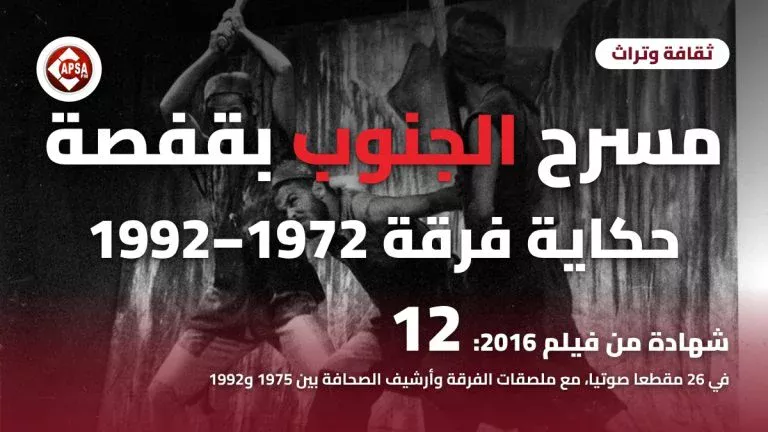
Founded in 1972 in Gafsa, in south-western Tunisia, on the decision of the region’s governor, Tahar Bousma, a theatre troupe toured the country and performed in Lebanon, Canada, Algeria, Morocco and France before becoming a centre for theatre arts. This is its story, told by its founders and actors as recorded in 2016 by the documentary The Southern Theatre of Gafsa 1972–1992 (directed by Ahmed Akkouni, camera and editing by Aymen Zawali), and as documented by the press of those years.
In brief
- Before 1972: En-Nejma Ettamthiliya El Gafsiya (“The Gafsa Dramatic Star”) in the 1930s, the Mines Theatre in Metlaoui in 1964, and the Le Kef troupe as a model.
- 1972: the governor of Gafsa, Tahar Bousma, decides to set up a permanent troupe; Mohamed Raja Farhat is its first director, with Fadhel Jaibi, Fadhel Jaziri, Raouf Ben Amor and Mohamed Driss.
- Jha and the Bewildered East, the first production: recorded by television, then banned, then cleared again.
- 1973–1974: Carthage and Hammamet, then Lebanon, Canada, Algeria and Morocco.
- 1975: the founding generation moves to the capital, Abdelkader Mokdad takes over as director, and the troupe opens its doors to young people from the region.
- Hamma El Jeridi and Firan Eddamous (“Rats of the Mine Galleries”, 1976), then Ammar Bouzouer (1978): the years of mass audiences, with up to 743 performances of the last of these, according to one witness.
- 10 July 1986: El Arich is stopped in Monastir and the troupe’s activity is frozen until November 1987.
- 1992–1993: Jweb Msouguer (“The Registered Letter”), the first production of the Gafsa Centre for Theatre Arts, a provisional name; the Gafsa Centre for Dramatic and Scenic Arts is formally established in 1993.
In this dossier
- Theatre in Gafsa before the troupe: “The Dramatic Star” and the Mines Theatre
- Gafsa, 1972: a town with no theatre space
- A decision in five minutes (1971–1972)
- Jha: the first laugh and the first ban (1972)
- On the road, from Carthage to Deir el-Qamar (1973–1974)
- El Barni wel Atra: the South speaks in its own dialect
- Gafsa’s own take over the troupe (1975)
- Hamma El Jeridi: the script once called El Boustane (1976)
- Firan Eddamous: the mine on stage (November 1976)
- The troupe and the authorities: one thread across twenty years
- Ammar Bouzouer and the years of the audience (1978–1985)
- El Arich: the night in Monastir (July 1986)
- Two readings of one experience
- From troupe to centre (1989–1992)
- The centre today
- What is left for Gafsa?
How this dossier was put together
This dossier draws mainly on the testimonies of twelve people recorded for the documentary The Southern Theatre of Gafsa 1972–1992 (directed by Ahmed Akkouni, camera and editing by Aymen Zawali): more than nine hours of recordings, transcribed in full. It also relies on the Tunisian press archive from 1975 to 1992 (more than a hundred clippings kept in the troupe archive), the troupe’s posters and touring documents, and television recordings of five plays. Every piece of information is attributed to the person or document it comes from; where accounts conflict, they are presented as they stand. The dossier was reviewed by Dr Nizar Saidi, a researcher in cultural studies.
Theatre in Gafsa before the troupe: “The Dramatic Star” and the Mines Theatre
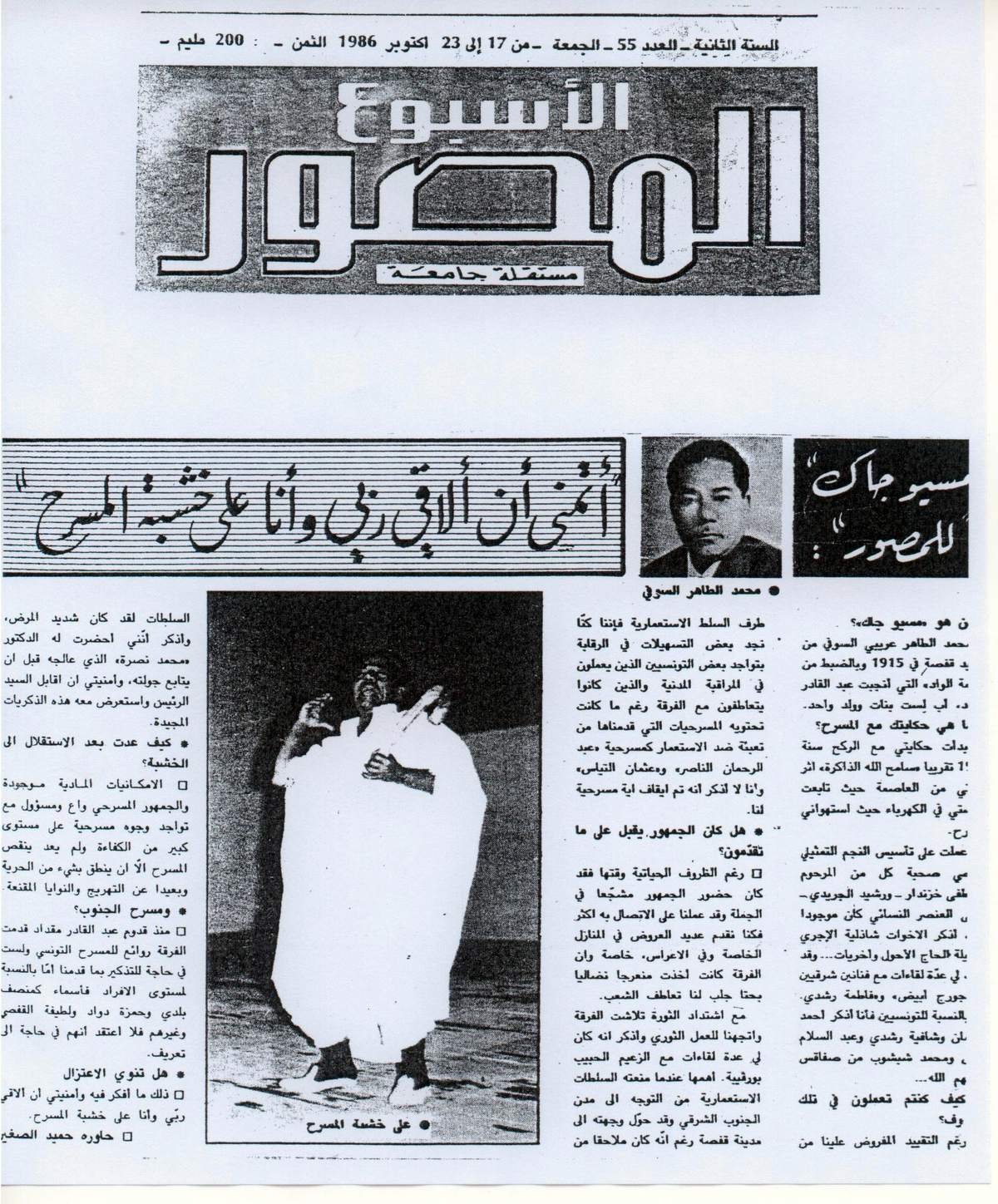
Gafsa had not waited until 1972 to have its actors. In an interview with the weekly Al Ousbou Al Moussawar (no. 55, 17–23 October 1986), Mohamed Tahar Soufi, born in Gafsa in 1915 and known as “Monsieur Jacques”, recounts how he founded the troupe En-Nejma Ettamthiliya El Gafsiya (“The Dramatic Star of Gafsa”) with Mustapha Khaznadar and Rachid Jeridi, in 1934 according to Mohamed Sassi Gattari. The troupe, he says, staged plays rallying people against colonial rule, among them Abderrahmane Ennacer, before it “faded away” as the national movement gathered strength.
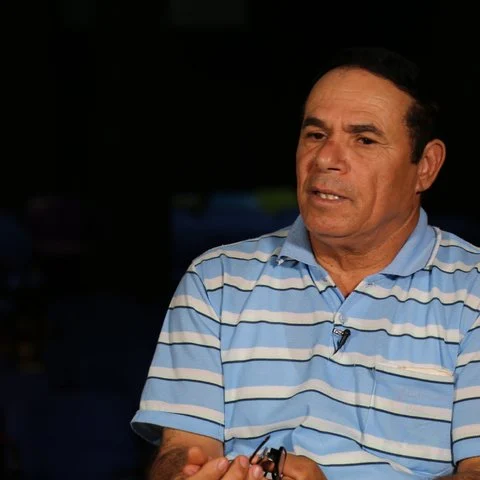
Mohamed Tahar Soufi… in thirty-four, him and a bunch of theatre people, they formed what’s known as ‘The Dramatic Star’.
Mohamed Sassi Gattari · actor with the troupe · in Tunisian Arabic
Soufi returned to the stage in 1975 at the urging of Abdelkader Mokdad, as he told Al I’lane in an interview published in its issue no. 204, undated but from around 1982, since it mentions a 1980 award won “two years ago”. He played Abdelkrim El Moueddeb in Hamma El Jeridi and won the best actor award in 1980, according to the same interview. He remained on stage with the troupe until the mid-1980s, and that is where his nickname comes from: in Ammar Bouzouer he played the French overseer “Monsieur Jacques”, and he was in the cast for the 1986 tour of France.
In Metlaoui, the poet Mohamed Ammar Chaabnia recounts that the “Mines Theatre” was founded in 1964 under the supervision and with the support of the Gafsa Phosphate Company (CPG), and that the company brought in a director from Sfax for it, providing his housing and his pay.
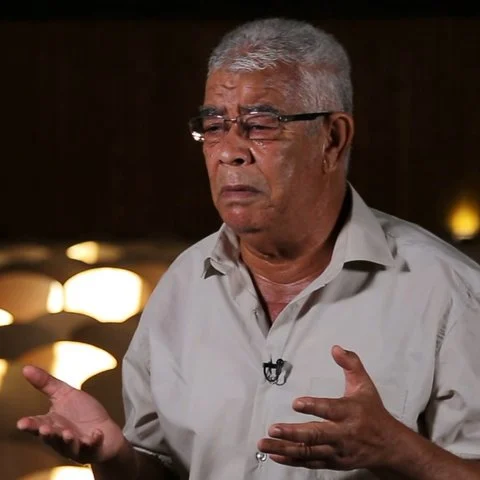
The Mines Theatre in Metlaoui… it was founded in 1964 under the supervision of the Gafsa Phosphate Company and with its support.
Mohamed Ammar Chaabnia (1950–2023) · poet from Metlaoui · in Arabic
The model that would be transplanted to Gafsa, however, came from Le Kef. There, since around 1967, Moncef Souissi’s troupe had been the country’s first permanent regional troupe. Tahar Bousma says that in 1970 he found it “withered away through lack of attention and lack of funding”, and brought it back to life.
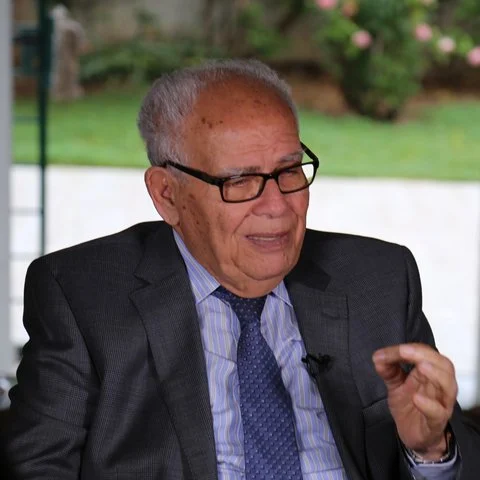
I caught it just in time, it came back to life, I followed it through with Si Moncef Souissi, and it came back stronger than it had ever been.
Tahar Bousma · governor of Le Kef (1970–1971), then of Gafsa · in Tunisian Arabic
Gafsa, 1972: a town with no theatre space
After dinner in the canteen of Gafsa’s secondary school, the tables would be pushed back against the walls. Some 500 to 600 pupils gathered, and a makeshift stage was built on top of those very tables. That is how Mohamed Raja Farhat, first director of the Théâtre du Sud troupe of Gafsa (the Southern Theatre), remembers the first performance of Jha and the Bewildered East, in 1972.
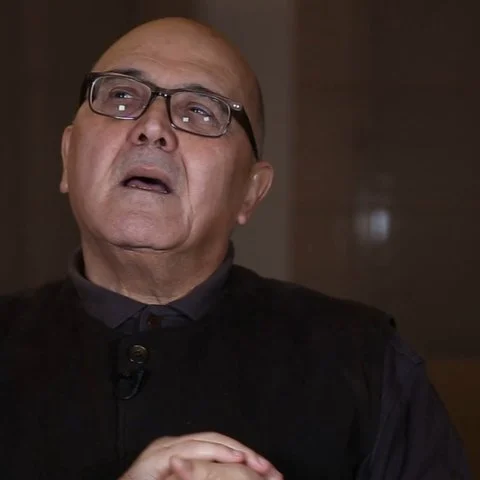
It was like a conspiracy: a conspiracy against ignorance, a conspiracy against the absence of theatre.
Mohamed Raja Farhat · first director of the troupe (1972–1975) · in Arabic
In the early 1970s Gafsa was, as Farhat and several witnesses describe it, a town with a single cinema and a house of culture that had burned down. Cultural life revolved around the secondary school, the youth centre, the film club and amateur troupes. The country, for its part, was building its first cultural network: houses of culture in the districts, each with its own cinema hall and a secretary paid forty dinars a month, Farhat recalls, and performances spread across markets, schools and hospitals.
Farhat himself had come back from the Piccolo Teatro in Milan, where he had studied under Paolo Grassi and Giorgio Strehler, and then from the Higher Institute of Dramatic Art in El Omrane. He had worked with Ezzedine Madani on Ezzanj, the documentary play that opened the Hammamet festival in 1972 before an audience of some ten thousand, by his account. It was from there that he came to Gafsa. He sums up the whole story in a single sentence:
The story of the Théâtre du Sud is a very simple story, in a land without theatre.
Mohamed Raja Farhat · in Arabic
1971–1972A decision in five minutes
It all began in Le Kef. Tahar Bousma, governor of Le Kef since the summer of 1970, says he found the regional troupe there “in a state of decay” and revived it with the director Moncef Souissi. Appointed governor of Gafsa on 1 November 1971, he found a governorate stretching from the Jerid to Sidi Bouzid, and a mining basin employing some 9,000 workers.
I found that Gafsa needed culture as much as Le Kef did, and even more than Le Kef.
Tahar Bousma · governor of Gafsa (1971–1972) · in Tunisian Arabic
It was Souissi who put forward Raja Farhat’s name. Farhat describes the scene in detail: after opening the Hammamet festival with Ezzanj, he left Le Kef at dawn with Souissi in a small Volkswagen, bound for Gafsa. There, by his account, the governor told them he “would not accept running a governorate without a theatre troupe and a centre of theatrical outreach”. Farhat came out of the meeting as director of the “project”, as he calls it.
He was frank with us, in five minutes. He said: I want to set up a permanent theatre troupe in Gafsa.
Mohamed Raja Farhat · in Arabic
The funding, according to Bousma, came from the emergency funds of the regional council, the municipality of Gafsa and the Compagnie Sfax-Gafsa, the former name of the Gafsa Phosphate Company. The company’s money did not come easily: Bousma recounts that its chairman and managing director, Tahar Amira, at first refused to allocate two thousand dinars to the troupe, and that the cheque arrived the next day, after he had confided the matter to the minister Chedly Ayari at the end of a three-day visit during which the minister and the governor had gone down into the galleries with the miners.
Farhat jokes that the troupe was born “with a gigantic, royal budget: two thousand dinars”.
The testimonies agree on the year 1972 without settling the month of the founding: between June and September, depending on the witness. A press account published in 2019 gives the date as 2 August 1972; we found no founding document to confirm it.
And all that with a gigantic, royal budget: two thousand dinars.
Mohamed Raja Farhat · in Arabic
Farhat was joined by friends returning from studies abroad: Fadhel Jaibi, Fadhel Jaziri, Raouf Ben Amor and Mohamed Driss. Jaibi says they were the “first cohort” of baccalaureate holders to study theatre on a Ministry of Culture scholarship, and that the state “loved us and hated us at the same time”. They travelled across the “greater governorate”, from Gafsa to the Jerid and Sidi Bouzid, with a selection panel made up of Jaibi, Jaziri and Ben Amor, looking for young people among the unemployed, final-year secondary pupils and miners.
Among them were Lazhar Missaoui, a son of Metlaoui and an employee of the Phosphate Company, Abdelkader El Kek, and Abdelkader Mokdad, a son of Gafsa who taught theatre there and came at Farhat’s invitation. Of that first group, Farhat and Missaoui say, between ten and twelve stayed on.
Training lasted two full months, from morning to evening. Rehearsals took place in the “tin hall” next to the regional library and the governorate headquarters, then, after the house of culture burned down, in the governorate’s meeting room. Lazhar Missaoui recounts that they lodged at the youth centre and ate first at the governorate annexe, then on credit at the restaurant of a man named Hedi Abid, who would wait two or three months to be paid. When they rented a house in town, the neighbours started calling it “Jha’s house”, after the troupe’s first play.
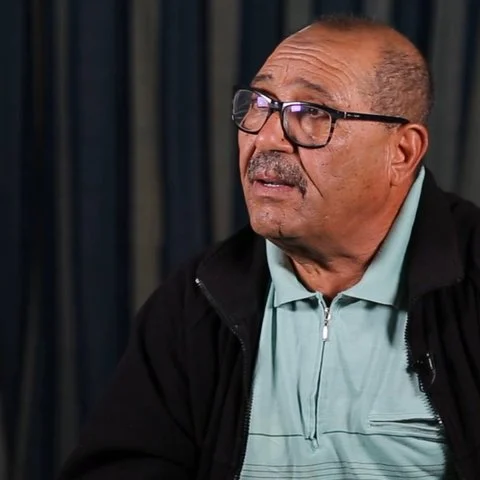
There was a casting in the mining basin, and in Gafsa of course… a marathon job, from morning till evening, that went on for about two months.
Lazhar Missaoui · member of the first group (1972) · in Tunisian Arabic
Even the house we lived in, they started calling it Jha’s house.
Lazhar Missaoui · member of the first group (1972) · in Tunisian Arabic
1972Jha: the first laugh and the first ban
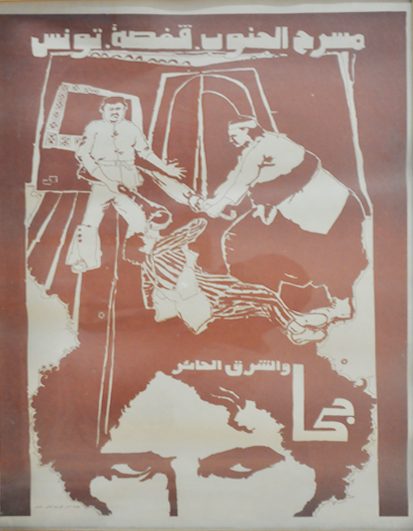
Raja Farhat adapted Jha and the Bewildered East from Arlecchino, Servant of Two Masters by the Italian playwright Goldoni; the music was composed by Hamadi Ben Othman. According to Lazhar Missaoui, Fadhel Jaziri directed it, and the play was built up “scene by scene” during the training.
Fadhel Jaibi describes a way of working that, in those early days, was collective even in the writing:
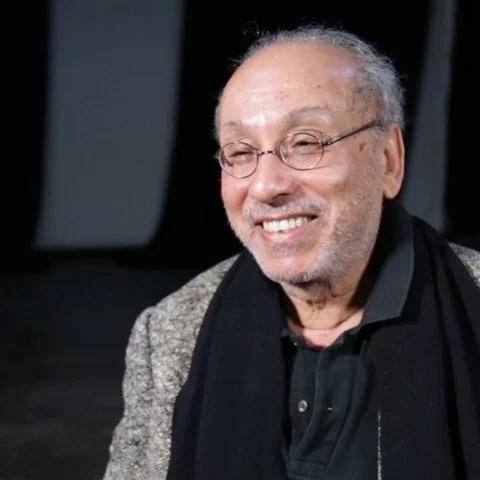
You ask who made Jha? They’ll name you five people… a word from you, an idea from him, a remark, a comment from me.
Fadhel Jaibi · one of the troupe’s founders · in Tunisian Arabic
The play toured the region for two months, then television recorded it at the Municipal Theatre of Tunis, and that is how audiences came to know the troupe. But it was banned when the troupe wanted to stage it in the capital, Jaibi recounts. Accounts differ as to why: according to Farhat, Jaziri mimicked a famous phrase of President Habib Bourguiba on stage; according to Bousma, who had by then left Gafsa, “ill-wishers” read the character of Jha as a figure for the president.
Deprived of performances for months, the troupe found refuge in Le Kef with Moncef Souissi, according to Farhat and Jaibi. The matter then reached Chedli Klibi, a former culture minister who was by then director of the presidential cabinet, through the painter Zoubeir Turki, who, Farhat relates, told him: “How can we crush the hopes of young people who came to serve a region with no culture?” Klibi watched the black-and-white recording, found the security services’ objections “utterly ridiculous”, according to the same account, and ordered television to broadcast the play. Bousma says he too intervened with him. After that, Jaibi says, the play was performed “dozens of times”.
Jaibi sums up the period in a single, rhythmic sentence:
Tunisians loved it, the people of Gafsa loved it, Tunis loved it, and the censors rejected it.
Fadhel Jaibi · one of the troupe’s founders · in Tunisian Arabic
1973–1974On the road, from Carthage to Deir el-Qamar
In 1973 the troupe staged Sirat Mohamed Ali El Hammi (“The Life of Mohamed Ali El Hammi”), a documentary play about the trade unionist Mohamed Ali El Hammi, which Raja Farhat assembled from speeches, workers’ testimonies, writings by Tahar Haddad and press articles, as he had done for Ezzedine Madani’s Ezzanj. Farhat recounts that Chedli Klibi, back at the Ministry of Culture after a government reshuffle, instructed Abderrahmane Ameri, director of the Carthage festival, to fund a new production by the troupe. The choice of subject was not an innocent one, in his view: Bourguiba had glorified El Hammi in his book La Tunisie et la France; the troupe took that text to the ministry’s printing press in the Kasbah, had five hundred copies printed free of charge and handed them out to the audience.
The play was performed at the close of the 10th Carthage International Festival in 1973, as its poster, kept in the troupe archive, attests, and then before President Bourguiba in the small theatre of the Carthage Palace, a hall of around 250 seats according to Farhat, in the presence of Prime Minister Hedi Nouira and members of the government. Farhat himself played El Hammi, and the last word went to Hamadi Ben Othman’s song “Mohamed Ali is dead”. Farhat describes the “icy silence” that followed, then Bourguiba rising to applaud and telling his ministers: “Did you hear the history lesson they gave you?” It is an episode he says he related to Abdelhalim Messaoudi for his book Bourguiba and the Theatre. Lazhar Missaoui adds that Bourguiba also saw El Barni wel Atra and El Jazia El Hilalia at the palace.
That performance came after a difficult spell. According to Farhat, Bousma was succeeded by a “hard-line” governor, party members denounced the troupe, and its budget, voted each year by the governorate council at around 2,000 to 2,500 dinars, was cut off. The actors then lodged at the headquarters of the regional cultural committee “in very miserable conditions”, the director’s salary went on rice and pasta, and Fadhel Jaziri left for Tunis. Ibrahim Zidi, secretary-general of the regional cultural committee, nicknamed “the emperor of culture”, did what he could, according to the same witness. Fadhel Jaibi recalls that Sirat Mohamed Ali El Hammi and El Barni wel Atra were also hit by censorship.
Bousma reports that after the performance the president gave the troupe a personal grant of five thousand dinars. Farhat recounts that the governor handed him this “gift” and that he asked him to hold on to it until another sum could be added, so as to buy a Land Rover: “The Théâtre du Sud is a touring theatre, it goes to every region… and none of us has a driving licence.” The governor made a phone call and had a purchase order drawn up; the vehicle arrived in less than a month. Rachad Manai, who had come from the Puppet Theatre, was the only one with a licence. Farhat adds that students of the “Cultural Action Group” in Paris, Taoufik Jebali among them, collected money and sent it as a gift to the troupe’s members, on top of their salaries.
Then came the news that Farhat describes as a dream: Klibi was sending the troupe to represent Tunisia at the Deir el-Qamar festival in Lebanon. The “lads from Gafsa”, who had never been outside Tunisia, flew on an Italian plane via Rome, stayed for about a month and performed the play twice at this young festival, forty kilometres from Beirut, accompanied by Raouf Basti and Samir Ayadi. Jaibi says the troupe went to Lebanon and Canada with Jha and the Bewildered East “against all odds and all enemies”, while Jalila Baccar places the Lebanon trip “before the war”, in 1973. Jaibi recalls that the censors rejected the troupe even as “the people of Gafsa loved it and Tunis loved it”.
And I remember the joy of our lads in the Gafsa troupe, who had never once been outside Tunisia… You’re going to represent Tunisia at the theatre festival in Deir el-Qamar, in Lebanon. What joy!
Raja Farhat · first director of the troupe (1972–1975) · in Tunisian Arabic
In Deir el-Qamar the troupe met a Canadian delegation that invited it to Quebec; it went there “a year later”, according to Farhat, to represent Tunisia at a French-speaking youth festival bringing together some fifty countries. The first performance after the return was in Redeyef, where the head of the local cultural committee introduced the troupe with the words “You are about to see a play that has come back from Canada”, Farhat recounts. Two members of the troupe stayed behind and never came back. According to Farhat, one of them, skilled with props and sets, married there and later became a union official at Quebec’s Ministry of Culture; the other, an actor, also married there. Moncef Beldi names them: Abdelkader El Kek, then in charge of the troupe’s lighting, a post Beldi took over after him, and “Nili” (name transcribed as pronounced, unconfirmed), and he says they are still in Canada “to this day”.
That September, according to Jalila Baccar, the troupe returned to Gafsa and toured the whole mining basin. It was this tour, she says, that made her choose theatre as a profession, “because theatre as mere spectacle is one thing, and theatre as a tool of communication is another”. Jaibi lists the places: the market, the street, schools, hospitals, barracks, prisons, Metlaoui, Oum El Araies, Mdhilla. According to Missaoui, the troupe set itself a target of at least 150 performances a year, “almost every night in a different place”, and all the plays were performed in secondary schools.
We performed in the market, in the street, in schools, in barracks, in prisons.
Fadhel Jaibi · in Arabic
It was in the Land Rover that the troupe set off for Algeria, on a tour prepared, Farhat recounts, by friends met at the Maghreb theatre festival in Monastir, among them Abdelkader Alloula in Oran and Mustapha Kateb at the Algerian National Theatre. Nineteen people, driver included, took the coast road to Oran; there they performed El Barni wel Atra ten times and were paid in Algerian dinars “with very respectable sums”, which allowed the actors to buy clothes and have their teeth seen to. The troupe then went on to Morocco at the invitation of the director Tayeb Saddiki: it played at the Mohammed V Theatre in Rabat, the municipal theatre in Casablanca, in El Jadida and, “I think”, in Marrakesh, and stayed for two weeks. Farhat regards the trip as “a lofty university lesson in love for the Greater Maghreb”. Baccar confirms the “big” tour of Algeria and Morocco, and Al Bayane of 4 August 1980 states that the troupe had visited Lebanon, Canada, Algeria and Morocco.
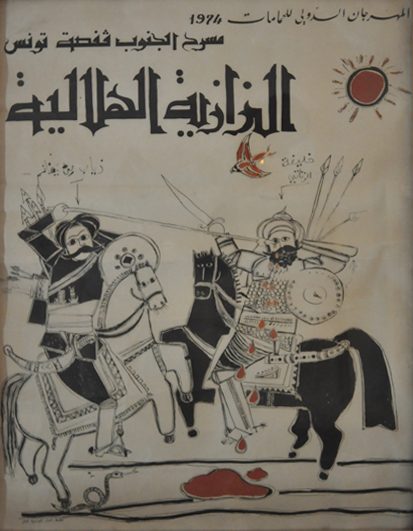
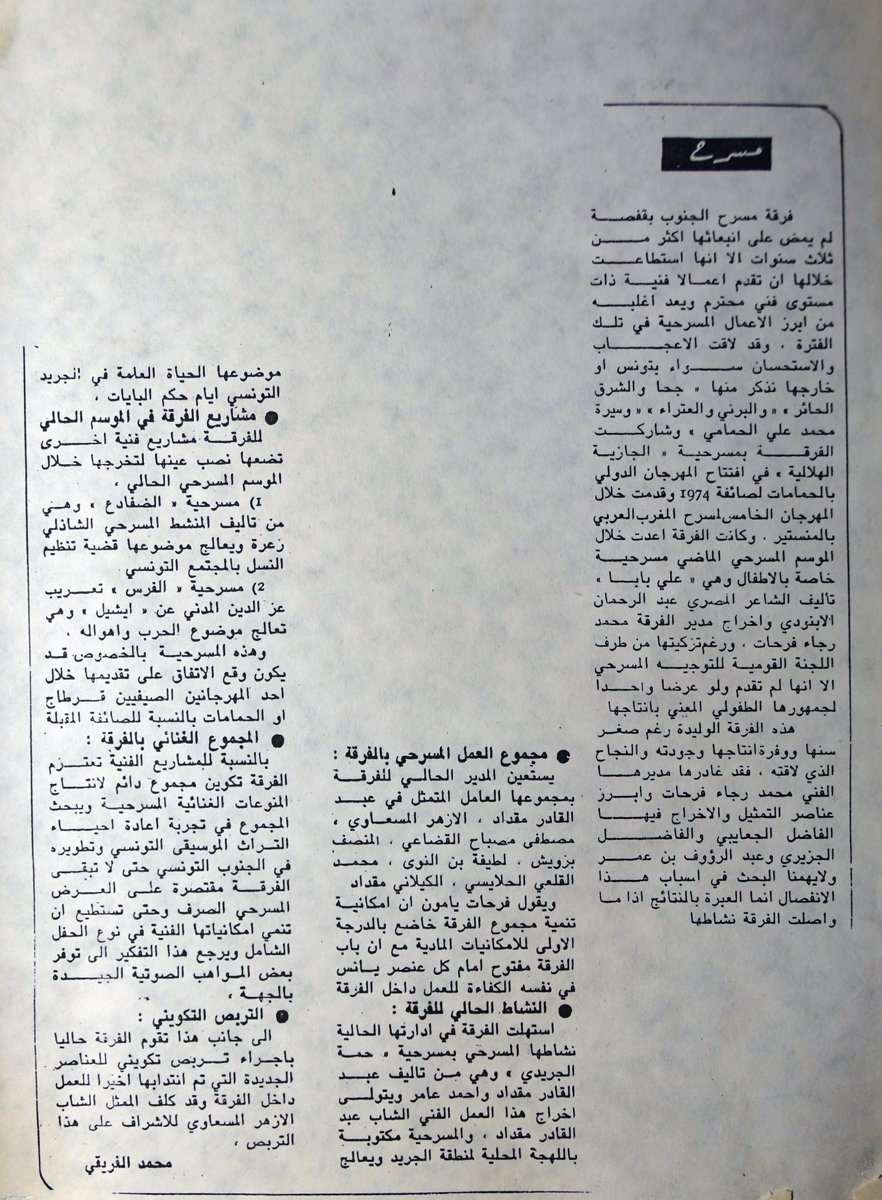
In the summer of 1974 the troupe opened the Hammamet International Festival with El Jazia El Hilalia, which it then presented at the 5th Maghreb Theatre Festival in Monastir, as attested by its poster and by an undated clipping from a “Theatre” column whose newspaper does not appear, dating from around 1975, since it says the troupe “has not been in existence for more than three years”. Baccar explains the choice of subject by the imprint of the Hilalian epic on the region’s tribes, just as Jha had been chosen for the disarray of the Arab world in the 1970s and Mohamed Ali El Hammi for the weight of trade union activity in the region: the troupe, she says, did not work from ready-made texts, “except El Barni wel Atra”. In the same period the troupe prepared a children’s play, Ali Baba, based on a text by the Egyptian poet Abderrahmane El Abnoudi and directed by Farhat; although approved by the National Commission for Theatre Guidance, it was never staged, “not even once”, according to the same clipping, and Latifa Gafsi lists it among the founders’ works.
Jalila Baccar joined the troupe in 1973. A student with experience of school and university theatre, she had seen Jha on television and decided to work “with that particular group”. The invitation reached her while the troupe was rehearsing Sirat Mohamed Ali El Hammi. In her testimony she corrects what is commonly said about her:
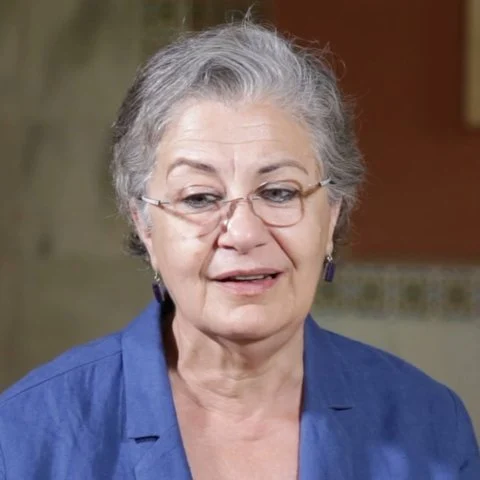
I wasn’t one of the founders… It was in ’73 that I started with them.
Jalila Baccar · actress with the troupe (1973–1975) · in Tunisian Arabic
El Barni wel Atra: the South speaks in its own dialect
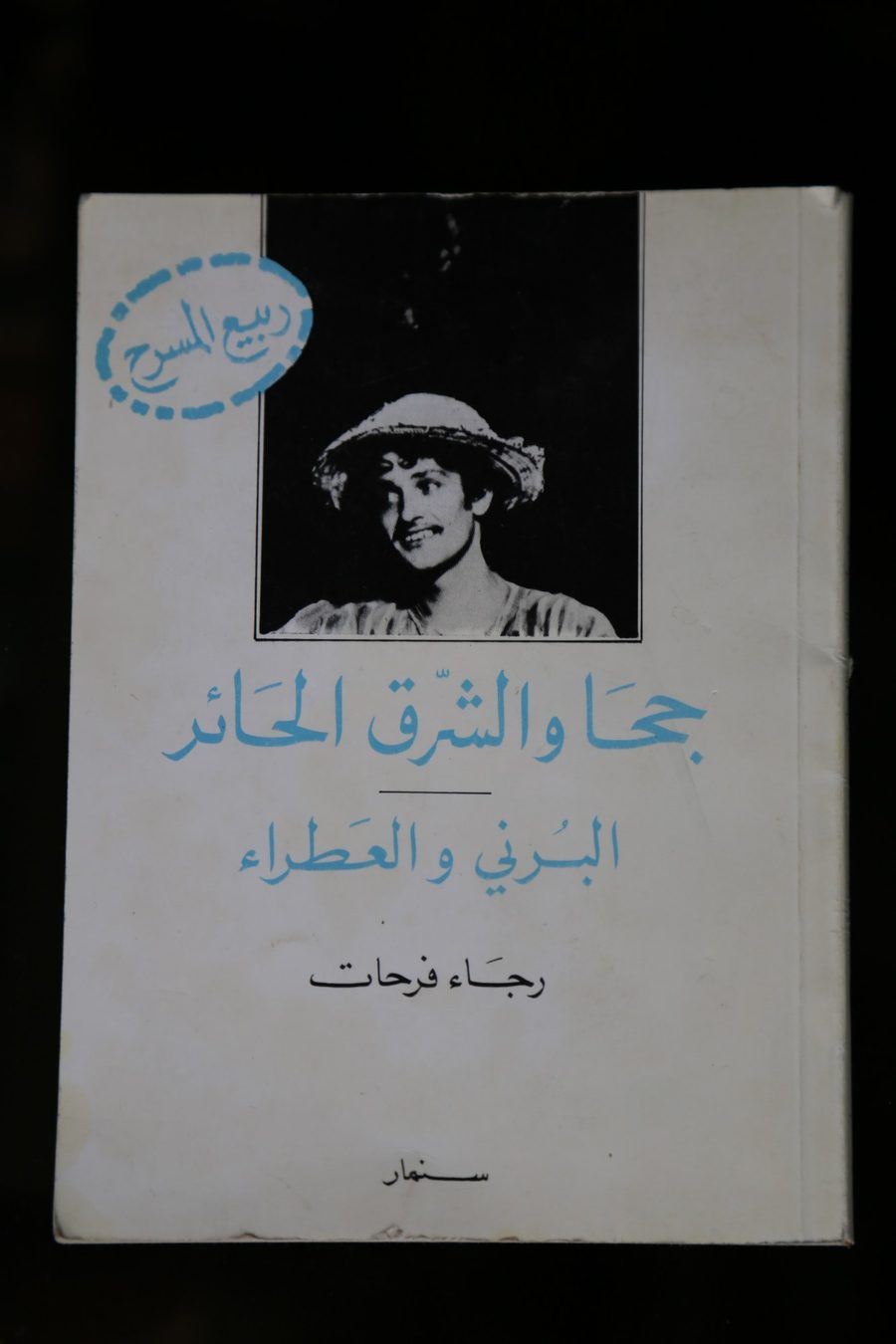
Raja Farhat wrote El Barni wel Atra from an Italian text, and Fadhel Jaibi directed it, say Chokri Smaoui, Latifa Gafsi and Moncef Beldi. Jaibi corrects the idea of a single author: “You ask who made El Barni wel Atra? They’ll name you five people” – in other words, the text was put together collectively, “a word from you, an idea from him, a remark from me”. It was later published together with Jha and the Bewildered East in a book from the Sinmar publishing house. Commonly cited references date the play to 1973; it went on being performed in Tunisia and during the Maghreb tour.
The first troupe had no actresses. Jalila Baccar explains why: it was very hard to find an actress in Gafsa, not for lack of willing candidates – “there were girls, we knew them all, they were mad about theatre” – but because the social milieu forbade it and art was looked down on from a moral standpoint, especially where women artists were concerned. She herself, she says, had difficulties with her family, “and above all with the father”, without meeting an outright refusal. So it was Farhat Yamoun who played El Atra, according to Farhat, Ahmed Amer and Latifa Gafsi, before Baccar took over the role on tour. Abdelkader Mokdad played El Barni, Mustapha Gdhai played El Hdili according to Ahmed Amer, Raouf Ben Amor and Lazhar Missaoui were in the cast according to Mohamed Sassi Gattari, and Moncef Beldi handled the lighting and music.
Beldi sums up the plot: Hmida, the feudal lord, rapes a woman and carries her off to his house by force; against him stands the khammes peasant, the sharecropper paid a fifth of the harvest. For him the play is about the “oppressive force” that exploits “the weak class”, a thread he sees running on to Hamma El Jeridi and Firan Eddamous (“Rats of the Mine Galleries”). Ahmed Amer says Mokdad joined the group as an actor and gave the play “its own character”, just as Raouf Ben Amor gave it “a special flavour”. It stood out, in his view, because it was the most popular work of the period, “and it went round the Tunisian festivals”.
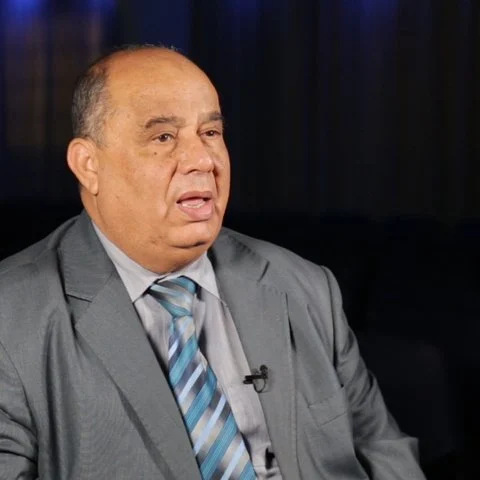
For the first time a character appears in the troupe who speaks in the local dialect… and that’s El Barni.
Ahmed Amer (died 2016) · author of Hamma El Jeridi, Essouk (“The Market”) and Al Jerad (“The Locusts”) · in Tunisian Arabic
For Smaoui, this play was the “pivotal moment” in the troupe’s history, and he attributes the same view to Mokdad: “If you ask him what the real turning point of the Théâtre du Sud was, it’s El Barni wel Atra.” He adds that the works that followed, from Hamma El Jeridi to Firan Eddamous and Ammar Bouzouer, were woven on the pattern of the “popular genre” it embodied. Missaoui, for his part, says Mokdad is an “excellent” actor when he is directed by someone “from outside”, “as happened in El Barni wel Atra”.
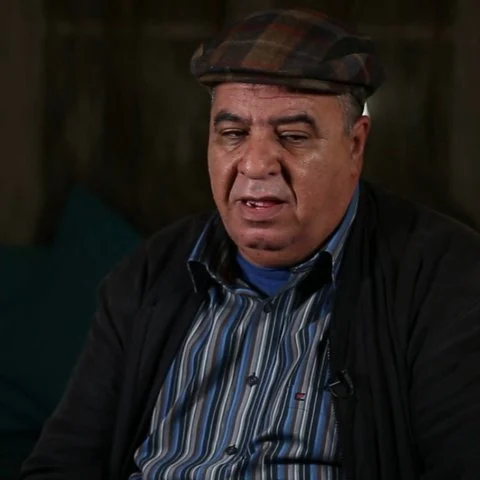
The pivotal moment in the history of the Théâtre du Sud of Gafsa is El Barni wel Atra… which Raja Farhat wrote from an Italian text, and which Fadhel Jaibi directed.
Chokri Smaoui (died 2021) · intellectual and figure of Gafsa’s theatre scene · in Tunisian Arabic
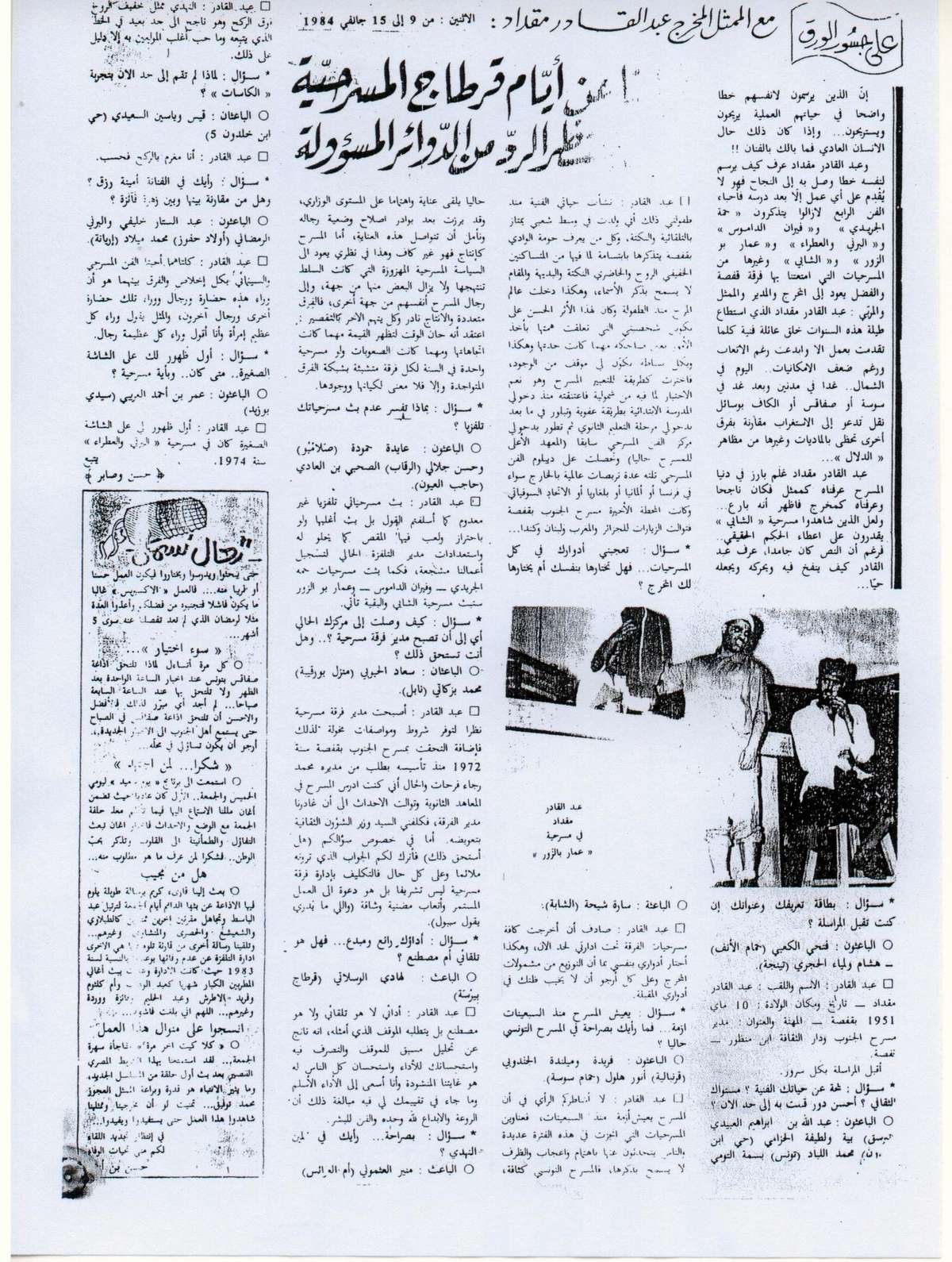
Television recorded the play in 1974; the recording is kept in the troupe archive. Mokdad told Al Bayane, in its issue of 9–15 January 1984: “My first appearance on the small screen was in the play El Barni wel Atra, in 1974.” And when Le Temps of 23 March 1976 reviewed Hamma El Jeridi, it described it as “this satirical comedy in the same vein as ‘El Borni wa el atra’, the troupe’s previous success”. Farhat recounts that the culture minister Mahmoud Messadi attended a performance at the Gafsa youth centre and liked it a great deal, and that it was at that dinner that the minister decided the fate of the founding “nucleus”. Missaoui reports that Bourguiba saw it at the palace. Jaibi adds that it was censored, just as Sirat Mohamed Ali El Hammi had been.
1975Gafsa’s own take over the troupe
According to Raja Farhat, the decision came from Tunis. After the Maghreb tour, “the funding dried up once again”. The new culture minister, Mahmoud Messadi, visited Gafsa, saw El Barni wel Atra at the youth centre, and then, over dinner with the governor, said something to the effect that one does not give alms while one’s own house stands empty. In his view the capital had been empty since the death of Aly Ben Ayed. He therefore asked that the troupe’s “theatre teachers” – Jaibi, Jaziri, Rachad Manai and Mohamed Driss, together with Taoufik Jebali – come back to revive the “Centre d’art théâtral” (today’s Institut supérieur d’art dramatique), and he offered Farhat the directorship of the Ibn Rachiq cultural centre and the Yahia gallery. “We did as we were told,” says Farhat, who moved to Ibn Rachiq in October 1975 and was then, at 27, put in charge of the Carthage International Festival. Raouf Basti was appointed head of the theatre directorate, with the task of establishing the regional troupes.
So in 1975 the founding “core” left for the capital. Jaibi, Jaziri, Ben Amor, Driss and Jalila Baccar, with others, set up the Nouveau Théâtre company in Tunis, one of the landmark ventures of modern Tunisian theatre; among its productions, according to Farhat, was El Ors (“The Wedding”), with Driss and Baccar in the leading roles. Baccar says the collective way of working she learnt in Gafsa is the very same one she practised at the Nouveau Théâtre and later with “Familia”. The core of that venture, in other words, took shape in Gafsa. La Presse, in a clipping whose date is not visible, wrote of “Le temps des… migrations” (“The time of… migrations”) towards the capital; Jaibi summed it up in a line: “Some of us stayed, some of us left.”
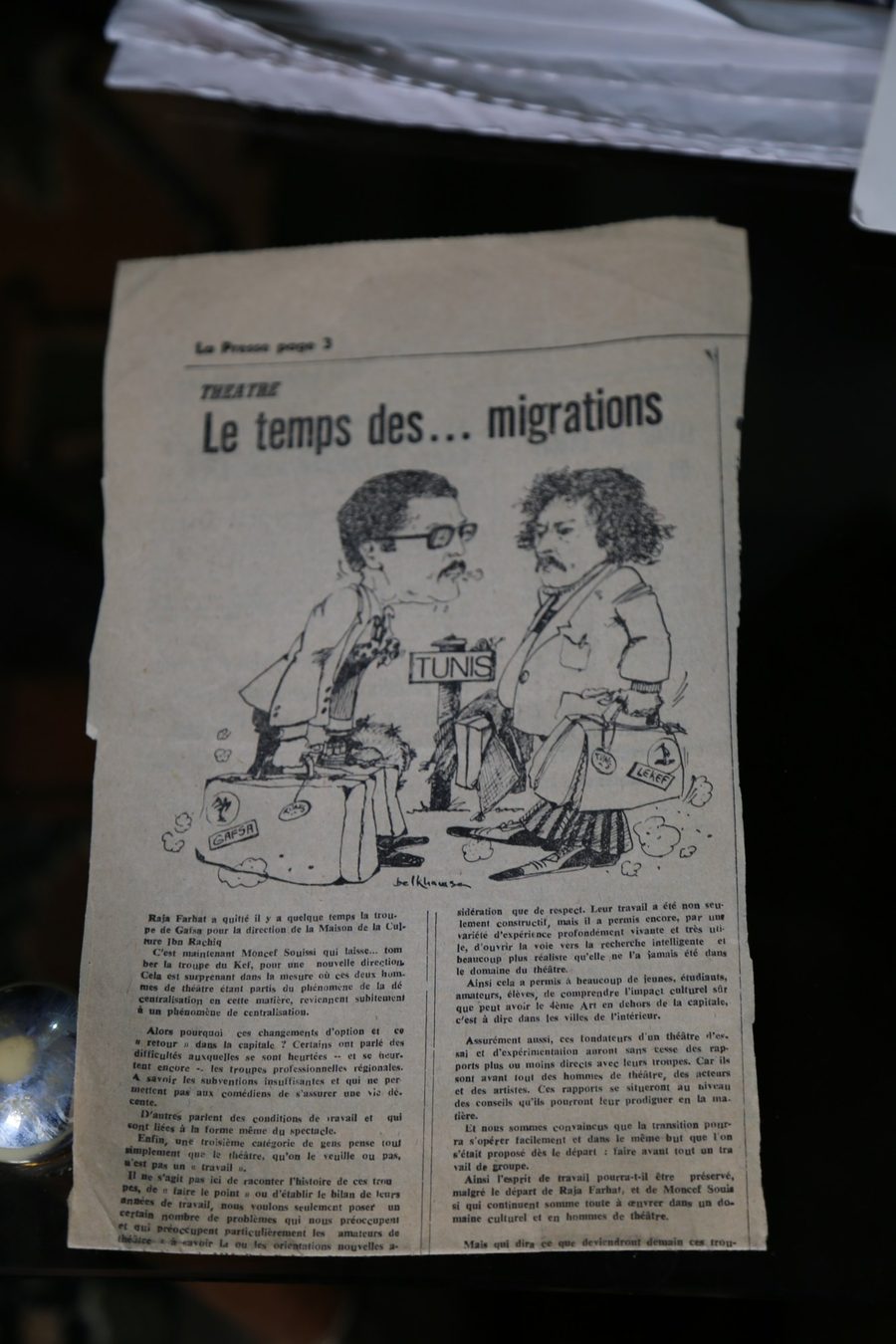
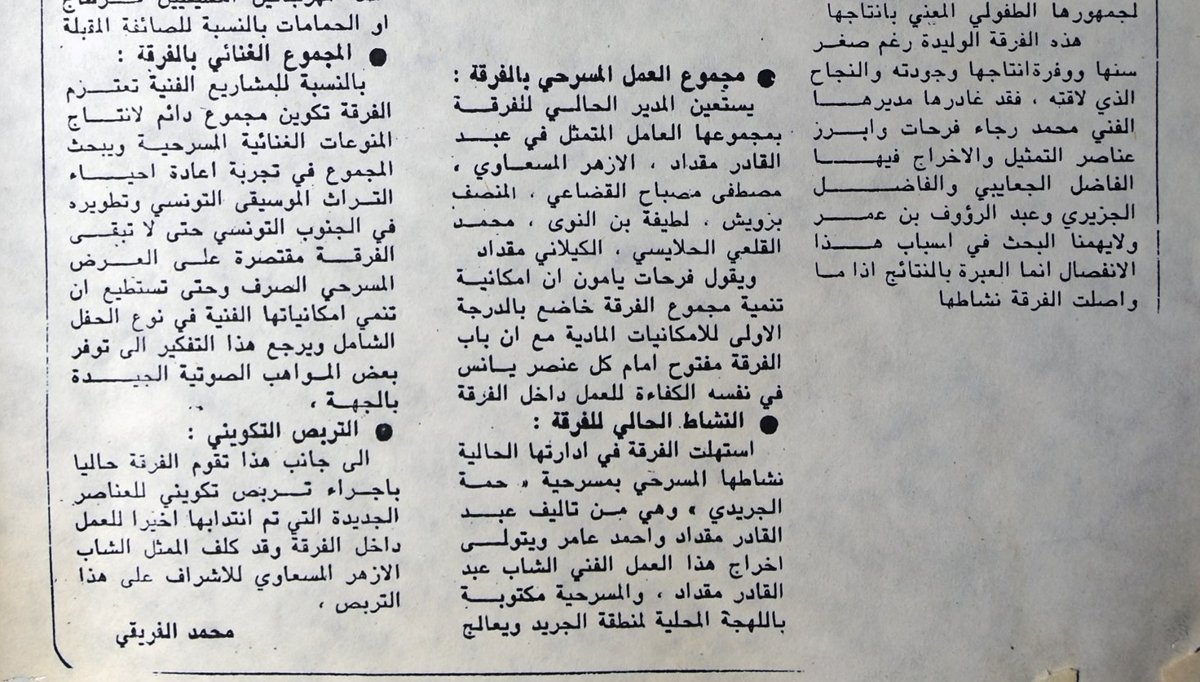
In Gafsa, Abdelkader Mokdad, Lazhar Missaoui, Farhat Yamoun “and a group” stayed on, as Missaoui lists them; he describes the period as a “void”. The same undated clipping (c. 1975) quotes the troupe’s management, through Farhat Yamoun, as saying that any chance of enlarging the company “depends first and foremost on material resources”. Yamoun, originally from Djerba according to Smaoui and Gattari, had run the troupe on an interim basis for “two or three months”, according to Smaoui, “until the troupe was rebuilt with people from the region”, according to Latifa Gafsi. Mokdad then became the troupe’s director. He told the story himself to Al Bayane (9–15 January 1984): he had joined the troupe in 1972 “at the request of its director Mohamed Raja Farhat” while teaching drama in secondary schools, and after the director left, “the Minister of Cultural Affairs asked me to replace him”. Farhat says he was the one who put Mokdad forward: “The most outstanding person we had in Gafsa was Abdelkader Mokdad.” Moncef Beldi says the decision was taken at regional level, in September 1975, with the backing of Ibrahim Zidi, one of the troupe’s supporters in the region.
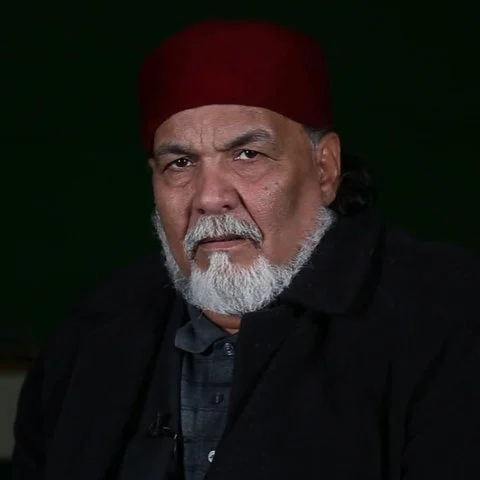
The management had to go to someone from the region, so that this troupe would last and carry on. September ’75.
Moncef Beldi · actor with the troupe until 1986 · in Tunisian Arabic
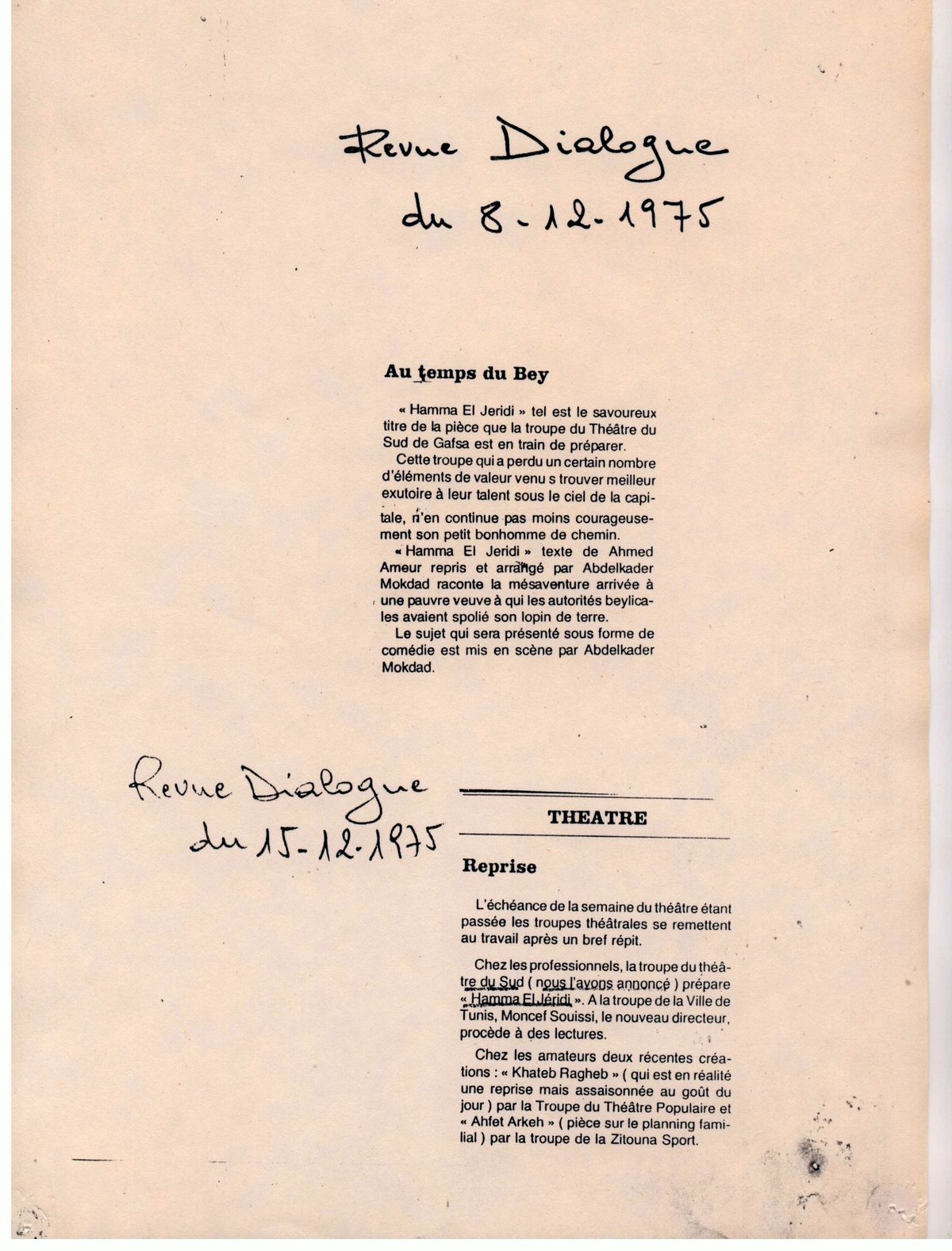
When exactly the handover took place remains unsettled: September 1975 according to Beldi; “director of the troupe since last January” in an interview published by Echaab on 9 April 1976; “eleven years under my direction” in a reply by Mokdad in Assabah on 23 March 1985. Ahmed Amer believes the first generation left the troupe “on a sound footing”, and adds: “The first founding is the real founding… If that founding hadn’t happened, there would have been no Théâtre du Sud troupe.” The magazine Dialogue, for its part, wrote on 8 December 1975 that the troupe, which “has lost a number of valuable members who have gone to find a better outlet for their talent under the skies of the capital, is nonetheless bravely carrying on its modest way”.
Recruitment was opened to young people from the region through a public call, at “the end of 1974” according to Mohamed Sassi Gattari. The selection panel, Latifa Gafsi recalls, was made up of Farhat Yamoun, Mustapha Gdhai, who had stayed on from the old troupe, and Lazhar Missaoui. Candidates sat a written test and then each performed “a scene of their own”. Gattari explains what the panel was looking for: theatrical imagination, talent and the kind of “magnetism” that holds an audience, a sound body and a bearing that suggested “an actor in the making”. Out of “a large group”, four were accepted: Latifa Gafsi, Mohamed Sassi Gattari, Sassi Askri and Larbi Bakkari. Those selected then went through a training course run by Missaoui, “a son of the troupe” in Gattari’s words, on “what theatre is and the schools of theatre”, according to Latifa; the same clipping (c. 1975) mentions “a training course for the new members, supervised by the young actor Lazhar Missaoui”.
Latifa Gafsi describes how she came to the audition. She was a secondary-school pupil; the town had spent a month preparing celebrations for President Bourguiba’s birthday, and a classmate had persuaded her that there was paid work sewing costumes, worth sixty dinars. She went along “without thinking”, and Farhat Yamoun told her it was in fact recruitment for the Théâtre du Sud troupe, asking her to consult her family and prepare “a sketch or a monologue”. Her family – her father and her paternal aunt – did not stand in her way, she says. Ahmed Amer gives a similar account: she had come to the troupe to sew for the celebrations, Yamoun asked her whether she could act, and Amer pays tribute to “her steadfastness and her courage”.
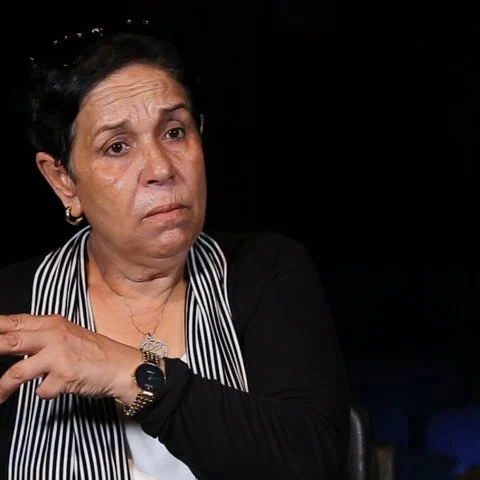
I was 16 and 6 months, exactly… I was scared stiff, every bit of me.
Latifa Gafsi · the first actress from Gafsa on the troupe’s stage · in Tunisian Arabic
Her contract, she says, was for twenty dinars a month and five hundred millimes per performance; she still keeps the first application she wrote and the first reply she received. Beldi recalls that the fee per performance was two dinars five hundred in later years. Latifa describes the winter tours under what was called the culture ministry’s “national programme”: ten days away from Gafsa, in the cold and the snow, sometimes sleeping on cardboard, performing in the yard of a two-classroom village school, in an olive-oil press or in a market. Beldi confirms the principle: “I go to the audience, the audience doesn’t come to me” – performances on the bare ground, on sacks of wheat, in restaurants. The bonus at the end of a tour was a hundred dinars, “like a billion”, says Latifa.
The contract I signed was 20 dinars a month and 500 a show… But we were madly in love with it.
Latifa Gafsi · in Tunisian Arabic
She paid a price for being a pioneer in a conservative town: stones were thrown at her and she was abused in the street on her way home from rehearsals, which ended late at night. She recounts how an elderly relative in the large family house called the police one night because her colleagues always walked her to the door; Mokdad, Beldi and others went in to explain that they “had been working”, and the station chief, who knew every one of them by name, stepped in. Then people’s attitude changed once they had seen her on television. Her aim, she says, became to plant in the minds of Gafsa’s men and women the idea that “acting and art are a noble thing”, and later fathers would bring their daughters to her to work with her at the Centre.
They’d throw stones at me… When Hamma El Jeridi was shown on TV, everyone came and asked me to forgive them.
Latifa Gafsi · in Tunisian Arabic
1976Hamma El Jeridi: the script once called El Boustane
The original title of Ahmed Amer’s script was El Boustane (“The Orchard”). He wrote it at 21 and, as he tells it, gave it to Raja Farhat in 1974; then, protesting at the delay in staging it, he and Farhat became embroiled in “press battles”, which Farhat brought to a close with an article in a French-language newspaper – one we have not found in the troupe archive – in which he wrote: “See you at the play Hamma El Jeridi.” The title, Amer says, was therefore Farhat’s choice. Farhat, for his part, explains his reservations by “the fear of regionalism”: he knew the people of the Jerid, his own schoolteachers came from there, and he did not want the Jerid to become “a joke”. According to Lazhar Missaoui, the idea was Farhat’s, and a plan for the two of them, Farhat and Amer, to write it together never came off. The script then became Hamma El Jeridi after being co-written with Mokdad. Five testimonies agree on the first title, El Boustane; the joint authorship is borne out by the poster, which is undated and reads “written by Abdelkader Mokdad and Ahmed Amer”.
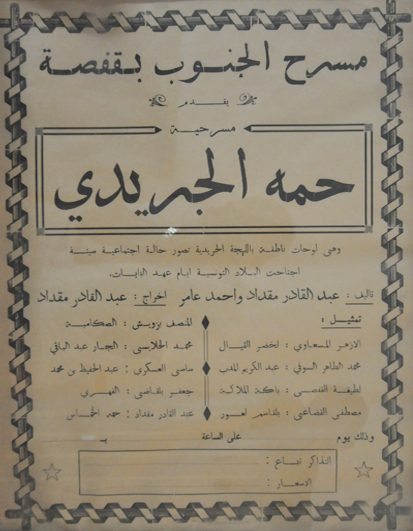
Amer recalls that Mokdad came to see him in 1975 with Farhat Yamoun, after taking over the troupe, and said: “You’ve got the script, I want to work on it.” Mokdad wanted “to open the troupe up to its surroundings” with a play in the Jerid dialect that dealt with old issues with “echoes in everyday life”. So Mokdad came to Tunis and the two worked on the script, because in Amer’s view the writer provides “the first dough” and the director has to work it. Latifa Gafsi says they wrote and refreshed their ideas in Nefta. Mohamed Sassi Gattari describes the El Boustane script as “a few pages… the kernel of a script”, rewritten on stage as “stage writing”; most of the additions that gave the play its shape, he says, came from Missaoui, with further contributions from Mokdad, Latifa, Mohamed Tahar Soufi and Moncef Beldi. Amer testifies that Missaoui “had a hand in everything, big and small”. Dialogue wrote on 8 December 1975 that the troupe was preparing Hamma El Jeridi, a script by Ahmed Amer “reworked and arranged” by Mokdad, who was also directing it.
The play is set in the oases of the Jerid, in the dialect of the people who live there. Amer says the dialect was “the element of difference” he was looking for, because nobody had written in Jeridi before him except the novelist Bechir Khraief, and because it has “its own music, its own rhythms and things left unsaid”. So the actors went to Nefta and Tozeur to learn it on the ground: Missaoui recalls travelling to the Jerid with Mokdad, staying in a hotel and meeting people who helped them get the language right, because a Jeridi word “if you deliver it wrong, it doesn’t carry the meaning”.
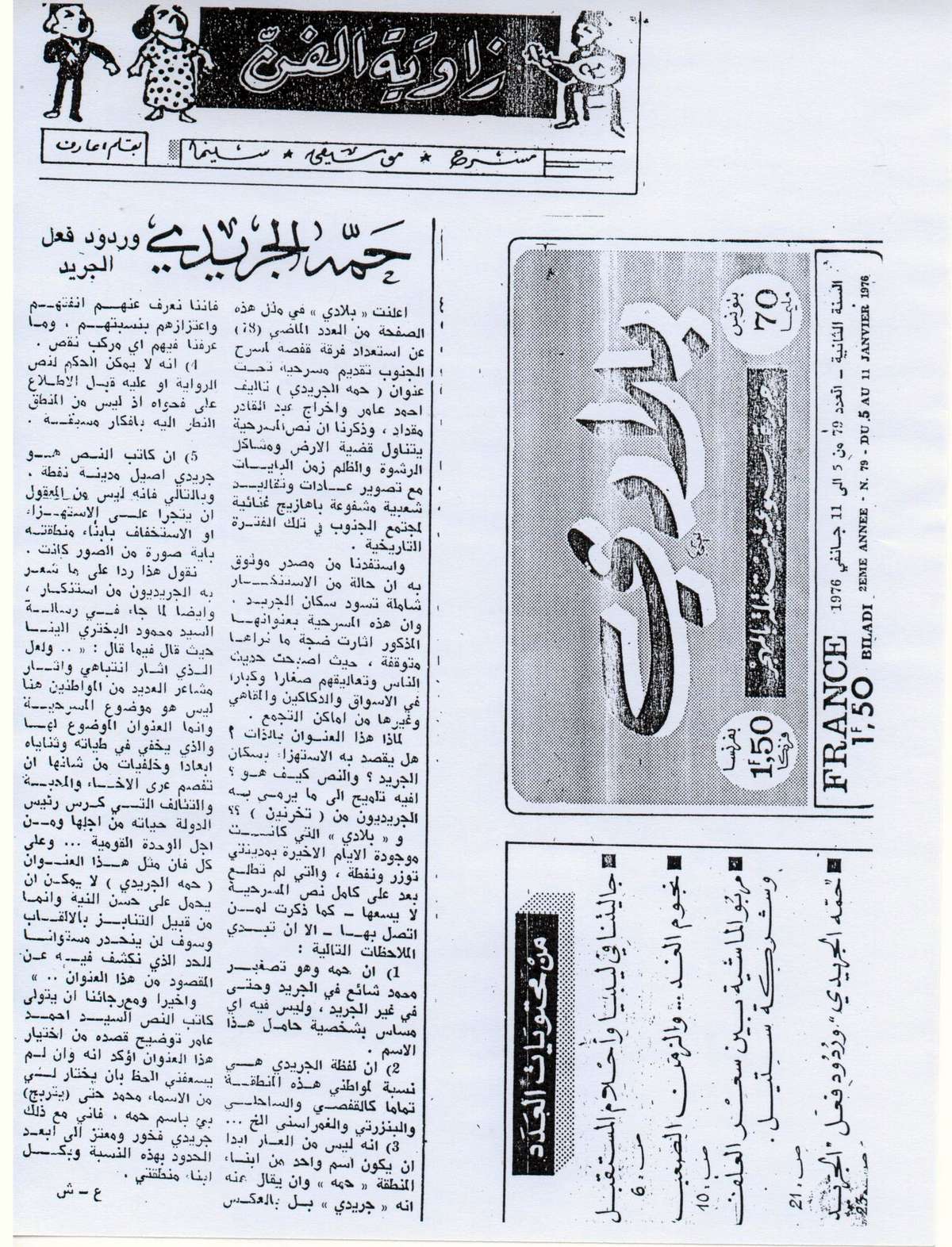
Even before the first night, the title itself caused a stir. Biladi, in its issue 79 (5 to 11 January 1976), published a letter from a reader in the Jerid arguing that the title Hamma El Jeridi “cannot be taken in good faith but rather as a form of name-calling”, and reporting that the matter was being discussed in the markets and cafés of Tozeur and Nefta. The columnist replied that the author of the script was “a Jeridi born and bred, from the town of Nefta” and could hardly be expected to mock his own people, and that “Hamma” is a diminutive of Mohamed.
We went and spent a whole day at the date harvest… and I learnt how the women wrap themselves in their veils.
Latifa Gafsi · played “Baka” in Hamma El Jeridi · in Tunisian Arabic
Latifa recounts that the troupe’s premises, above the cultural committee, were cramped, so permission was obtained to rehearse in a wedding hall near the railway station; the work, combining training and the script, lasted about six months, with rehearsals running until three or four in the morning. When it turned out that nobody in the troupe could handle the Jeridi pronunciation for one of the roles, Mokdad went to Mohamed Tahar Soufi, a veteran actor from the old En-Nejma Ettamthiliya, and won him over. Soufi confirms this in his interview with Al I’lane (issue 204, c. 1982): “I was taken up with my job until 1975, when Abdelkader Mokdad… pressed me to come back. So I came back.” Latifa says she was afraid to speak among “giants” – Mokdad, Missaoui, Beldi and Mustapha Gdhai – and that after each performance she would ask Soufi why the audience had applauded a particular line, because the criticism was “veiled”, slipped in between the lines.
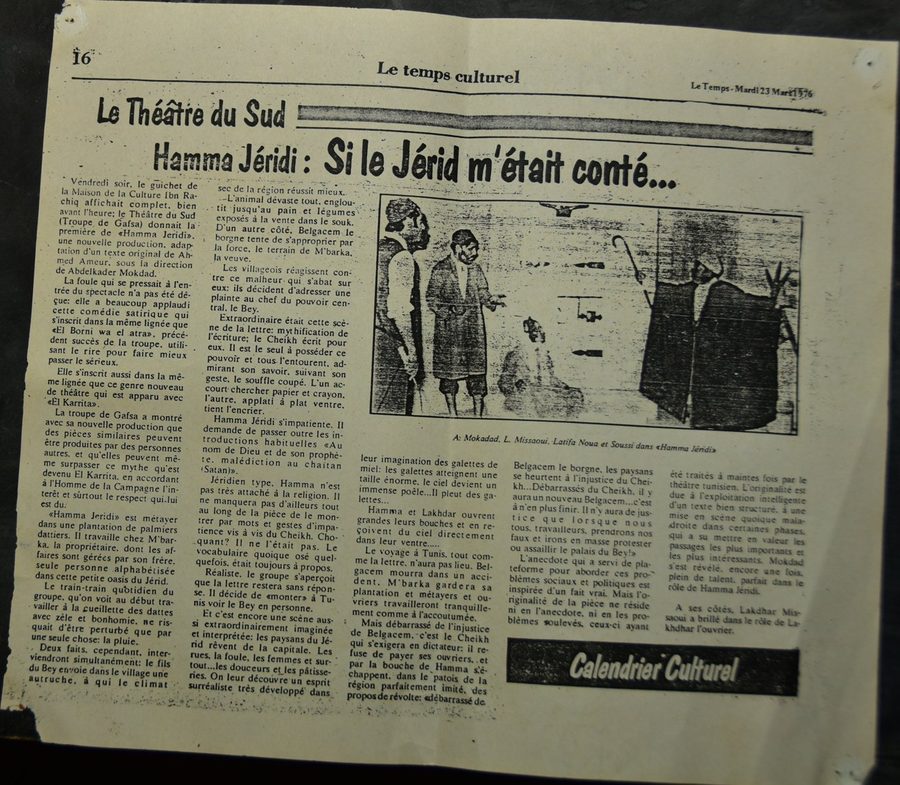
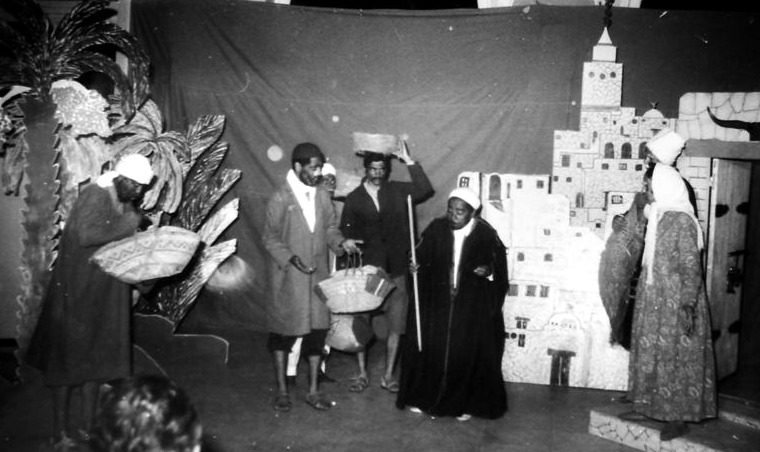
Mokdad played Hamma the khammes (sharecropper) and Missaoui played Lakhdar El Gayyal, as Le Temps reported on 23 March 1976; Latifa played “Baka”, short for Mbarka, the widow robbed of her orchard; Soufi played her brother Abdelkrim El Moueddeb; and Gattari the labourer Abdelbaki Ben Abdelhafidh, a character who, he says, “for all the humiliation and degradation he lives with, was funny and endearing”. Assabah published on 16 March 1976 the cast list, written by Mohamed Ammar Chaabnia: Lazhar Missaoui, Abdelkader Mokdad, Mustapha Gdhai, Latifa Belnaoui (that is, Latifa Gafsi), Mohamed Tahar Soufi, Mohamed Hlaissi, Moncef Bezouich, Sassi Askri and Jaafar Belgadhi, and described the play as “a realist comedy with a Tunisian character”. As for the story, as the newspapers summarised it (Assabah, Echaab, Le Temps), it concerns Belgacem the One-Eyed, a Jeridi back from Algeria and close to the cadi, who tries to seize the widow’s land; an ostrich that the Bey’s son sends to the Jerid, where it destroys the crops; a letter to the Bey; and events dating back to the protectorate. Le Temps wrote that it was inspired “by a true event” and quoted a line from it: “There will be no justice until all of us workers take up our scythes and go together to protest at, or storm, the Bey’s palace!”
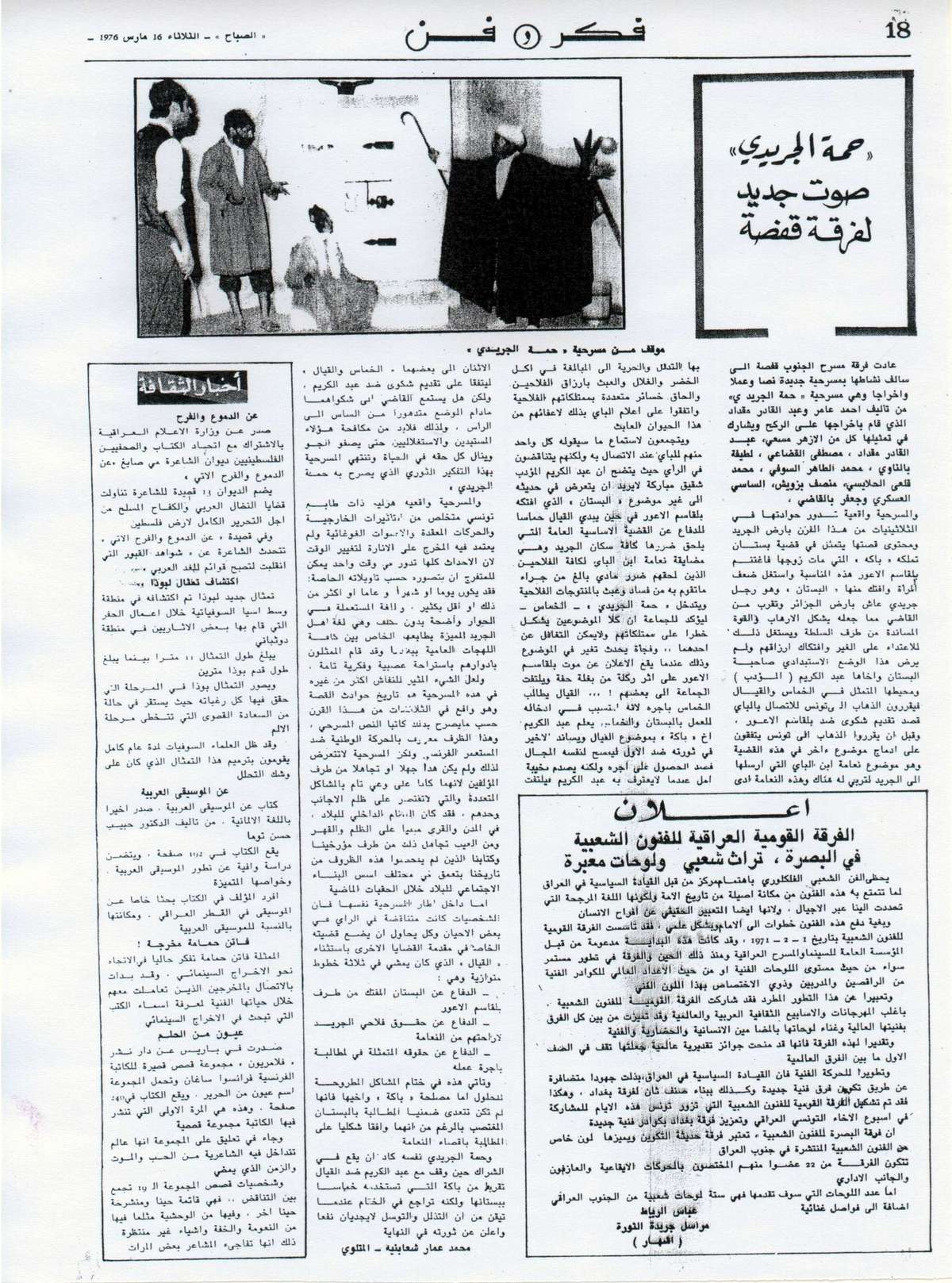
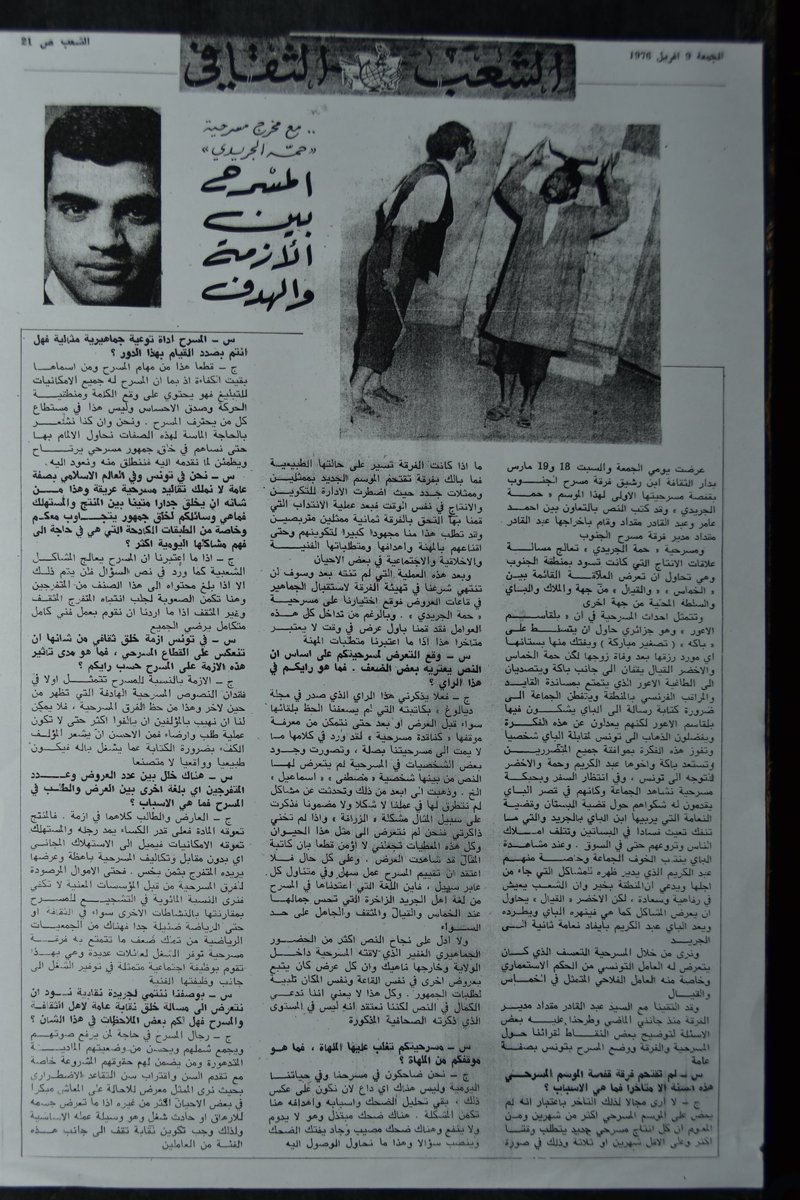
The play was performed at the Ibn Rachiq cultural centre in Tunis on 18 and 19 March 1976, according to Echaab (9 April 1976). Le Temps wrote on 23 March that “on Friday evening, the box office of the Ibn Rachiq cultural centre was showing ‘full’ well before curtain-up”, that Mokdad had been “perfect in the role of Hamma Jéridi” and that Missaoui “shone in the role of Lakhdhar”; the paper placed the work in the line of El Barni wel Atra and of the new theatre that had emerged with El Karrita. The date is settled by the dated clippings, contrary to the year 1974 repeated by some references circulating online. The author was not in the auditorium for the first night.
I didn’t go to the first night because I was scared… When I heard the hall erupt with applause, I came running in.
Ahmed Amer · in Tunisian Arabic
Missaoui, Latifa Gafsi, Moncef Beldi and Gattari all recount that the theatre guidance committee initially refused to grant the play its permit. Missaoui says the committee saw “insinuations” in it; Latifa recalls the committee coming to the wedding hall and saying “no” after six months of work, “as if we hadn’t been doing anything”. Gattari explains how the system worked: there was a regional committee and a national committee, and the national one would not consider a work the regional one had not approved. The play was then shown to President Bourguiba during a visit to the region, and he cleared it. According to Gattari, the play was on the programme of the presidential visit, and the governor “took the responsibility on himself” and put it on even though the committee insisted it had not approved it; he was “afraid of how the president would react”, but the opposite happened: Bourguiba laughed and applauded. Missaoui recalls that Bourguiba, known for his views on the beys, “had a ball”, and Latifa that Missaoui improvised a line in front of him after asking Mokdad “Shall I say it or not?” and being told “Say it”. Gattari says Mokdad in turn added a line at the end that “covered over everything that had been said”. After that, says Gattari, “the permit came from Bourguiba himself”.
The witnesses disagree on where that performance took place. Missaoui, Latifa, Beldi, Gattari and Smaoui say it was the governorate hall in Gafsa – “a small room with chairs, a meeting room”, in Latifa’s words – during a visit in which Bourguiba spent a few days in Gafsa before going on to Nefta. Ahmed Amer, who presented his account as “the first time I’m going to tell it”, says Bourguiba was convalescing for the winter at a hotel in Nefta; he asked about theatre activity in the region, was told there was a troupe in Gafsa, said “Bring it to me so I can see it”, and the troupe “went to him”. We found no document in the troupe archive or its press clippings that dates the episode. Amer says it is the only play for which “Bourguiba took responsibility”, and that he gave no written permit but simply said “Go on, put on your play.”
He liked it enormously… And he said: this play is to be performed throughout the territory of the Republic. So Hamma El Jeridi has a presidential permit.
Ahmed Amer · in Tunisian Arabic
Latifa recounts that the first performances after that were in a big tent at the fair held in the Ech-Chabab neighbourhood: six shows back to back in a single day, because the audience kept pouring in. Beldi mentions three shows back to back in one day at the Ibn Rachiq cultural centre, at 3 p.m., 6 p.m. and 9 p.m., and two consecutive shows in Nefta. Ahmed Amer says the troupe sometimes had to put on “a five o’clock show and a nine o’clock show, like the cinema”, and puts the number of performances at 781, while Gattari speaks of more than 500 and says he cannot think of “a single spot in Tunisia where a show can be put on and it wasn’t put on there”. These are witnesses’ figures that no document confirms; indeed Al Bayane wrote on 4 August 1980 that the troupe had given “the equivalent of 120 performances” up to that point. Latifa remembers a show in a vegetable market in a village with no theatre – “they’d never heard of it, for the record, never heard of it” – yet people jostled to see the actors.
Mokdad told Echaab on 9 April 1976: “We are people who laugh, in our theatre and in our daily lives”; the language of the Jerid, he said, is one “whose beauty you feel in the khammes, the gayyal, the educated and the ignorant alike”, and the best proof of the script’s success was “the huge turnout of audiences both within the governorate and beyond”. In the same interview he announced that the management had recruited “eight trainee actors”, and responded to a critique published in Dialogue that has not been preserved in the troupe archive. After the play, Missaoui left the troupe and returned to the Gafsa Phosphate Company (CPG), going on to run the Mines Festival for four or five editions; Chaabnia regards his departure as a loss, since he was a “pillar” who added to both script and stage, while Gattari calls him “the backbone” of Hamma El Jeridi.
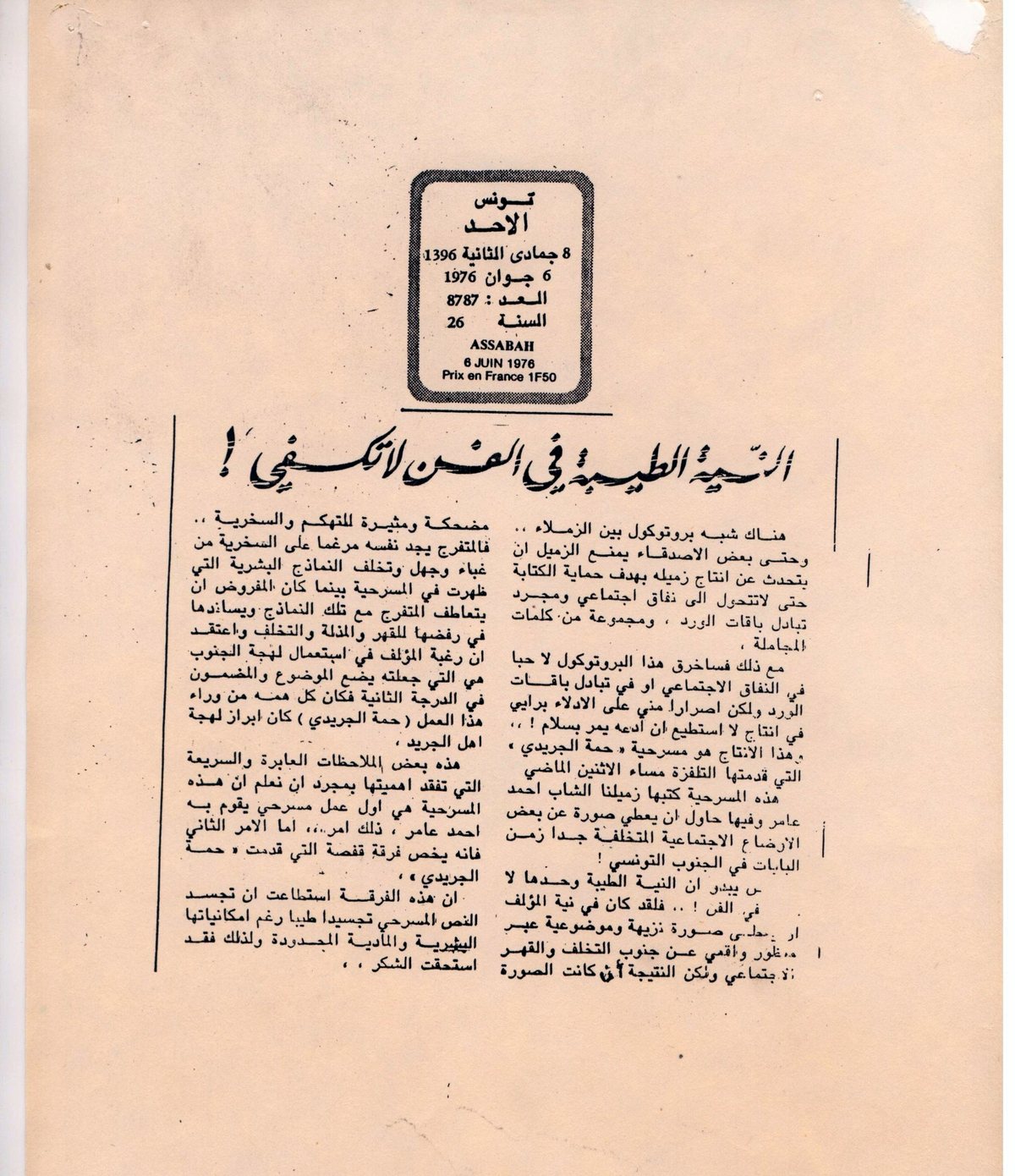
Television broadcast the play “on the Monday evening” before 6 June 1976, that is, around 31 May. Assabah wrote on that date, under the headline “Good intentions are not enough in art!”, that the troupe “managed to bring the script to life well despite its limited human and material resources, and therefore deserves thanks”, but criticised it for pushing the subject into second place by foregrounding the Jerid dialect, and for making the characters objects of ridicule rather than sympathy; it noted that this was the first play by Ahmed Amer, “our young colleague”. Television showed it again on Monday 11 May 1981 at 8.35 p.m., as announced by Al Amal in its issue of 10 May 1981, on the eve of the centenary of the establishment of the protectorate. Mokdad confirmed to Al Bayane (9–15 January 1984) that Hamma El Jeridi had been broadcast on television, as had Firan Eddamous (“Rats of the Mine Galleries”) and Ammar Bouzouer.
November 1976Firan Eddamous: the mine on stage
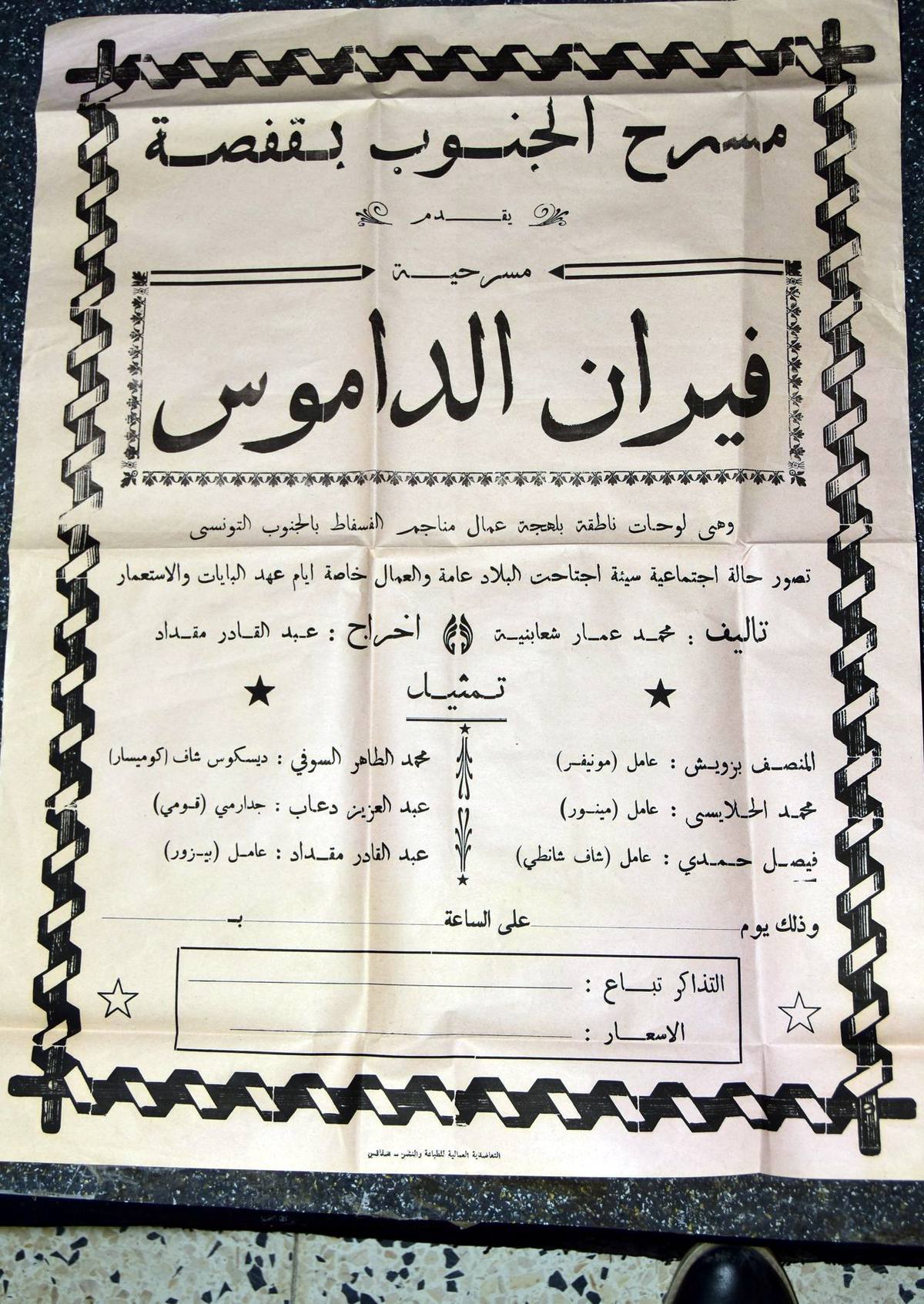
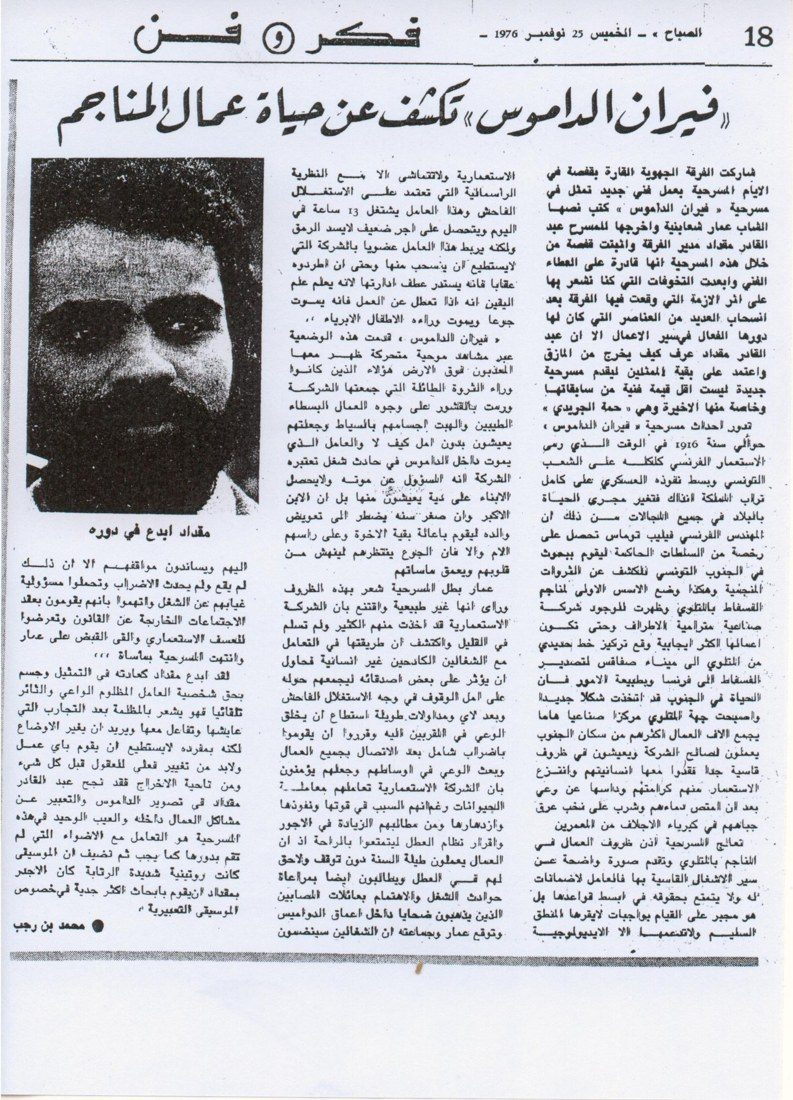
In November 1976 the troupe staged Firan Eddamous (“Rats of the Mine Galleries”) by the poet Mohamed Ammar Chaabnia. A native of Metlaoui, where he was born on 28 July 1950, he was the son of a miner who worked for 33 years at the Gafsa Phosphate Company (CPG) “and was promoted only once in his life”. The play is set in the phosphate mines in 1916 and has five characters: the French official Discos and four workers, Ammar, El Hadef, Slimane and Ettoumi. Chaabnia describes Ammar as the most revolutionary of them, El Hadef as “half-revolutionary”, Ettoumi as a man who “doesn’t care about anything”, while Slimane, the eldest, tries to reconcile them. Its undated poster presents it as “tableaux spoken in the dialect of the phosphate miners of southern Tunisia”.
Chaabnia had known Mokdad since his appointment to the Metlaoui house of culture in 1974, when Mokdad came with Ahmed Amer to borrow equipment for Hamma El Jeridi. He recalls that an article he wrote in Assabah in 1975 about the “mines festival”, which we could not find in the troupe archive, led to the organisation of a festival of the mines. The paper then asked him for an introductory piece on the history of the mines. Searching the company’s archives, he found in the file for 1916 the reports of a head of department named Discos, who ended every report on an accident involving a Tunisian or North African worker by declaring him “at fault”, whereas he described an injured European worker as a “victim” and attached the doctor’s report to his own. In the 1917 file he discovered that Discos had been promoted to engineer. He says he wrote the play, his first work for the theatre, in roughly fifteen or sixteen days, then showed it to Mokdad, who found in it room to add something of his own. In Echaab Ethaqafi on 12 November 1976, Mohamed Laich Gouti wrote that the play surveys “the wretched conditions of workers under colonial rule, and precisely in 1916”, when the working day lasted twelve hours; Assabah (25 November 1976) gave thirteen hours a day.
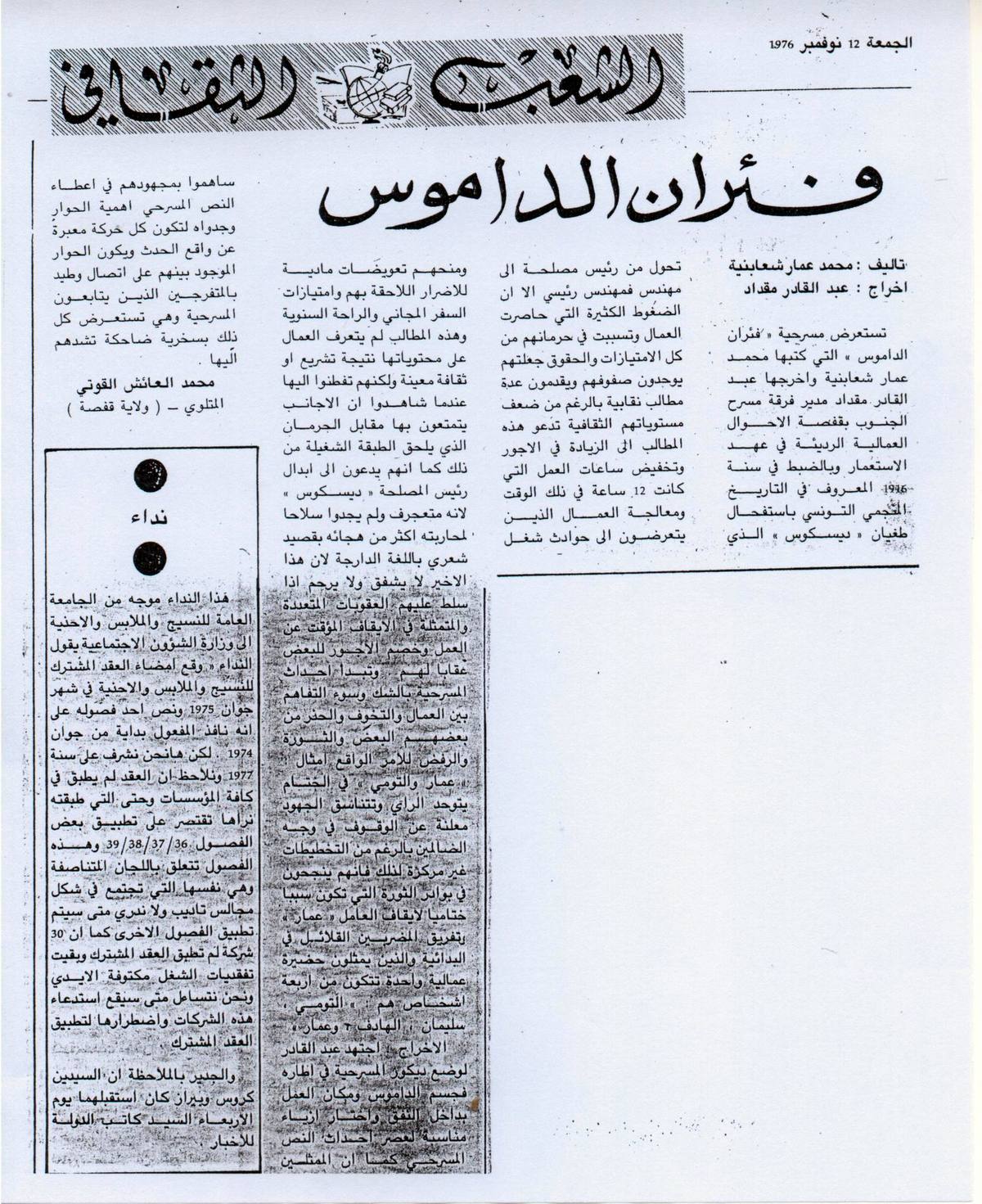
Chaabnia wrote the dialogue in the miners’ speech as he had heard it from his father, “who swore by the haram”, and loaded it with what he knew would “stir people’s feelings”. At the end the workers agree to stand up to the company and to Discos; but they are few, they lack experience, and one of them informs on the others. Arrested while still planning, they are led off to prison singing: “O my country, O phosphate mine, we want warm bread, clothes and shoes.” Assabah, in the same article, describes the hero, Ammar, calling the workers out on strike; the play ends with his arrest. Some objected to the word “rats” in the title, seeing it as mockery of the workers. His answer:
I wasn’t mocking anyone. I’m the rat… I’m like the rat down in the galleries.
Mohamed Ammar Chaabnia (1950–2023) · author of Firan Eddamous · in Arabic
Chaabnia explains the image: the miner “dies unknown”, like a rat; a stone falls on him and nobody hears a thing about it. He had already used it in a poem before the play. In the evenings he attended rehearsals in Gafsa, after the meetings of house-of-culture directors with Ibrahim Zidi at the regional cultural committee, until Mokdad offered him a bed and dinner. He recalls that he was sometimes annoyed by the additions of Mokdad, Moncef Beldi and others, only to be delighted with them later, and that he would leap onto the stage to redo a tableau or a gesture, which was then adopted, because “the best thing in theatre is rehearsal”. His only regret was that he wrote it for five men and found no part in it for a woman. At the end of the first performance at the Théâtre municipal de Tunis, during the theatre days of November 1976, Chaabnia recalls, the audience of intellectuals, trade unionists, workers and students from the mining basin stood up and sang the closing song with the actors.
When that verse was sung at the Théâtre municipal… everyone in the theatre stood up and sang along.
Mohamed Ammar Chaabnia · in Arabic
The undated poster gives the cast: Moncef Bezouich, Mohamed Hlaissi and Fayçal Hamdi as workers, Mohamed Tahar Soufi as Discos, “the boss”, Abdelaziz Daab as a gendarme and Abdelkader Mokdad as a worker. Mohamed Sassi Gattari, however, says the five characters were played by Mokdad, Soufi, himself as El Hadef, Moncef Beldi, and Fayçal Hamdi as Slimane, which suggests the casting changed from one season to the next. Beldi sees in the play another face of exploitation: the coloniser, “harsh towards the mining community”, takes the phosphate, “the gold of the earth”, from the hands of the worker who digs it out. Gattari reveals a small trick in the set:
What we’re talking about, mind you, is seventy-six, not 1916.
Mohamed Sassi Gattari · member of the troupe since 1974–1975 · in Tunisian Arabic
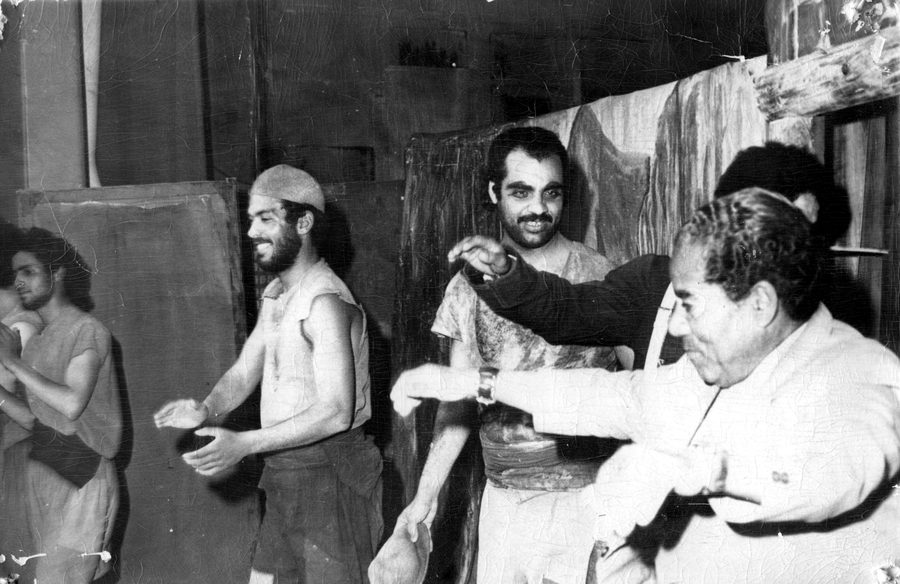
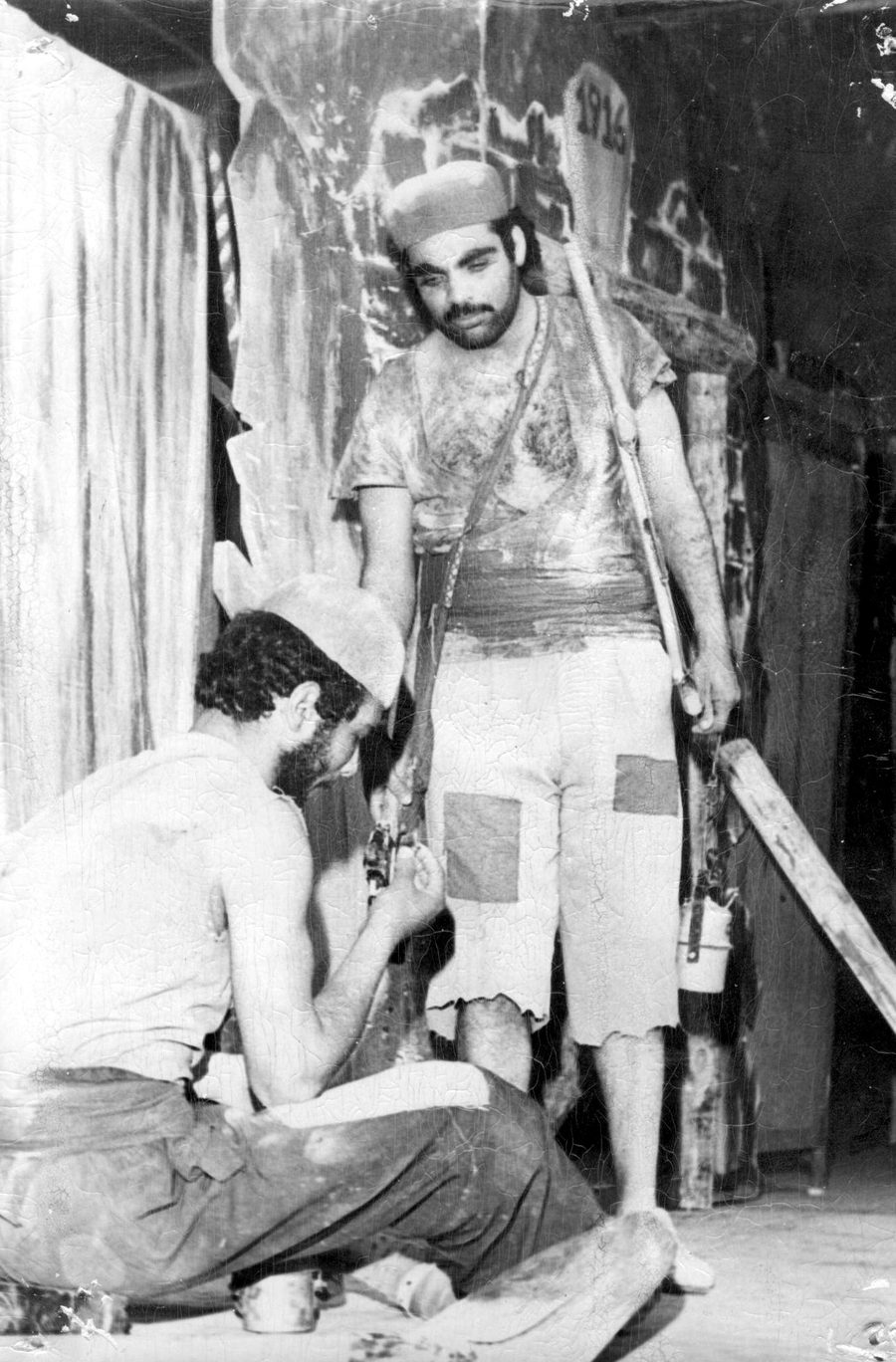
The figure “1916” written over the entrance to the gallery in the set, Gattari explains, was drawn so that the seven could be read as a one and the one as a seven, hinting to the audience that the subject was 1976. The play was first performed in Gafsa in the restaurant of the Hotel Jughurta, because the only cinema, a recent building, was unsuited to theatre, according to the magazine Dialogue (no. 123, 10 January 1977), which noted the paradox: a regional troupe unable to perform in the district of Gafsa. Television broadcast it on Monday 3 January 1977, according to the same magazine. Chaabnia says it was performed 122 times between November 1976 and July 1977 – “122 performances in the space of 8 months isn’t easy” – and that another 17 were still scheduled, a witness’s figure that no document confirms. He links its end to the fact that “some people saw it as inciting the workers”, in the climate leading up to the events of 26 January 1978 (the crushed general strike of “Black Thursday”), and cites an exchange in which a worker asks: “Hey, Ammar, the phosphate that comes out of the gallery, where does it go?” The reply: “Into the trains to Sfax, whoosh, whoosh, into the ships, whoosh, whoosh.” Moncef Beldi, for his part, believes it “foretold” the events of 1978. According to Chaabnia, it was shown on television only once; he has called for it to be brought back out of the archives, because “today’s generations don’t know this play”.
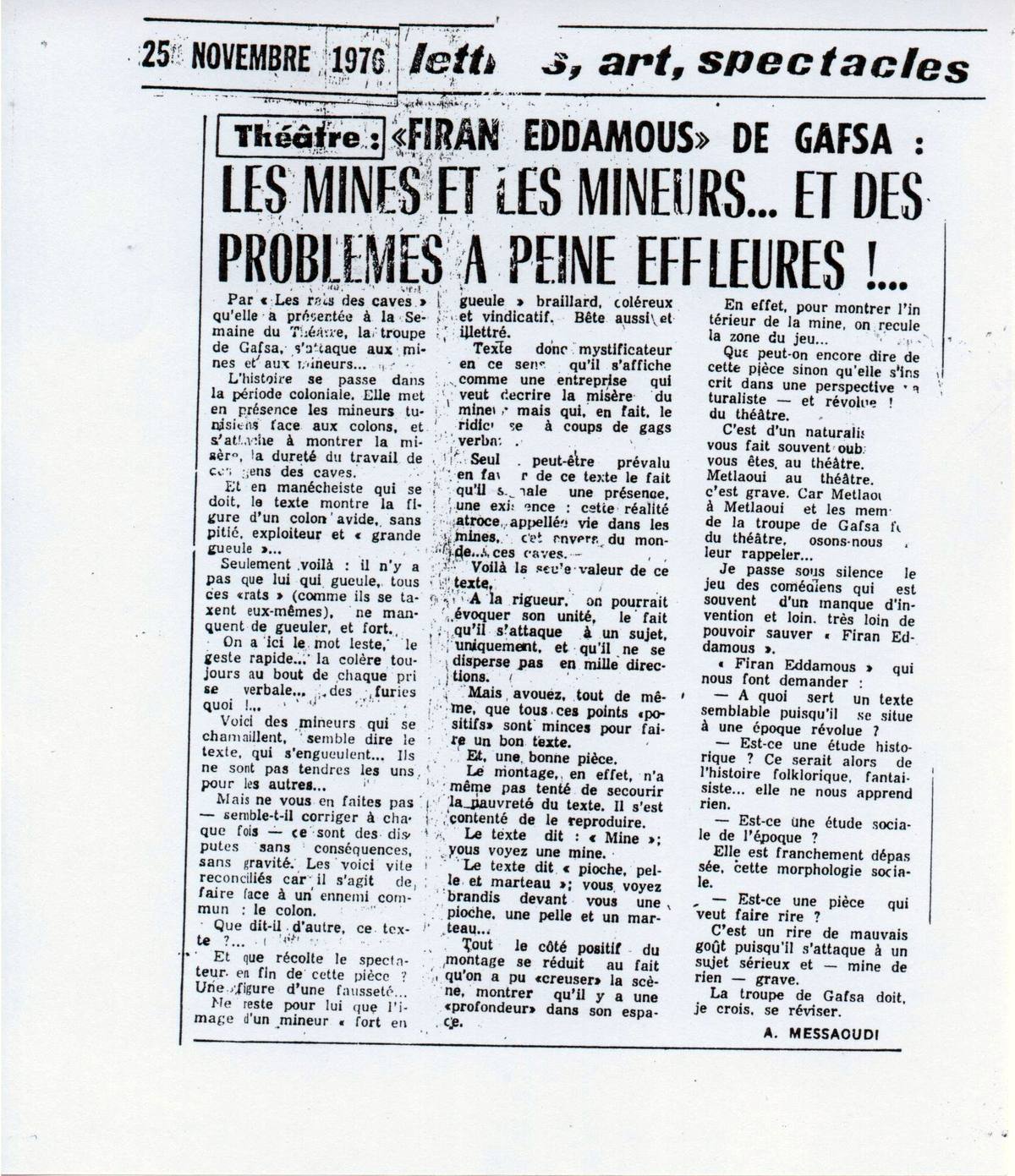
The press reaction was mixed. Before the premiere, Biladi, in its issue of 8–14 November 1976, corrected an earlier report and credited the text to Chaabnia rather than Ahmed Amer. In Assabah on 25 November 1976, under the headline “Firan Eddamous reveals the life of the miners”, Mohamed Ben Rejeb wrote that Gafsa “has proved it is capable of artistic creation and dispelled the fears we had”, and that Mokdad “excelled in his acting as usual and truly embodied the oppressed worker, aware and spontaneously rebellious”; he did, however, fault the production’s lighting and its “routine, extremely monotonous” music. The same day, in a French-language paper whose name does not appear on the clipping, the critic A. Messaoudi wrote: “The Gafsa troupe must, I believe, take a hard look at itself.” He added that “the staging, indeed, did not even try to rescue the poverty of the text”, and that the acting, “far, very far from being able to save ‘Firan Eddamous’”, did not redeem the play. On 21 December 1976, La Gazette du Sud published an interview with Mokdad, conducted in Kerkennah, about “his new play”; only its headline survives in the archive. Lazhar Missaoui, who had by then left the troupe, says he was not satisfied with it, while Chokri Smaoui believes it expressed the suffering of the worker who goes down into the gallery “not knowing whether he will come out alive”.
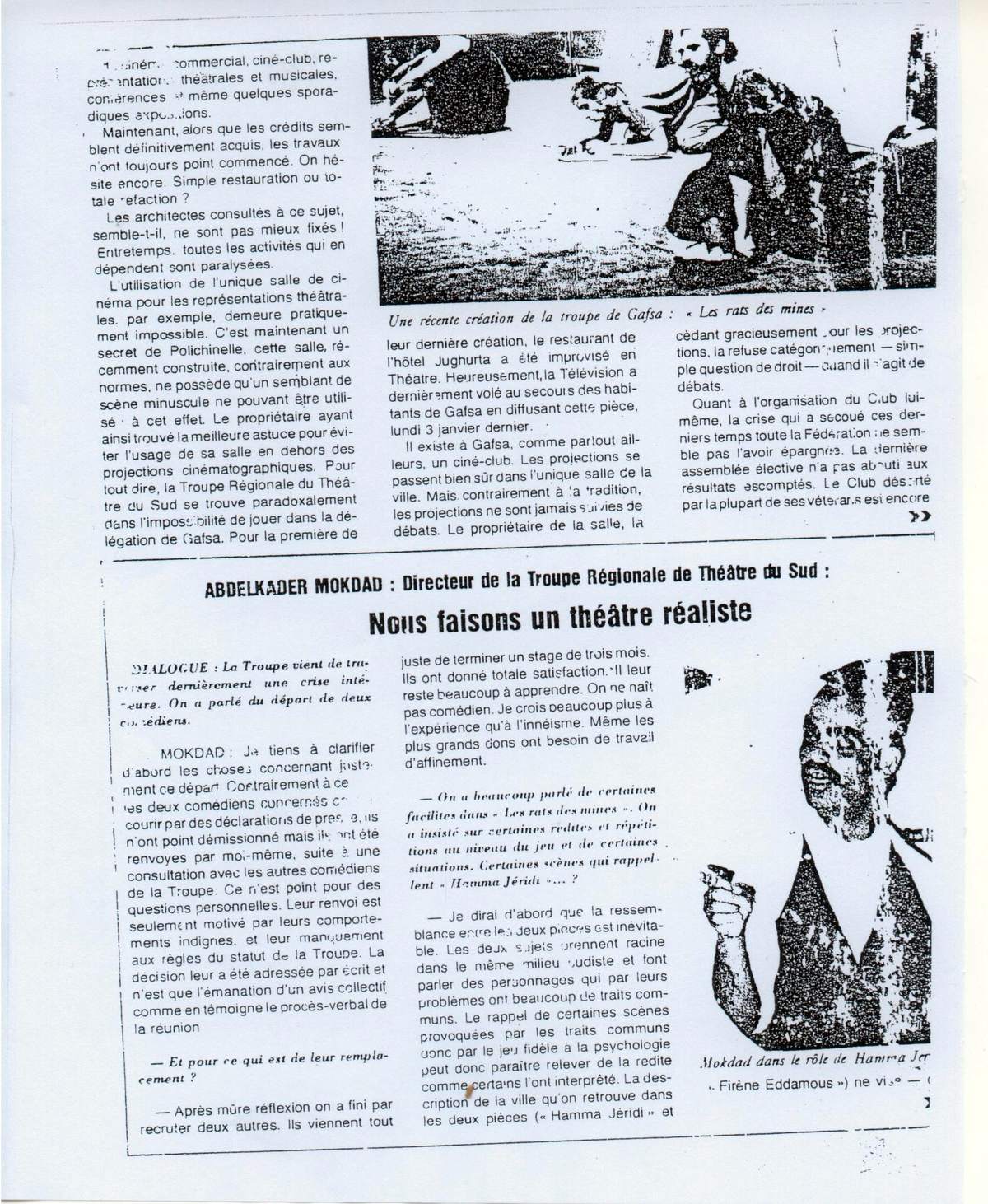
The troupe was emerging from an internal crisis. Assabah (25 November 1976) wrote that the work came after “the crisis the troupe fell into following the withdrawal of many of its members”, and that Mokdad had relied “on the remaining actors”. Mokdad himself told the magazine Dialogue on 10 January 1977 that two actors had not resigned but had been dismissed by a collective decision recorded in the minutes of a meeting, and replaced by two trainees after three months of training. In the same interview, to those who had noted a resemblance between Firan Eddamous and Hamma El Jeridi, he replied that the resemblance was “inevitable”, since both works came from the same southern milieu, and he summed up his approach: “We make realist theatre… Actors are not born. I believe far more in experience than in innate talent.”
The troupe and the authorities: one thread across twenty years
One episode recurs throughout this story in different guises: a work banned or halted, which then returns. Jha in 1972, after the television recording; Hamma El Jeridi in 1976, before the guidance committee; then El Arich in 1986, in Monastir. Fadhel Jaibi sums up the whole trajectory in one sentence: “The people of Gafsa loved it, Tunis loved it, and the censors rejected it.” He adds that censorship was not only central: there was also “violent regional censorship”, from the governor after Tahar Bousma left, from the district delegate, the secretary-general, the coordination committee and the cultural delegate, and sometimes “censorship by the citizen” in a conservative town.
Mohamed Sassi Gattari explains how the approval system worked as he knew it in the 1970s: a regional committee and a national committee, “and the national committee only comes to see the work once it has got approval from the regional committee”. Ahmed Amer distinguishes between the theatre guidance committee, whose “role is to guide, not to censor”, the decision to grant approval, which “rests with the minister of culture”, and the political decision, which goes through neither. Lazhar Missaoui recalls the climate of those years: “If anyone so much as hinted at a word or anything, the next day it got interpreted and all hell broke loose”; but with the backing of Governor Bousma, “there was always a rescue”.
Gattari alone mentions Eddounia Hkayet (“Life Is Made of Stories”), a play about the fighters who “gave their blood and their lives” in the mountains, only for “the state built on their sacrifices to disown them”. It was rehearsed for about six months, he says, with Mohamed Tahar Soufi, Latifa Gafsi, Fayçal Hamdi, Abdelkader Mokdad and himself as the fighter, and was performed only before the regional committee, which rejected it “with a stroke of the pen” around 1977: it never reached the national committee and was never staged, not even once. Gattari says he still knows his part by heart today.
In 1978, after the events of 26 January, the troupe staged Saheb El Kalam by the journalist Hassen Hamada, its first work in standard Arabic. Chokri Smaoui links it directly to those events:
The play ‘Saheb El Kalam’, the one from ’78… it raised the problems Tunisia went through in the events of January ’78. And the censors were against that.
Chokri Smaoui (died 2021) · intellectual and theatre activist from Gafsa · in Tunisian Arabic
Gattari describes its subject: a disorder that “creeps into the system of government, as the common people see it”, and back-room talk that “reaches the seat of power”; “the Supreme Saheb” (Moncef Beldi) and “the Valiant Saheb” (Gattari) then argue over how to hold back “the unruly groups”, while Mokdad played the chief of the hashish smokers, Soufi the philosopher Saheb and Mohamed Malek the Saheb of the army. The production involved “more than 22 people”, including acrobats who walked on their hands, according to Gattari, who dates it to 1979, whereas Hammadi Ammar places it in 1977 or 1978 and Smaoui in 1978. Hammadi Ammar says it was the only text the troupe took almost in its entirety, “eighty or ninety per cent”, while Ahmed Amer believes it “didn’t go down all that well, because people were used to Mokdad in the other style” – what Smaoui calls a “departure” from the popular genre.
Later on, the censors no longer waited for the performance. Latifa Gafsi recalls that agents of the interior ministry attended the troupe’s shows in particular “and took notes”, and that “the unease brought a warning from afar”: not a ban on the play, but a signal in advance. Hammadi Ammar says the pressure “went through the director, and from one to the next it took hold”, and Moncef Beldi sums up what he went through in a single phrase: restrictions, then plays banned, then “salaries frozen”, then “close surveillance of the actors”. Latifa Gafsi adds that Ammar Bouzouer, which had been broadcast on television, was later pulled from the schedule on the orders of its director-general, and that it returned under Ben Ali with shots cut, an account she repeated in a press interview in 2017 and for which we found no supporting document.
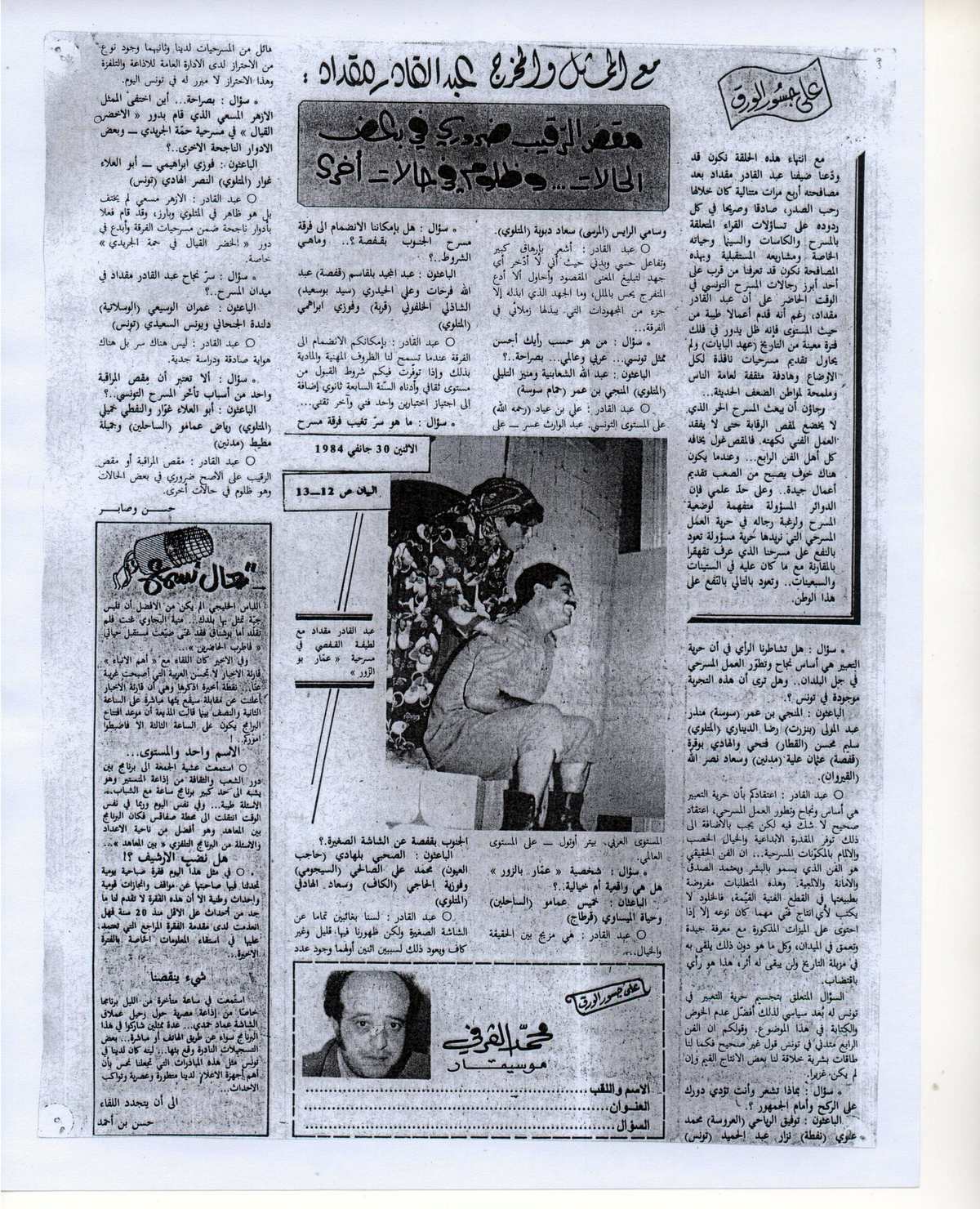
Mokdad, for his part, summed up his position in one sentence to Al Bayane on 30 January 1984: “The scissors of censorship, or more precisely the censor’s scissors, are necessary in some cases and unjust in others.” In the same interview he put the troupe’s scarce appearances on screen down to “a kind of reticence at the directorate-general of radio and television, a reticence that has no justification in today’s Tunisia”. After 7 November 1987, the date Zine El Abidine Ben Ali came to power, he told the same paper on 11 July 1988 that under “the previous era” El Arich was wrapped in symbolism “to avoid censorship in the absence of freedom of expression”, whereas now “the play has become a slice of life that we perform without fear of the weight of words”.
1978–1985Ammar Bouzouer and the years of the audience
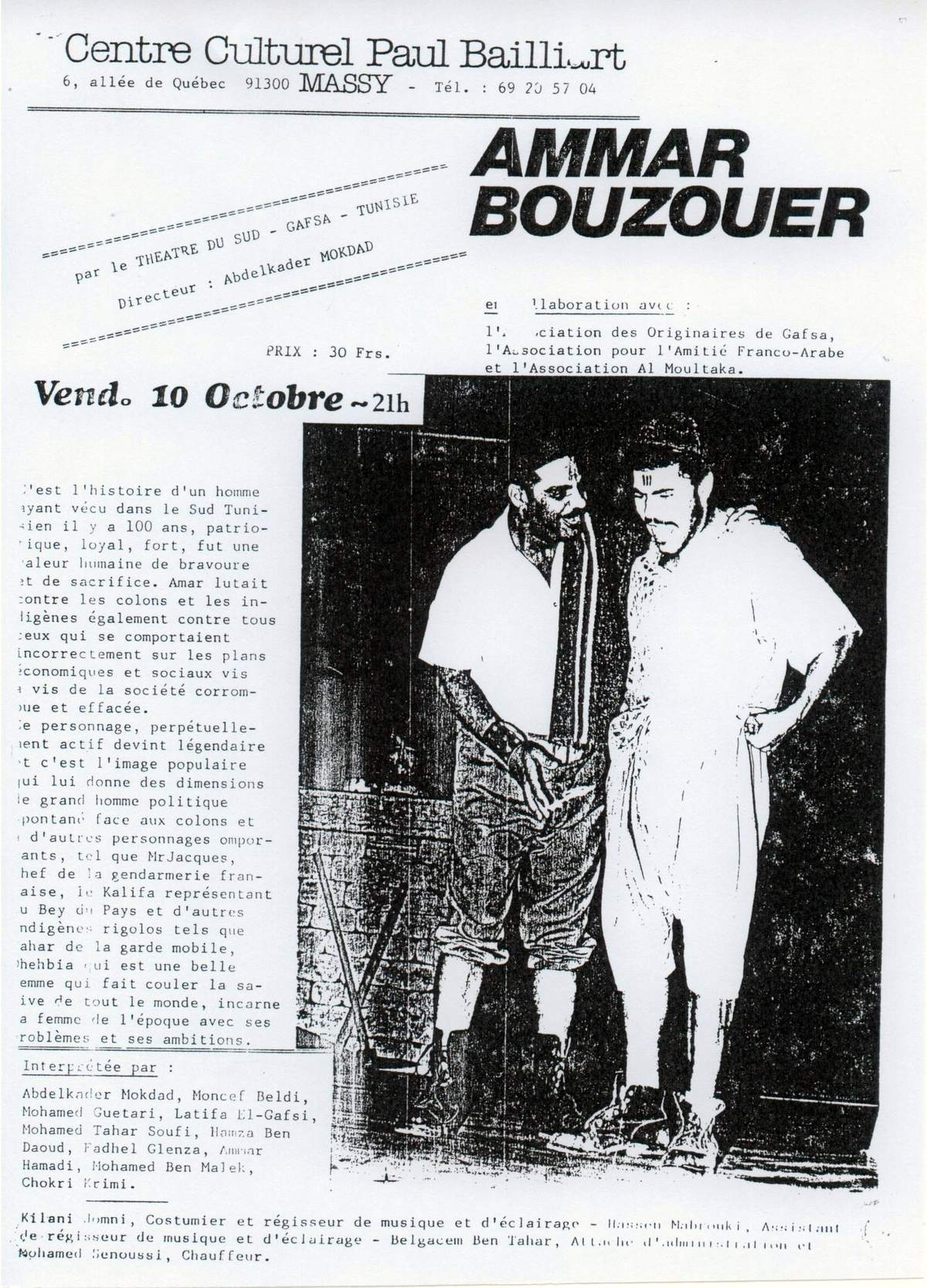
In 1978 the troupe staged Ammar Bouzouer by the poet and schoolteacher Ahmed Mokhtar Hadi, a native of Metlaoui who, according to Gattari, was still alive when the testimonies were recorded and lived in Monastir or Sousse. The play, says Chokri Smaoui, is about “a café in Metlaoui” and a character from the town; he sees in this “the secret of the Théâtre du Sud’s success: it started from its local roots and achieved national reach”. Mokdad described the character of Ammar to Al Bayane on 30 January 1984 as “a mixture of reality and imagination”, with the story set “in the era of the beys”. The leaflet of the Paul-Bailliart cultural centre in Massy, near Paris (October 1986), presents it as the story of a man who lived in southern Tunisia “100 years ago”, resisting the colonists and corrupt local notables, surrounded by characters such as “Mr Jacques, head of the French gendarmerie”, “the Kalifa, representative of the Bey of the country”, and “Dhehbia”, a beautiful woman who “embodies the woman of that time, with her problems and her ambitions”.
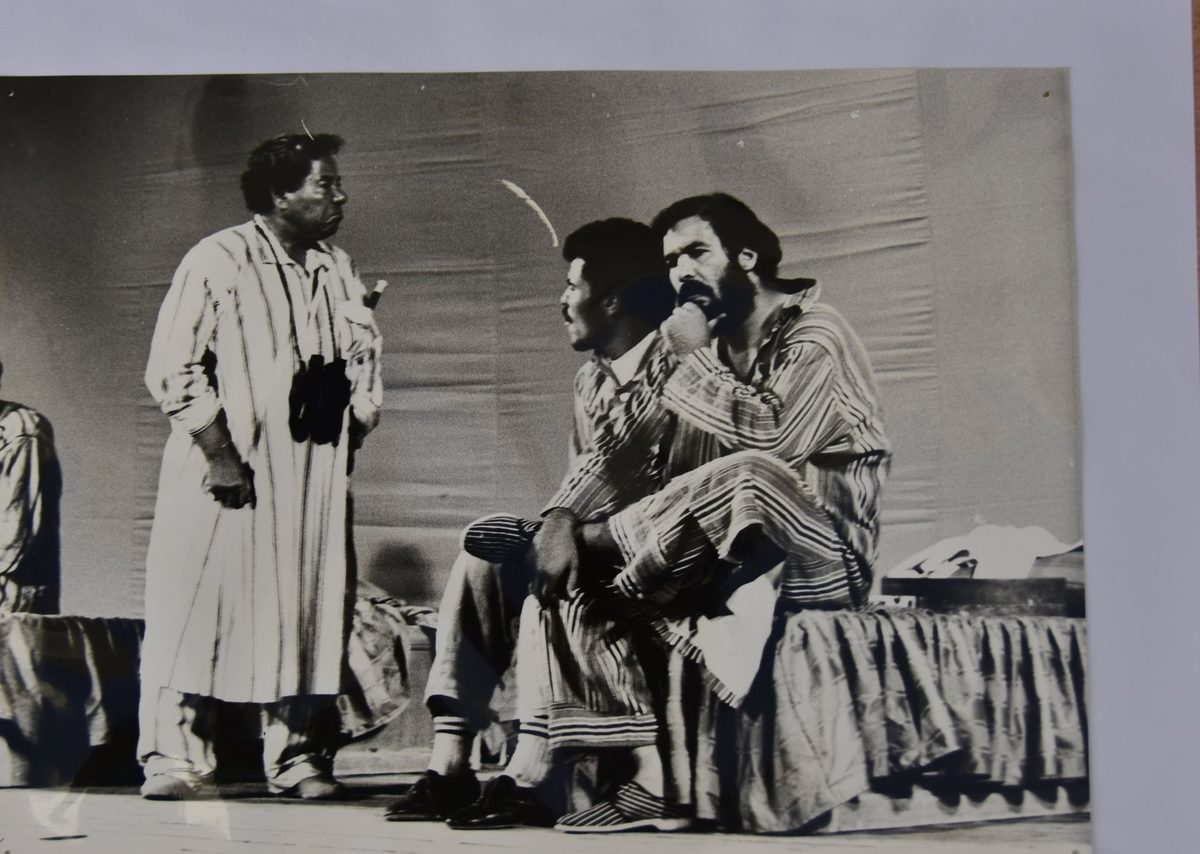
Gattari lists the cast: Mokdad as Ammar, Mohamed Tahar Soufi as “Monsieur Jacques”, Moncef Beldi as the khalifa, Latifa Gafsi as Dhehbia, Gattari himself as “Tahar El Habbas” and Hamza Ben Daoud as the café owner. The actors changed over the years: the part of “Smida”, Ammar’s brother, passed to Hammadi Ammar, and that of “El Aïfa” from Larbi Bakkari to Fadhel Glenza, and later Mohamed Malek and Chokri Krimi joined the revival. Forty years on, Gattari performs the speech of “Tahar El Habbas” about the government that “loves you and cherishes you… with its men, its stones, its trees… its cartridges, its bullets”, and says the passage does the rounds on Facebook every time a new government is formed.
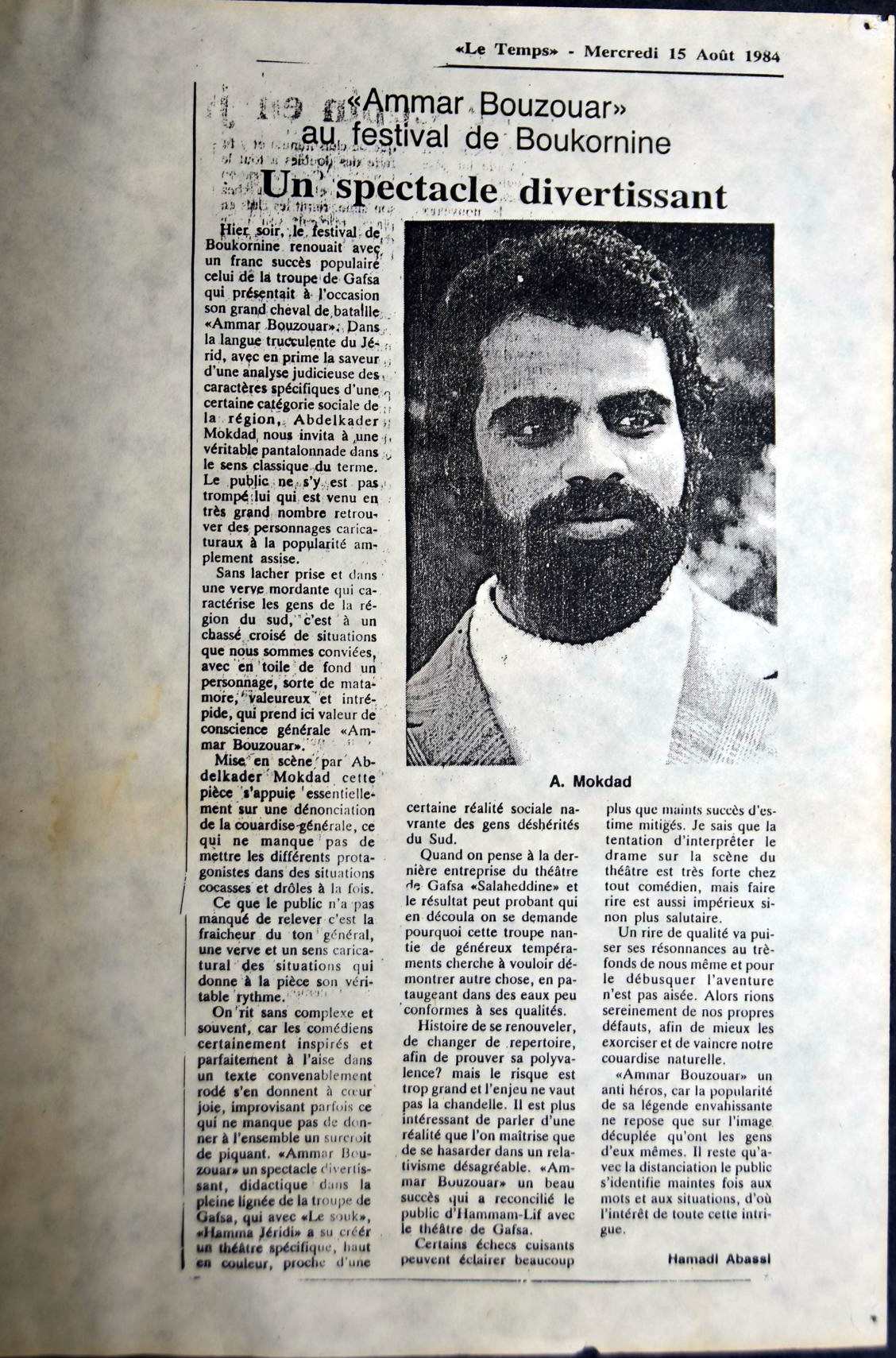
The text did not stay as it was written. Gattari says Ammar Bouzouer, like Firan Eddamous, was an “incomplete work”, and that the only condition the troupe set for an author was “the right to add and cut”, hence the credit “written by So-and-so, revised by the troupe”. Hammadi Ammar says that the Ammar Bouzouer “people talk about, the ’78 one, isn’t the Ammar Bouzouer of ’80 and after”, because Mokdad felt it “hadn’t had its chance” and reworked it with the new group, just as he revived Saheb El Kalam and Hamma El Jeridi after the first group broke up. The critic Hamadi Abassi wrote in Le Temps on 15 August 1984, the day after its performance at the Boukornine festival, that Mokdad “invited us to a true farce in the classical sense of the term”, a play that “rests essentially on a denunciation of general cowardice”; Ammar is “an anti-hero, for the popularity of his overbearing legend rests only on the magnified image people have of themselves”. He hailed “a fine success that has reconciled the Hammam-Lif audience with the Gafsa theatre”, after “the unconvincing result” of Salah Eddine.
According to Gattari, it reached 743 performances over about four years; Hammadi Ammar puts the figure at 860. It was sometimes performed three times a day, “matinee, second matinee and evening”, especially in Bouhjar and Sayada, where “the area was teeming with workers, so the hall filled up once, then a second time, and at night a third time”. Moncef Beldi recalls that Hamma El Jeridi had also been performed three times in a row on a single day at the Ibn Rachiq house of culture, at three, six and nine o’clock, as well as twice in Jemmal and twice in Nefta, and Ahmed Amer recalls that they sometimes had to “do a five o’clock show and a nine o’clock show, like the cinema”. According to Gattari, the play opened most festivals, “and if it wasn’t the opening, it was the closing”.
The queue stretched from the door of the Théâtre municipal all the way to Bab Bhar.
Mohamed Sassi Gattari · in Tunisian Arabic
The productions followed one another:
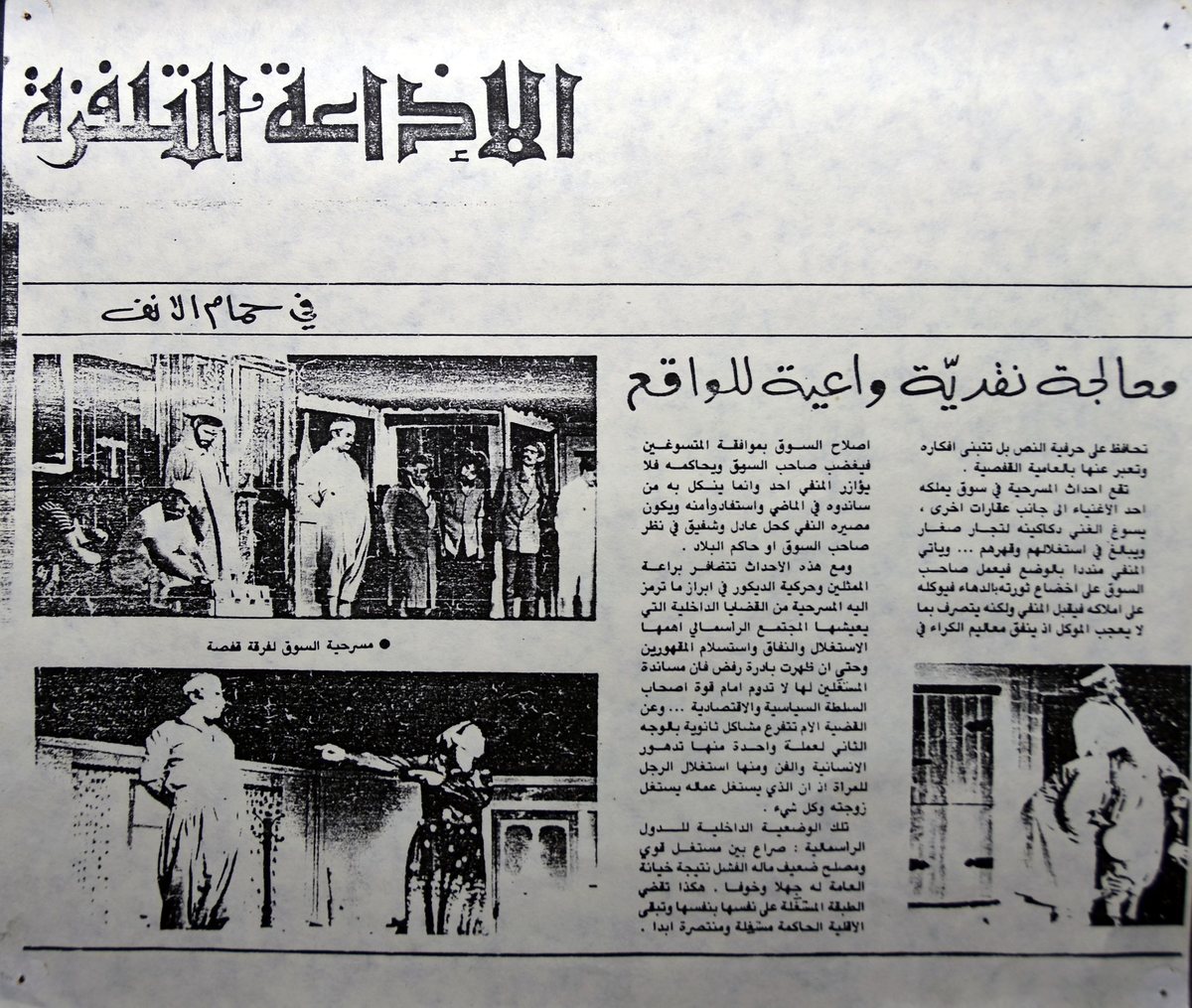
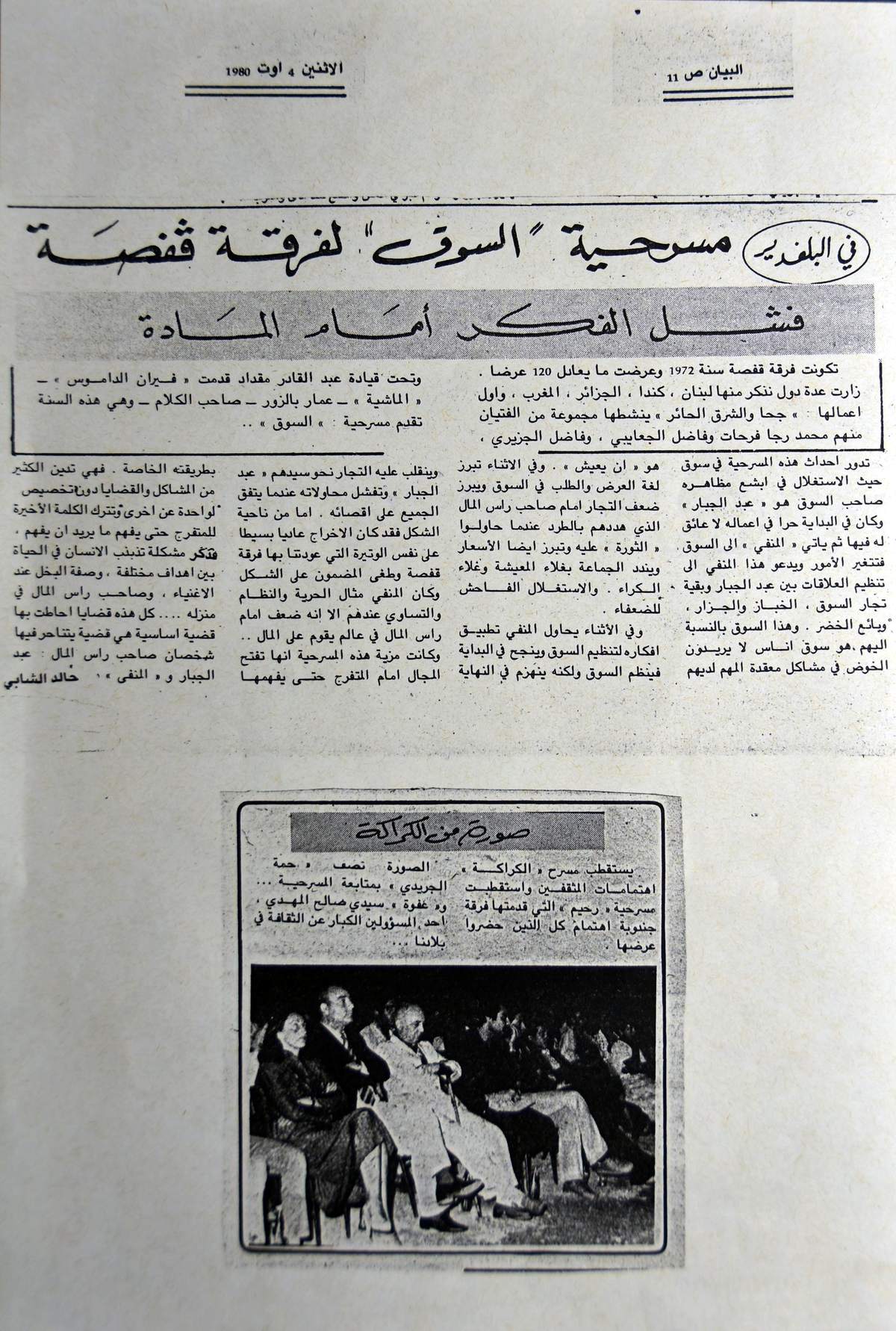
Essouk (“The Market”), by Ahmed Amer, around 1980. According to an undated clipping from the magazine Al Idhaa wa Ettalfaza on its performance in Hammam-Lif, it is set in a market owned by a rich man who rents out his shops to small traders and exploits them without restraint; along comes “El Manfi” (“the exile”) to denounce this, and the market owner, “Abdeljabbar”, then puts him in charge of his property only to have him tried in the end, all among the baker, the butcher and the greengrocer. It was performed at the Belvédère, and Khaled Chebbi wrote in Al Bayane on 4 August 1980 that its merit was that it “leaves the spectator free to understand it in his own way”, and that since its founding the troupe had given “the equivalent of 120 performances”. Gattari says his own part, “Bouaoun”, was not in the original text and that “the greater part” of the roles were added by the actors; Ahmed Amer confirms that he wrote “to fit the actors”: “I know how Mokdad acts, what word he wants to say.” It was in this play that Hammadi Ammar joined, in a silent role. The critic of Le Temps on 15 August 1984 found that with Essouk and Hamma El Jeridi the troupe “has managed to create a theatre of its own, colourful, close to a certain distressing social reality of the deprived people of the South”.
Chebbi, by the poet Bechir Kahouaji, summer 1982. The play was announced under the headline “Abdelkader Mokdad returns” by a clipping from the column “Tounes Ennoujoum” (“Tunisia’s Stars”), probably from Al I’lane (30 July – 5 August 1982), since it is kept on the same sheet as a box bearing the paper’s name and date. According to Gattari, it portrays episodes from the life of Aboulkacem Chebbi, the great Tunisian poet, in Tozeur and at the Zitouna mosque, his closeness to Mahmoud El Materi and Zine El Abidine Snoussi, and the controversy stirred up by his book The Poetic Imagination of the Arabs. Moncef Beldi played five parts in it, as he told Al Ousbou Al Moussawar (14–20 November 1986), and Mokdad told Al Bayane on 25 April 1988 that it had been criticised on historical grounds. Ahmed Amer believes it succeeded because Mokdad “added a lot of things to it and turned it into a biography of Chebbi”. Hammadi Ammar describes how it was prepared:
For the play ‘Chebbi’, we worked three days without leaving the stage. 72 hours.
Hammadi Ammar · member of the troupe (1980–1994) · in Tunisian Arabic
Hammadi Ammar adds that they would send one of them out for food, “so that when the door opened we’d know whether it was day or night”. Gattari says the production used a video projector, film clips and “slides” on stage, something new at the time, which he takes as proof that the troupe “kept its form and style while advancing technically”. Smaoui places Chebbi and Salah Eddine El Ayoubi in “another genre”, distinct from the popular one.
Salah Eddine El Ayoubi was staged before the summer of 1984 and drew little response in the press, apart from the verdict of the daily Le Temps (15 August 1984), which called it “the latest venture of the Gafsa theatre” and noted “the unconvincing result that came of it”. Moncef Beldi played “Lionheart” in it, a role he counted, along with that of Lakhdar in Hamma El Jeridi, among “the most important things I have performed”, as he told Al Ousbou Al Moussawar in 1986; Chokri Smaoui, for his part, describes it as “a window onto our Arab-Islamic heritage”. In 1983 or 1984, according to Hammadi Ammar, an actor in the national programme was paid 2,500 millimes per performance, “and even so, we were happy”.
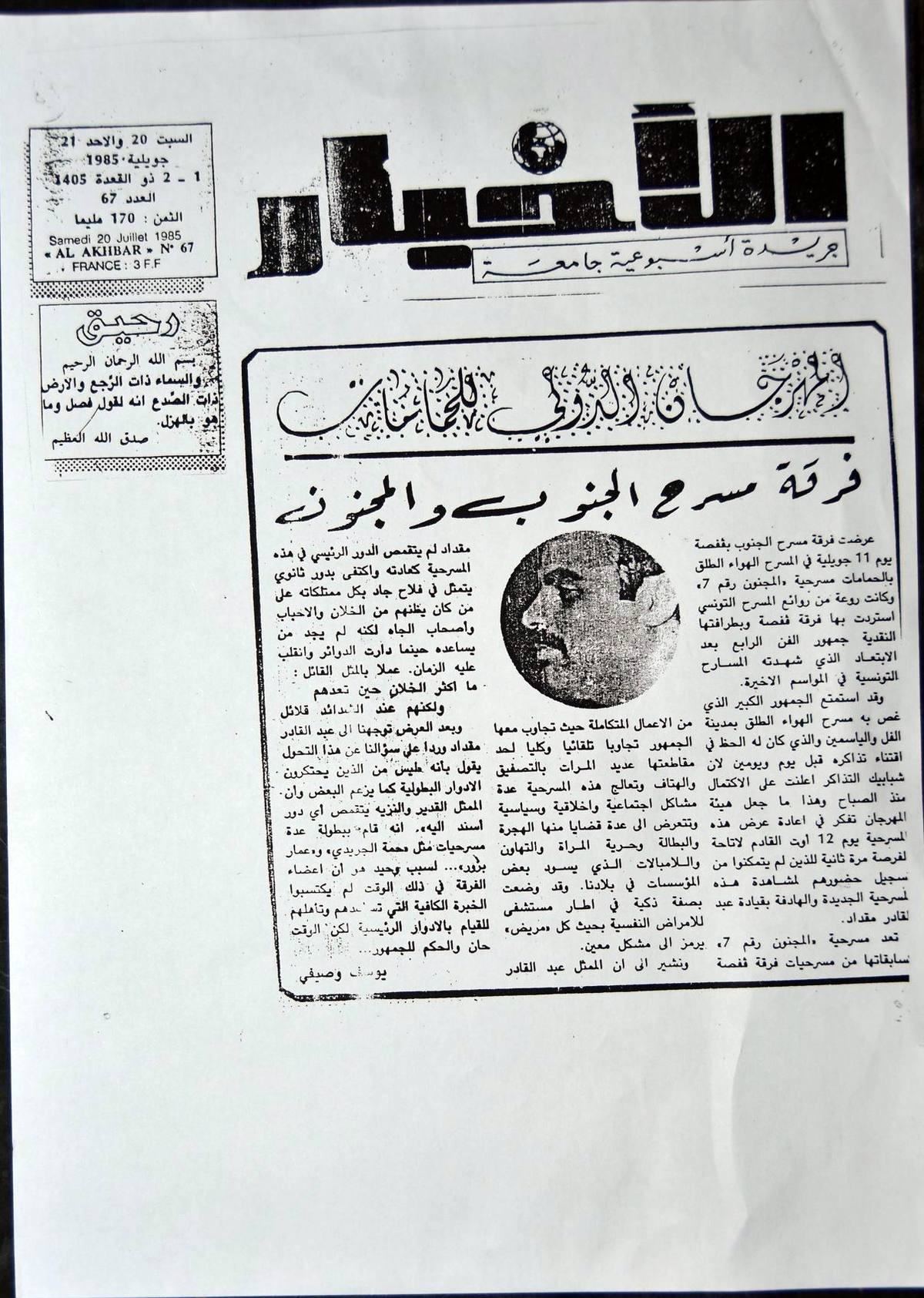
El Majnoun n° 7 (“Madman No. 7”), by Mokdad and Rachid Mansouri, dates from 1985. According to Gattari, Mansouri, who came from Metlaoui, wrote part of the text, “Abdelkader took care of adding to the writing”, and the actors then supplied most of the rest, because the roles were “monologues, each person did his monologue”. The play is set in a psychiatric hospital, “where each patient stands for a particular problem”, as Al Akhbar wrote in its issue of 20 and 21 July 1985: emigration, unemployment, women’s freedom, negligence and indifference. Gattari runs through the madmen: Soufi was No. 5, Gattari No. 4, Mohamed Malek No. 3, Beldi No. 2, Chokri Krimi No. 1, Hammadi Ammar No. 7 and Mokdad No. 6, with Latifa Gafsi as the nurse, Fadhel Glenza as the doctor and Hassen Mabrouki as the orderly. Beldi, however, told Al Ousbou Al Moussawar (14–20 November 1986) that he had played “Madman No. 1”. For Smaoui, the play “expressed the situation of the intellectual, meaning marginalisation”.
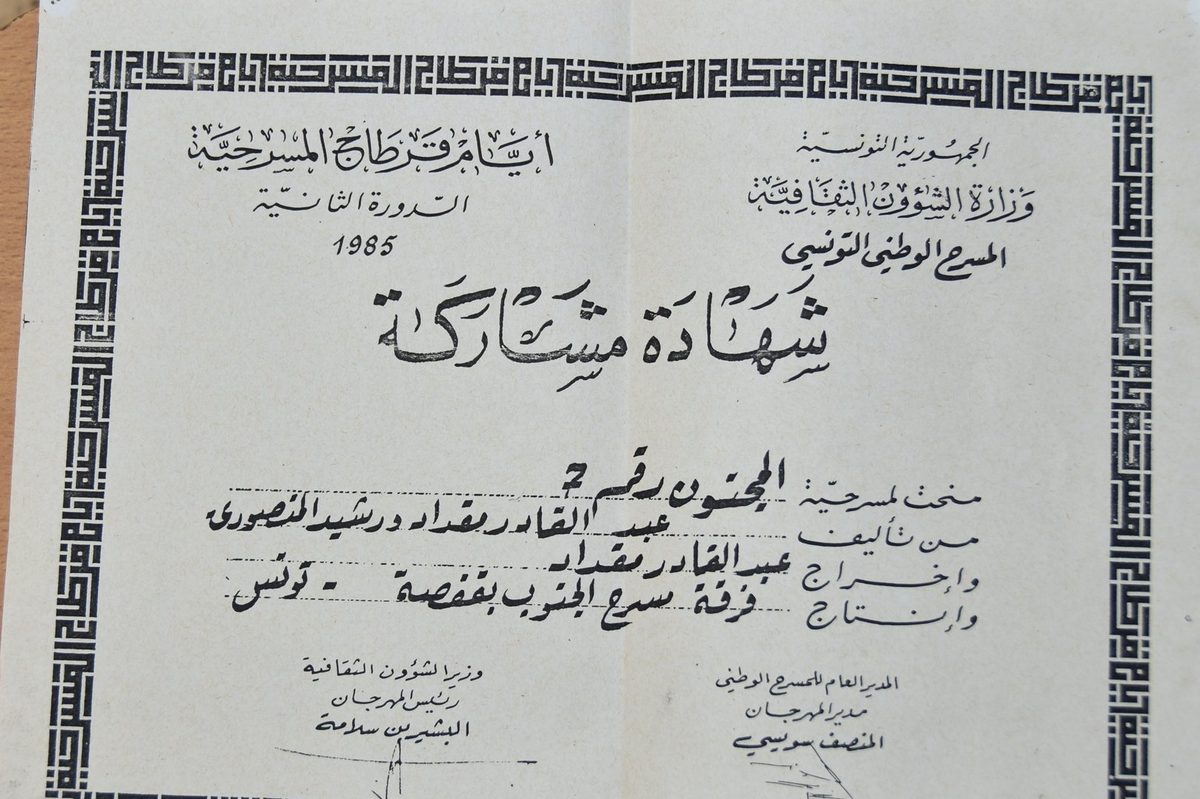
While he was preparing it, Mokdad told the magazine Al Qal’a in March 1985: “Some regard the work of the Gafsa troupe as mere clowning, others as committed and serious work… and every madman sings of his own Leila.” On 11 July 1985, tickets for the summer theatre in Hammamet were sold out “from the morning”, according to Al Akhbar, which hailed the play as “one of the masterpieces of Tunisian theatre, with which the Gafsa troupe has won back the audience of the fourth art”, and noted that Mokdad had settled for a supporting role, that of a farmer “who gave away all his possessions to those he thought were his friends”. The play then took part in the second Carthage Theatre Days, as the certificate of participation shows. Sometimes performed twice a day, it was dubbed “last summer’s play” by Assada on 25 May 1986. It returned at Theatre Week in November 1986, according to the programme published in Al Anouar Ettounsia (2 November 1986), and at the Ulysses festival in Djerba in July 1987, according to the festival calendar in Al Amal (15 July 1987). Gattari recalls that one night Mokdad asked him to come on stage with him unrehearsed, turning the monologue into a duet: “He says to me, ‘My grandfather was a bash-chaouch.’ I say to him, ‘Your grandfather, with the bash or without the bash? He’s still just a chaouch.’”
The TV came three times to record it, and the administration refused to let the play be recorded.
Mohamed Sassi Gattari · on El Majnoun n° 7 · in Tunisian Arabic
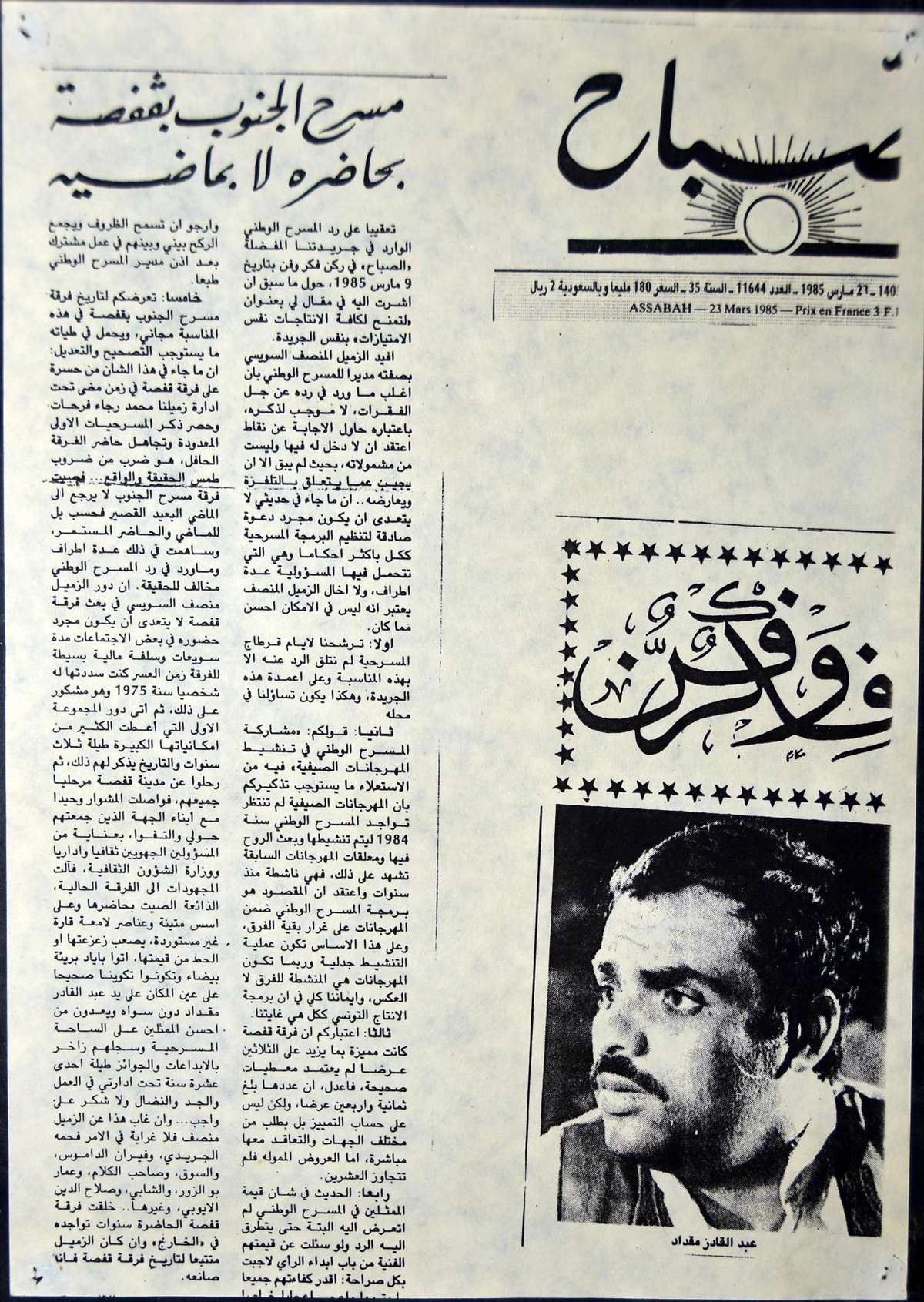
On 23 March 1985, Mokdad entered into a public dispute in Assabah with the National Theatre, replying to a rejoinder the latter had published in the same paper on 9 March about the number of the troupe’s festival performances: “It reached forty-eight performances, and the funded performances did not exceed twenty.” He defended “the troupe’s busy present” against those who would confine it to “a time gone by”, and wrote that the current actors had “received proper training, on the spot, from Abdelkader Mokdad and no one else”, after “eleven years under my direction”.
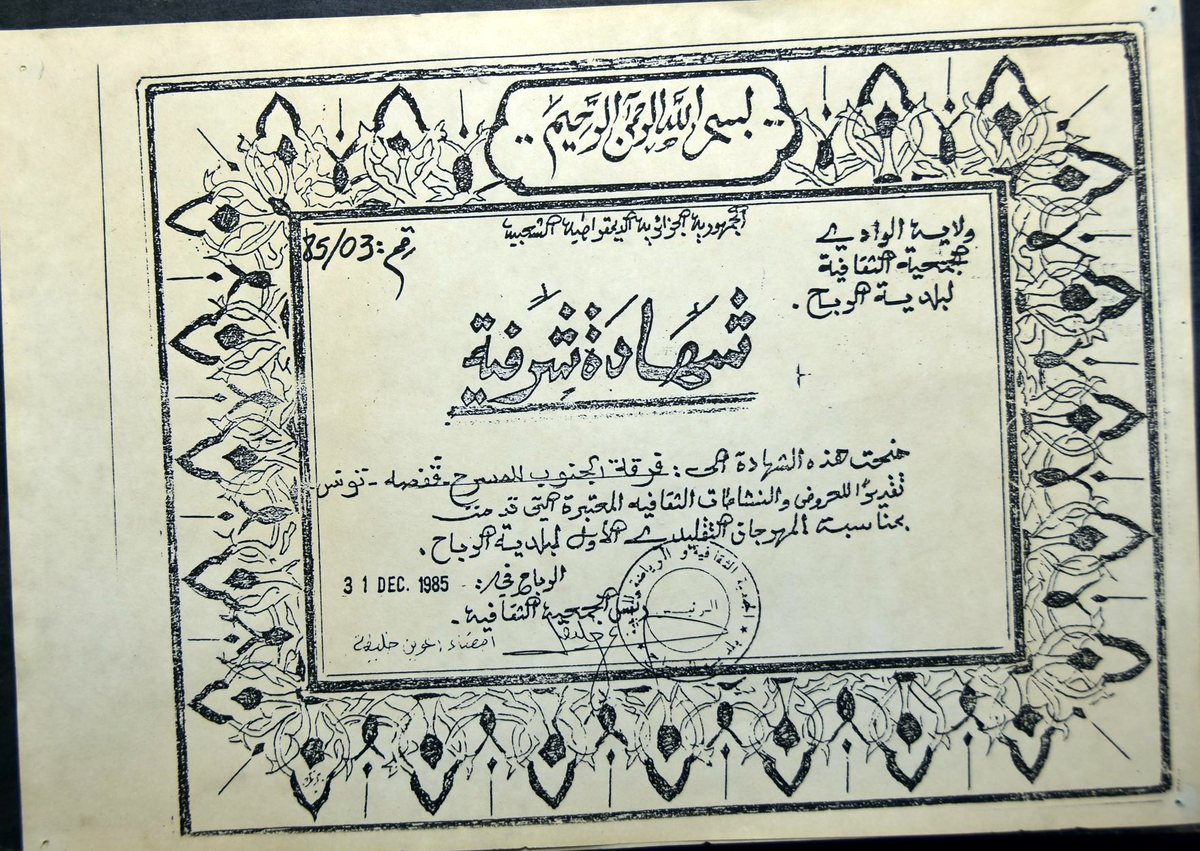
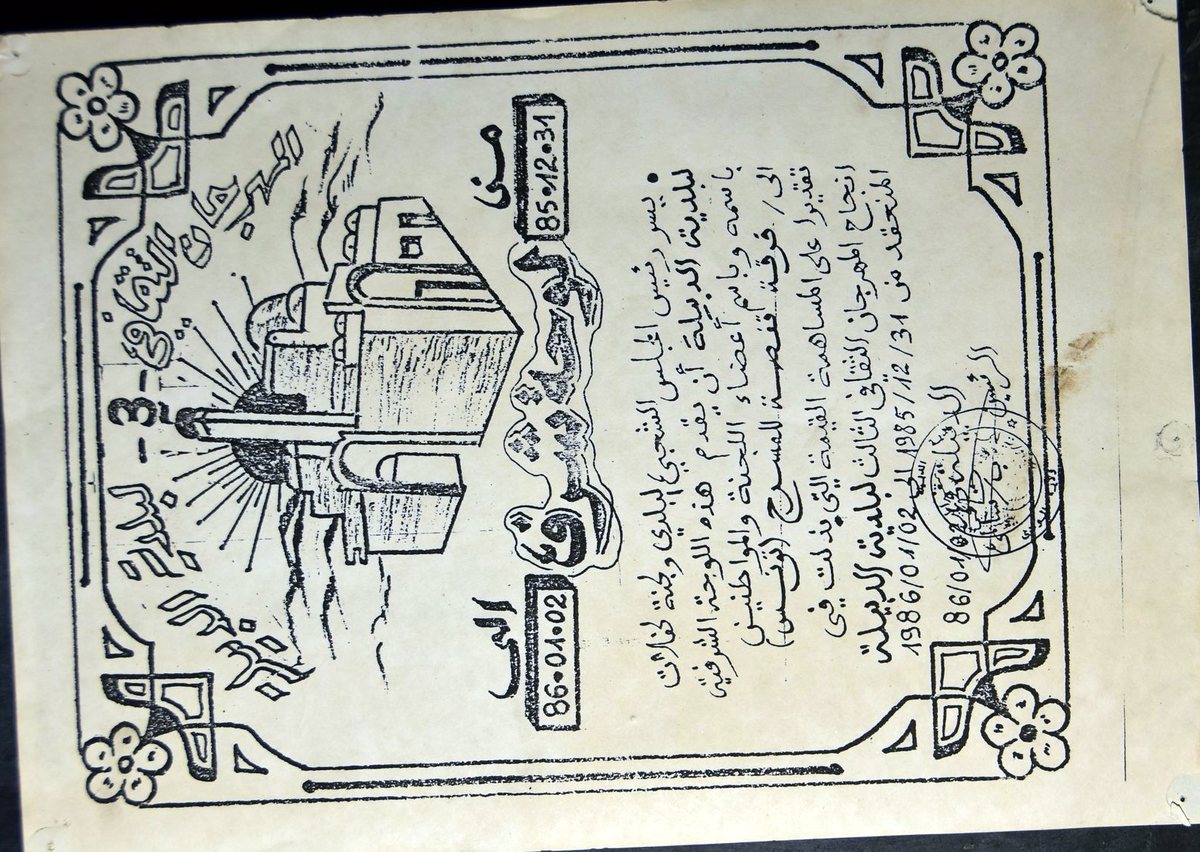
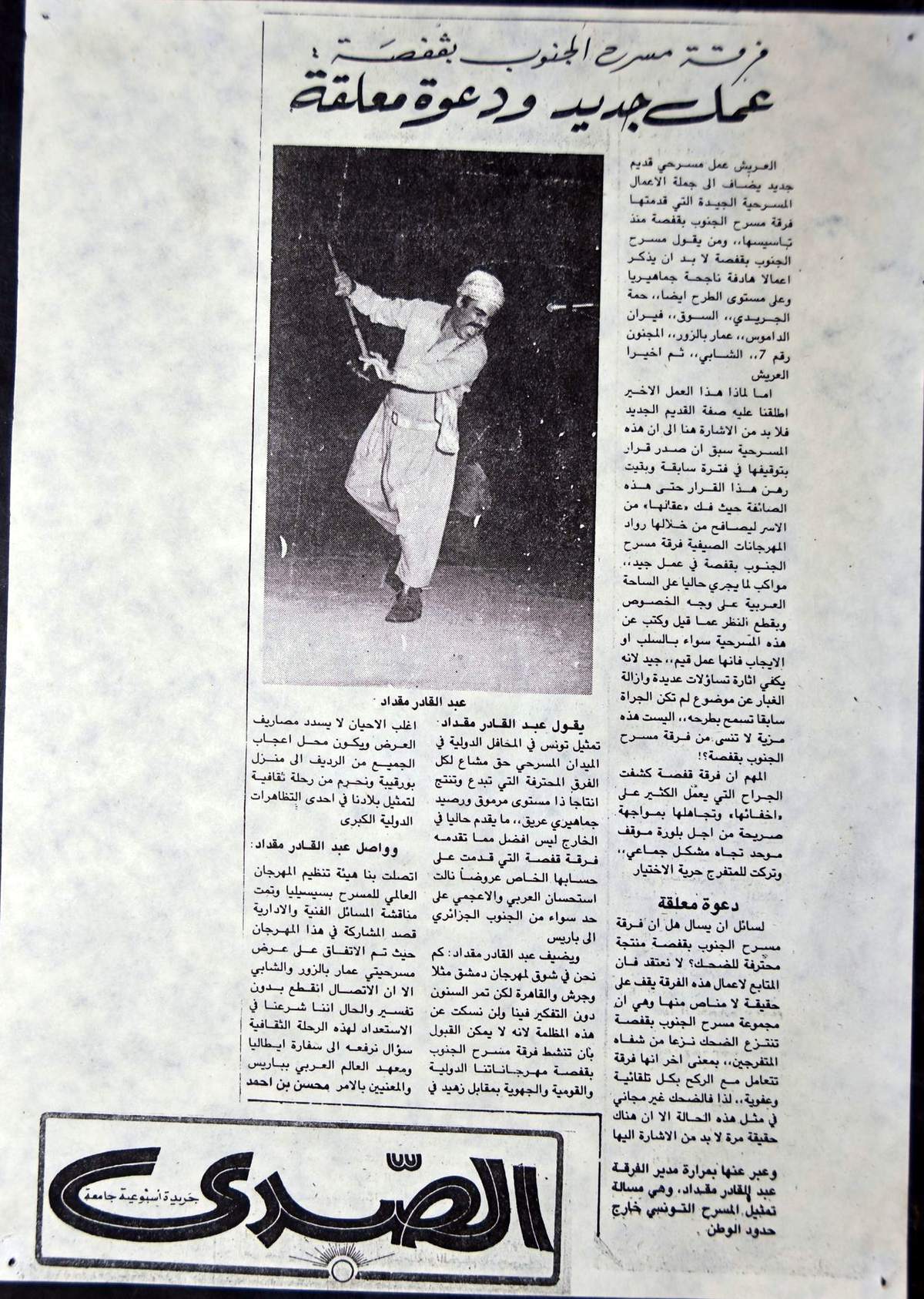
Between 31 December 1985 and 2 January 1986, the troupe performed in the Algerian south, in El Oued and Debila, as shown by a certificate of honour from the wilaya of El Oued dated 31 December 1985 and a roll of honour from the municipality of Debila for its third cultural festival (31 December 1985 – 2 January 1986), both kept in the archive. Assada, in an undated clipping, probably from the summer of 1988 since it mentions the lifting of the ban on El Arich “this summer”, wrote that the troupe had performed “from the Algerian south to Paris” and “from Redeyef to Menzel Bourguiba”, and that an invitation from the “World Theatre Festival in Sicily” to stage Ammar Bouzouer and Chebbi had fallen through without explanation. Mokdad called for the right of professional troupes to represent Tunisia: “How we long for the Damascus festival, for instance, or Jerash, or Cairo, but the years go by without anyone thinking of us.”
Moncef Beldi sums up the troupe’s philosophy of reaching people:
I go to the audience; the audience doesn’t come to me.
Moncef Beldi · actor with the troupe until 1986 · in Arabic
And he lists the places it reached:
We put on plays on the bare ground, just as it was… in an olive-oil press… on sacks of wheat… anywhere, in restaurants.
Moncef Beldi · in Arabic
According to Chokri Smaoui, the troupe was “the only one that achieved financial independence”, thanks to 40 to 45 performances every summer; its tours lasted 15 to 20 days and stretched from Ben Gardane to Bizerte. Beldi adds that in winter the ministry scheduled three performances in each governorate, one in its capital and two in its districts, so “the actor works summer and winter”. Hammadi Ammar says the troupe’s programme ran “from 26 June to 8 or 9 September, every night, not a single night off”, sometimes with a performance in Ben Gardane followed by another in Béja the next day, and that in the 1980s the troupe stayed “in very respectable hotels” rather than youth hostels.
Every actor who steps on stage is necessarily a hero.
Moncef Beldi · in Arabic
Beldi says some spectators came to see the same show several times and knew the parts by heart. Hammadi Ammar recalls that one night in Mahdia, Mohamed Tahar Soufi forgot his line in El Majnoun n° 7 and the whole audience said it for him. On another occasion the troupe took Ammar Bouzouer to a desert spot in the south whose name he cannot recall exactly; the stage was set up on the sand and, as night fell, around a thousand spectators turned up, by his estimate: “Where they came out of, God only knows, but they came out.” Ahmed Amer recalls attending a performance in Gafsa where the audience “applauded Abdelkader Mokdad when he came on, applauded Latifa Gafsi, and Hamza Daoud, and Mohamed Malek… because the experience had matured”.
Hammadi Ammar joined the troupe in 1980, aged 18, after a “casting” in front of Mokdad, with a silent part in Essouk (“The Market”): “I’d walk back and forth in the market, carrying a basket.” Then he found himself on the stage at Carthage.
I was 18… and you go up on the stage at Carthage, I mean, just imagine the situation.
Hammadi Ammar · actor with the troupe (1980–1994) · in Tunisian Arabic
The other regional troupes used to call us Brazil.
Hammadi Ammar · in Tunisian Arabic
Hammadi Ammar explains the nickname in a single word: “Work, work, work and nothing but work.” The “Italian reading” around the table, he says, lasted a month to a month and a half before they moved onto the stage; Beldi describes it as a “second writing” that takes apart characters and dialogue to turn the text on paper into a performance. Latifa Gafsi recalls that each production was preceded by a writing workshop and by training sessions in popular theatre and vaudeville lasting about three months, and that the writing was done “to fit the people available”: “There was one woman, which was me, and seven or eight other people.” The costumes, she says, were cobbled together from the leftovers of earlier productions by Kilani Jomni, and the old sets were repainted.
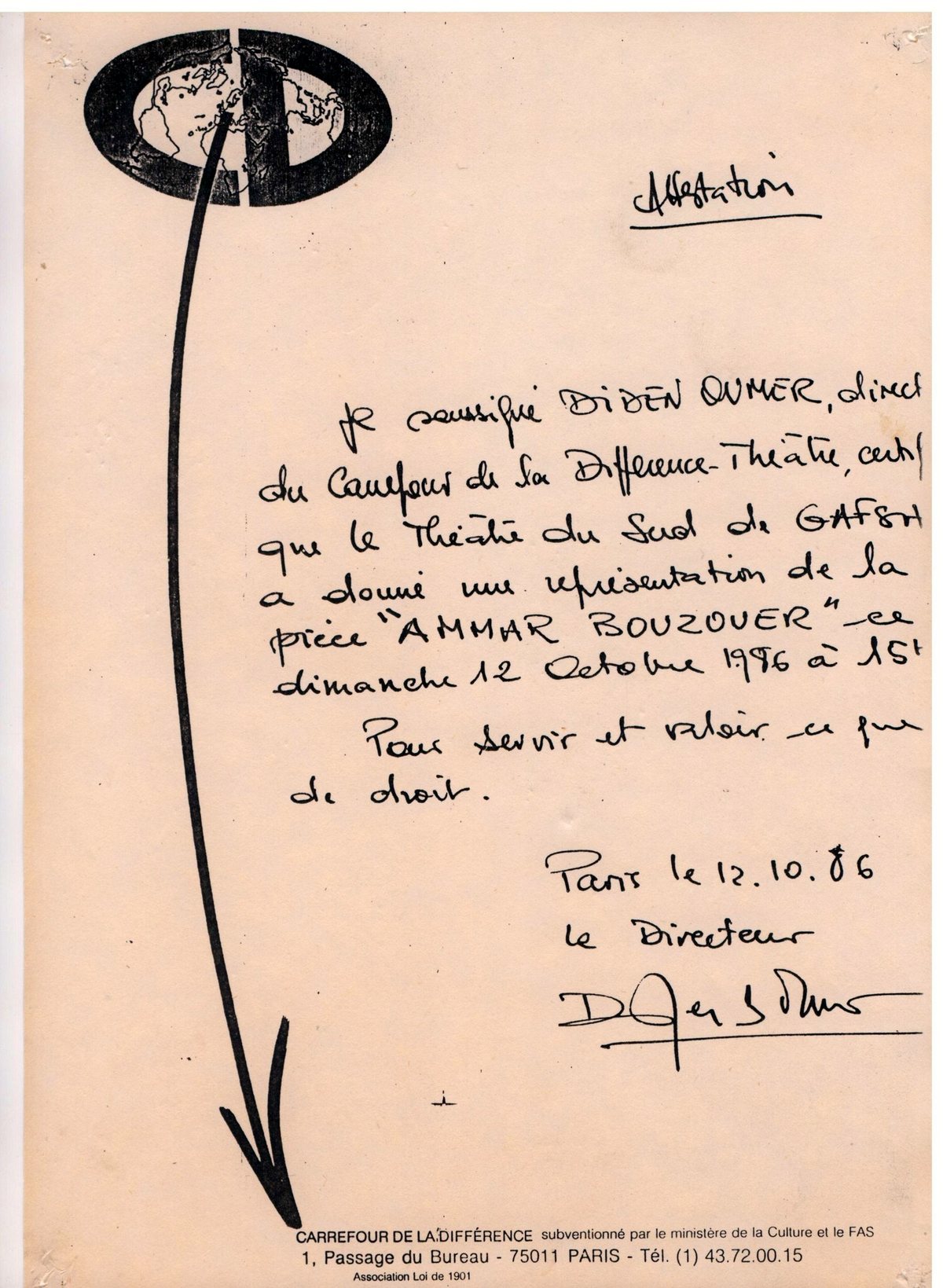
In October 1986 the troupe took Ammar Bouzouer to France: on Friday 10 October to the Paul Bailliart cultural centre in Massy, and on Sunday 12 October to the “Carrefour de la Différence” in Paris, as shown by the Paul Bailliart centre’s leaflet, the Massy municipal bulletin info Massy (no. 38, 26 September 1986) and a certificate from the director of the Carrefour de la Différence dated 12 October 1986, all kept in the archive. The Massy leaflet names the ten actors: Mokdad, Beldi, Gattari, Latifa Gafsi, Soufi, Hamza Ben Daoud, Fadhel Glenza, Hammadi Ammar, Mohamed Malek and Chokri Krimi, with Kilani Jomni on costumes, music and lighting, Hassen Mabrouki as assistant and Belgacem Ben Tahar as administrative officer. In Assabah on 5 November 1986, Mohamed Chaabnia wrote that the municipality of Massy presented the troupe with the town’s “certificates of honour and official symbolic medal”, that the set had travelled in a lorry donated by private individuals from Gafsa, that the troupe had entertained the passengers of the ship Habib with songs and theatre, that the Tunisian theatre-maker Mohamed Soussi “opened his home to put up the troupe”, and that the Paris performance was attended by students, immigrant workers and the deputy consul general. Straight after its return, the play was performed at the Ibn Mandhour cultural centre in Gafsa before “some two thousand people”, in the presence of the Minister of Planning and Finance and the governor of Gafsa.
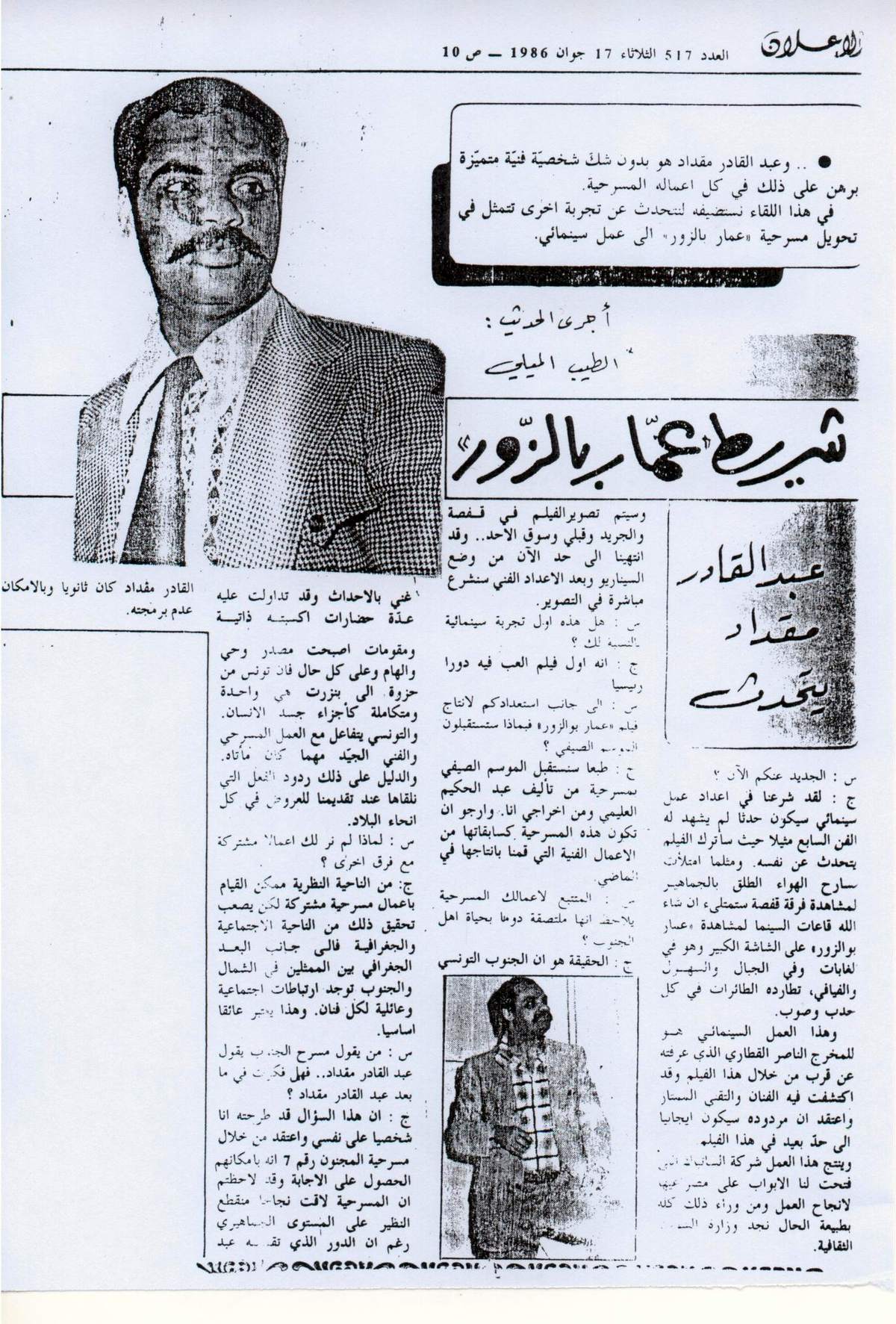
Mokdad had announced in Al I’lane on 17 June 1986 a film of Ammar Bouzouer by the director Naceur Ktari, to be shot “in Gafsa, the Jerid, Kébili and Souk Lahad”; later clippings say nothing of what became of it. In July 1987 the audience of the Carthage International Festival spent an evening with the play, and Jalila Souid wrote in Al Amal on 15 July 1987 that it was “a play that has not died”, telling “the story of a fearless militant who refused, raised his voice in refusal and wanted to teach people how to refuse”; but she hoped “the Gafsa troupe will not stop at reviving its old successes and forget to offer us something new”. That same summer Mokdad told Le Temps (16 August 1987) that his big project, the “Ammar Circus”, had stalled for want of “a budget of 20,000 dinars”.
July 1986El Arich: the night in Monastir
In the summer of 1986 the troupe staged El Arich, written by Abdelhakim Alimi, “from a play to be watched to a play to make you think”, as Assabah put it on 21 June 1986. Assada had announced it on 25 May 1986 under the title “El Aricha”, and Mohamed Chaabnia wrote in the same Assabah article that letters and phone calls had “rained down” on Mokdad asking for it to be programmed, and that it was a “rural epic” about a crisis that breaks out under an arbour in a farming area. The story, as the clippings summarise it: a quiet village is enveloped at dawn by a strange smoke or fog; the headmaster offers a scientific explanation, the meddeb, the Koranic schoolmaster, sees divine punishment, and the omda, the village head, imposes his solution, until the truth comes out: hot water had gushed up when a deep well was drilled, according to Al Anouar Ettounsia (20–26 July 1986). Mokdad played the omda, Moncef Beldi the meddeb, according to Hammadi Ammar, and Latifa Gafsi the blind “Om Essaad”, “the role dearest to my heart”, she says, because it came “at a time when I had matured”.
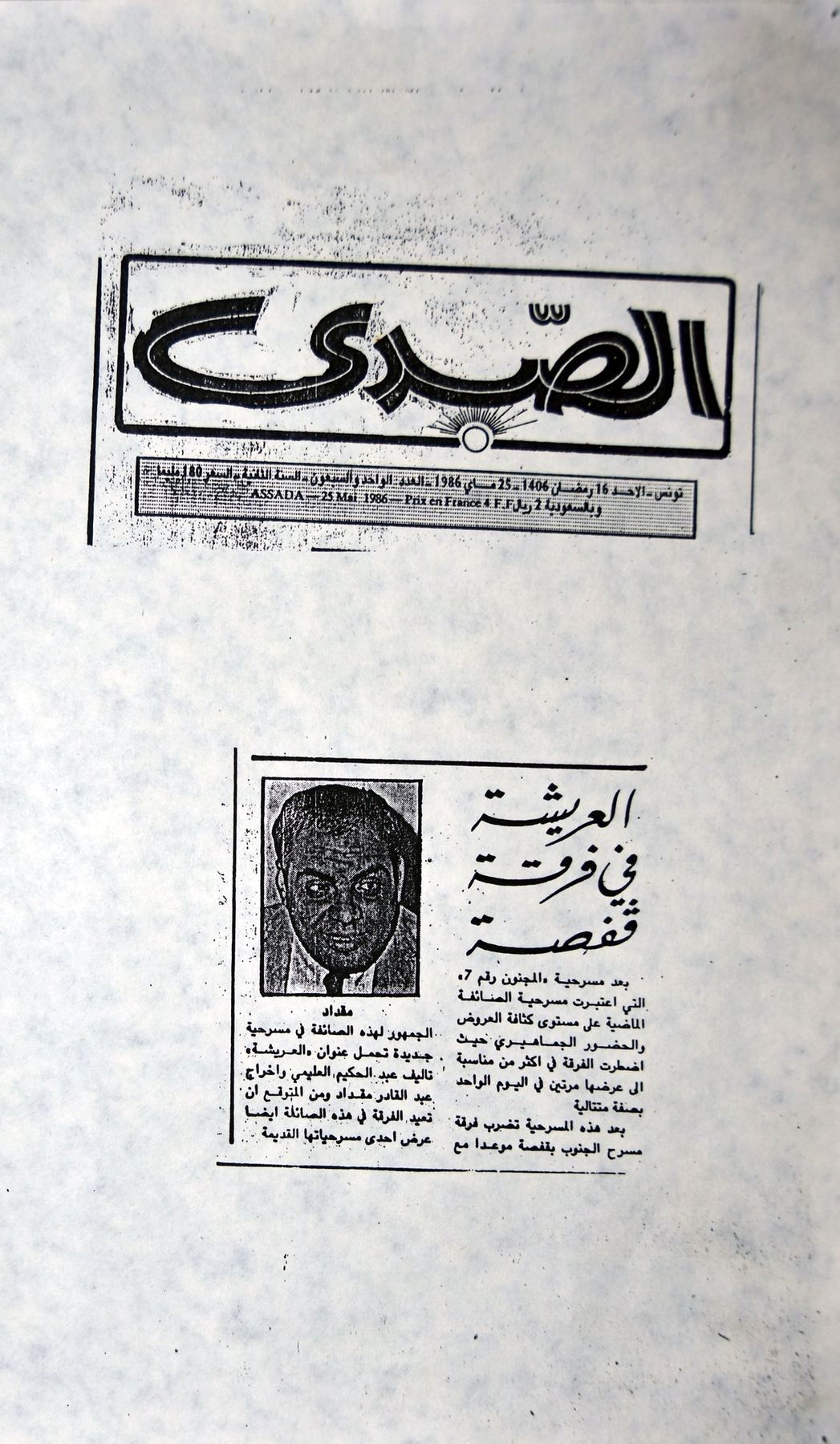
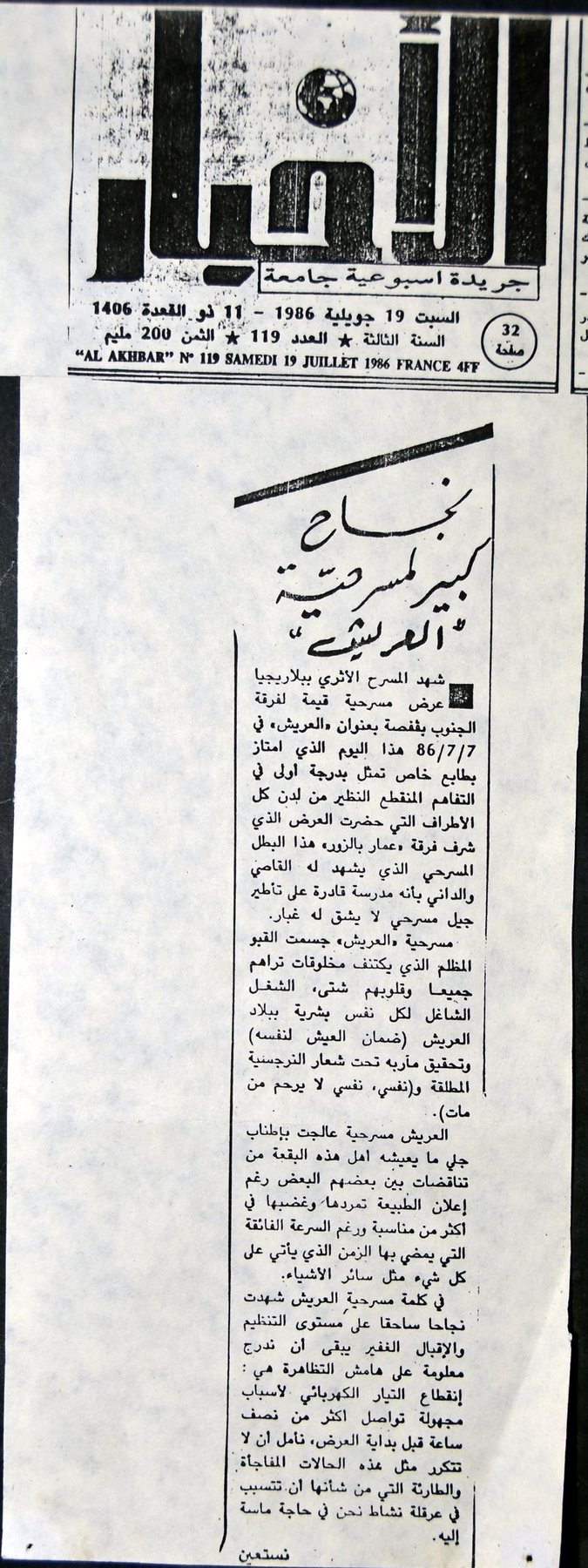
Accounts differ on the origin of the title. Al Anouar Ettounsia says El Arich is a place between Mdhilla and Gafsa, and Annahar (3–9 September 1986) that the name is “inspired by an area in southern Tunisia”. Gattari, for his part, says Alimi was working in Kasserine, where there is a place called El Arich, that the text was a dialect adaptation of a play in standard Arabic that he himself had read in an Iraqi magazine, and that when he told Mokdad, Mokdad replied: “What matters is that we’re working on a play.” We have nothing to confirm this last account. The play was performed in Gabès, then in Tabarka on 4 July according to Le Temps (4 July 1986), and at Bulla Regia on 7 July before “a large crowd” despite a power cut of more than half an hour, as Al Akhbar wrote on 19 July 1986. At the Ribat of Monastir, on Thursday 10 July 1986, as L’Action announced that very morning, the performance was stopped in the presence of a political official whom several witnesses name as Mansour Skhiri, though they disagree on the post he held at the time.
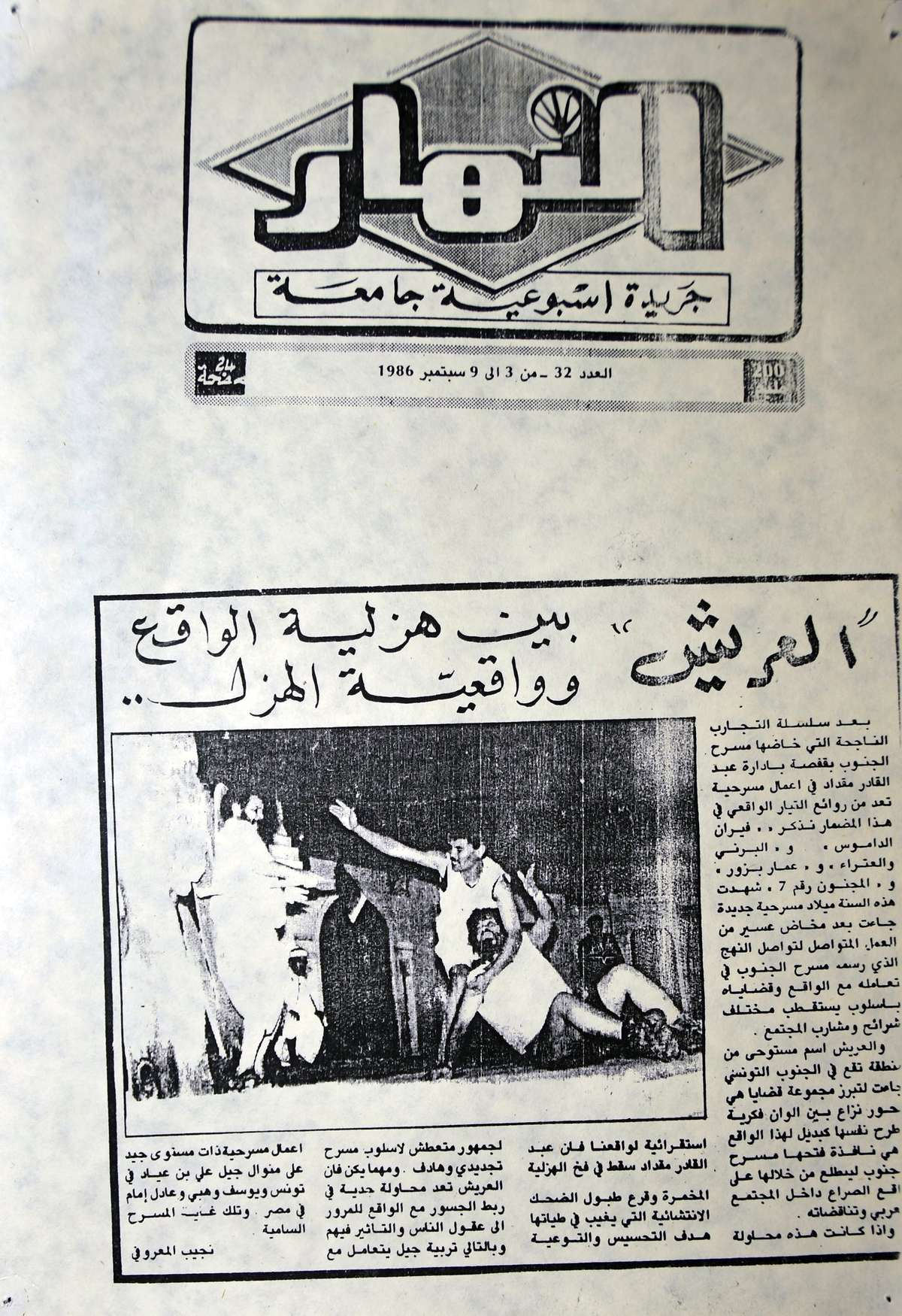
Gattari recalls that President Bourguiba was expected that night; he was unable to come, and Skhiri came in his place. Beldi recalls that before the show they saw “a whole row of empty chairs” and learned that an official was visiting; in the wings Mokdad asked, “What do I do? Cut it?”, then decided: “We put on the show as it is.” According to Hammadi Ammar, the troupe had come from the Sidi Dhaher festival in Sousse well rested, “we’d had plenty of sleep”, and it was “a really excellent show”, but the official “was annoyed by the audience’s strong reaction every time we expressed a view”, and by the role of the meddeb with his beard and jebba, and saw the play as “a provocation and a challenge”. Latifa Gafsi says the play ran for two hours and “after an hour and a bit, they wrapped it up, cut it off”; Gattari says it was stopped “in the final minutes” and “we went back home to Gafsa”.
Al I’lane wrote on 25 July 1986 that the play had been stopped “after its third performance”, when it had been scheduled at “nearly 45” festivals, and that the ban was put down to “departing from the text” and “allusions”, which Mokdad denied. Gattari says he was personally accused of departing from the text and denied it, citing the recording of the Kasserine performance, “but the administration ignored that”. El Arich was not alone: the same clipping listed, that same summer, the ban on El Hchaychia by the Théâtre de la Mer, the requirement that the Jendouba troupe cut passages from Essakhra (“The Rock”), and the postponement of the National Theatre’s Ala El Bahr El Wafer by decision of the Minister of Cultural Affairs.
Critics were divided. Echourouk ran the headline on 15 July 1986 “El Arich on the throne”, Al Akhbar (19 July) spoke of a “resounding success”, while Al Anouar Ettounsia (20–26 July) felt the troupe had relied “more than necessary on exaggerated clowning”, and Néjib Maaroufi wrote in Annahar (3–9 September 1986) that Mokdad had “fallen into the trap of farce”, even if the play was “a serious attempt to build bridges with reality”. Mokdad replied in Al I’lane (25 July 1986) that he was addressing an audience that was “aware and mature”, then told the same paper on 22 August 1986: “Alongside the authorities, I consider myself bound by discipline too.”
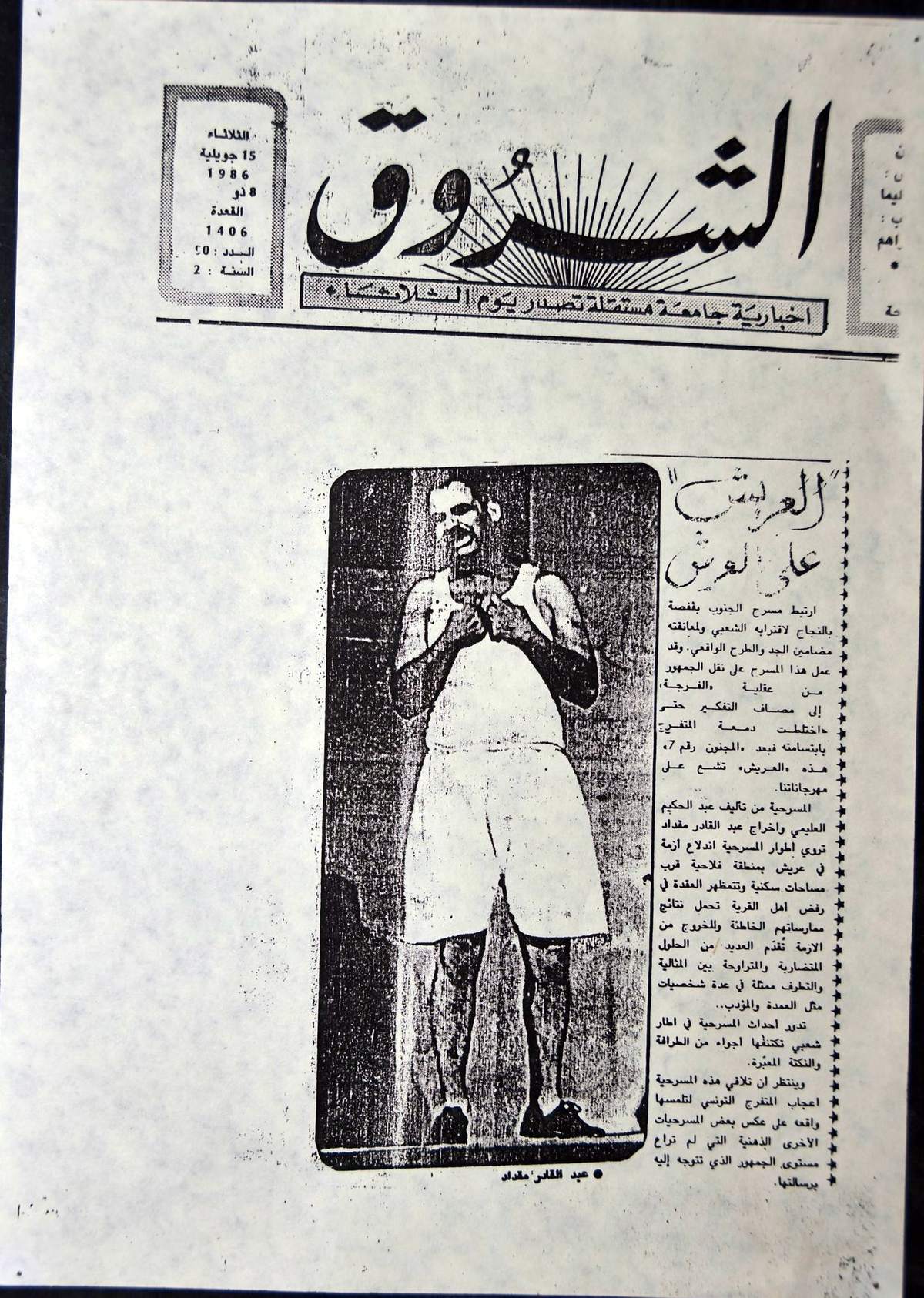
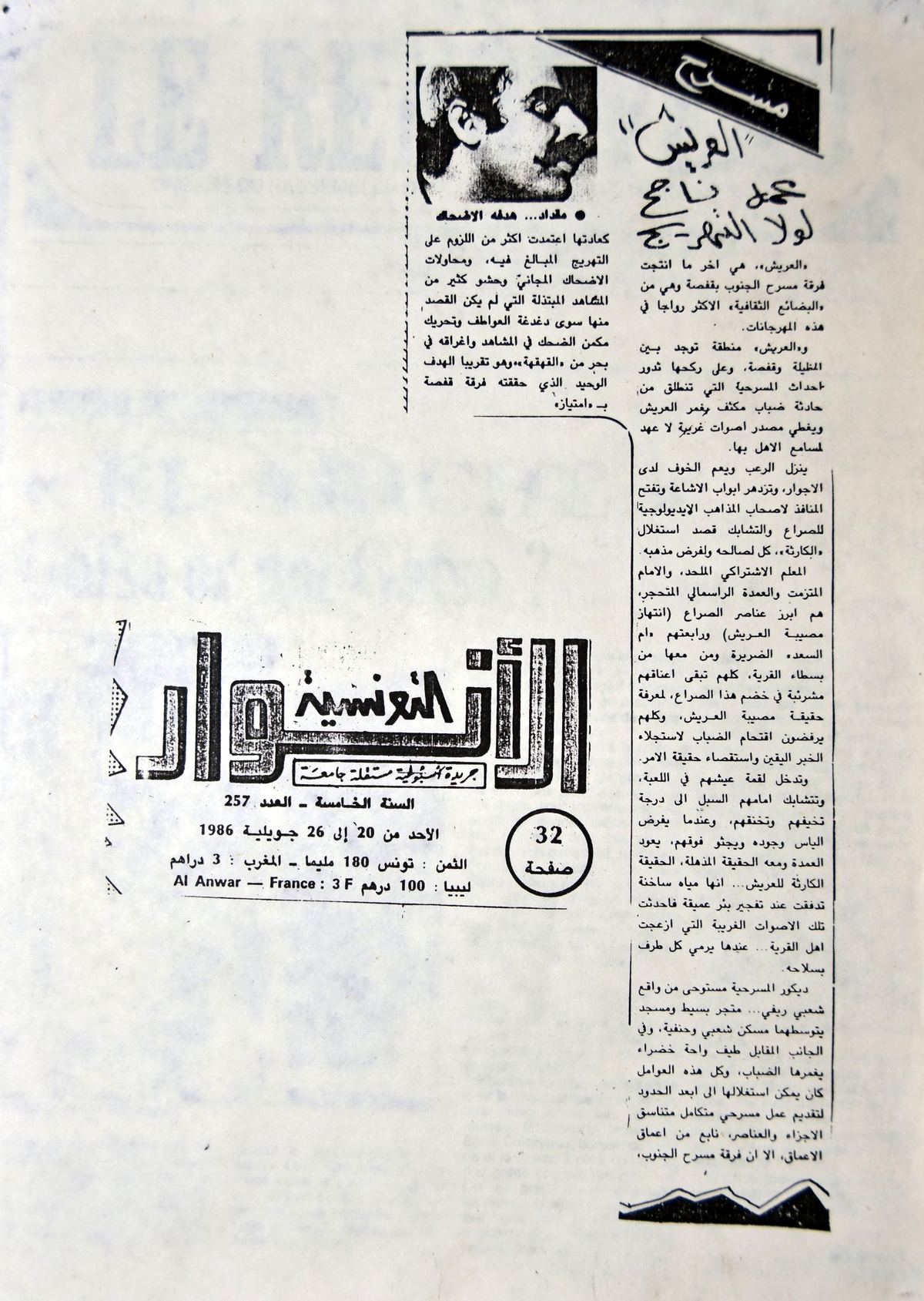
Witnesses say the troupe’s activities and its members’ pay were frozen for months. Beldi mentions 42 performances that had been requested; Hammadi Ammar says they had “reached thirty performances that summer”, that the freeze lasted six months during which “we didn’t perform”, and that someone then came asking for “an official apology to the authorities”:
And why should we apologise? The play had been approved by the theatre guidance committee… We’d reached thirty performances that summer.
Hammadi Ammar · on the demand for an apology after the night in Monastir · in Tunisian Arabic
Latifa Gafsi recalls that “the money was frozen for six months”, no salaries and no performance fees, so Mokdad “lent us” out of what he himself was paid, “a little to each of us, depending on our families”, and that she sold what gold jewellery she had, as she tells it. Ahmed Amer and Latifa Gafsi say Mokdad was summoned and questioned about the matter; Ahmed Amer describes the decision as “very harsh, it nearly wiped out the troupe”, in a country going through “a period of crisis”. Latifa recalls that Skhiri stopped by the cultural centre in Gafsa on his way to Nefta and asked them mockingly how “that troupe” was doing, then said: “I’m the one who stopped it for you.” Moncef Beldi left the troupe after that year. Hammadi Ammar recalls that it was Ibrahim Zidi, secretary general of the regional cultural committee, who reassured them: “Carry on, you’ll be fine.”
Yet the documents show that the ban did not cover everything: Al I’lane wrote on 22 August 1986 “Good news for the public: the Gafsa troupe is back”, quoting Mokdad as saying the matter was “moving towards a resolution”; the troupe took Ammar Bouzouer to France in October and performed El Majnoun n° 7 at Theatre Week in November 1986, according to its programme published in Al Anouar Ettounsia. The freeze the witnesses describe thus hit El Arich, that summer’s fees and their pay, without halting the older plays. Hammadi Ammar says that year went by “with no new production”, and that the troupe lived for “two years, three years” in fear “of being interpreted”, reviving Ammar Bouzouer, Hamma El Jeridi and Ali Baba. It was during this period, Latifa Gafsi recalls, that work began in secret on Al Jerad (“The Locusts”):
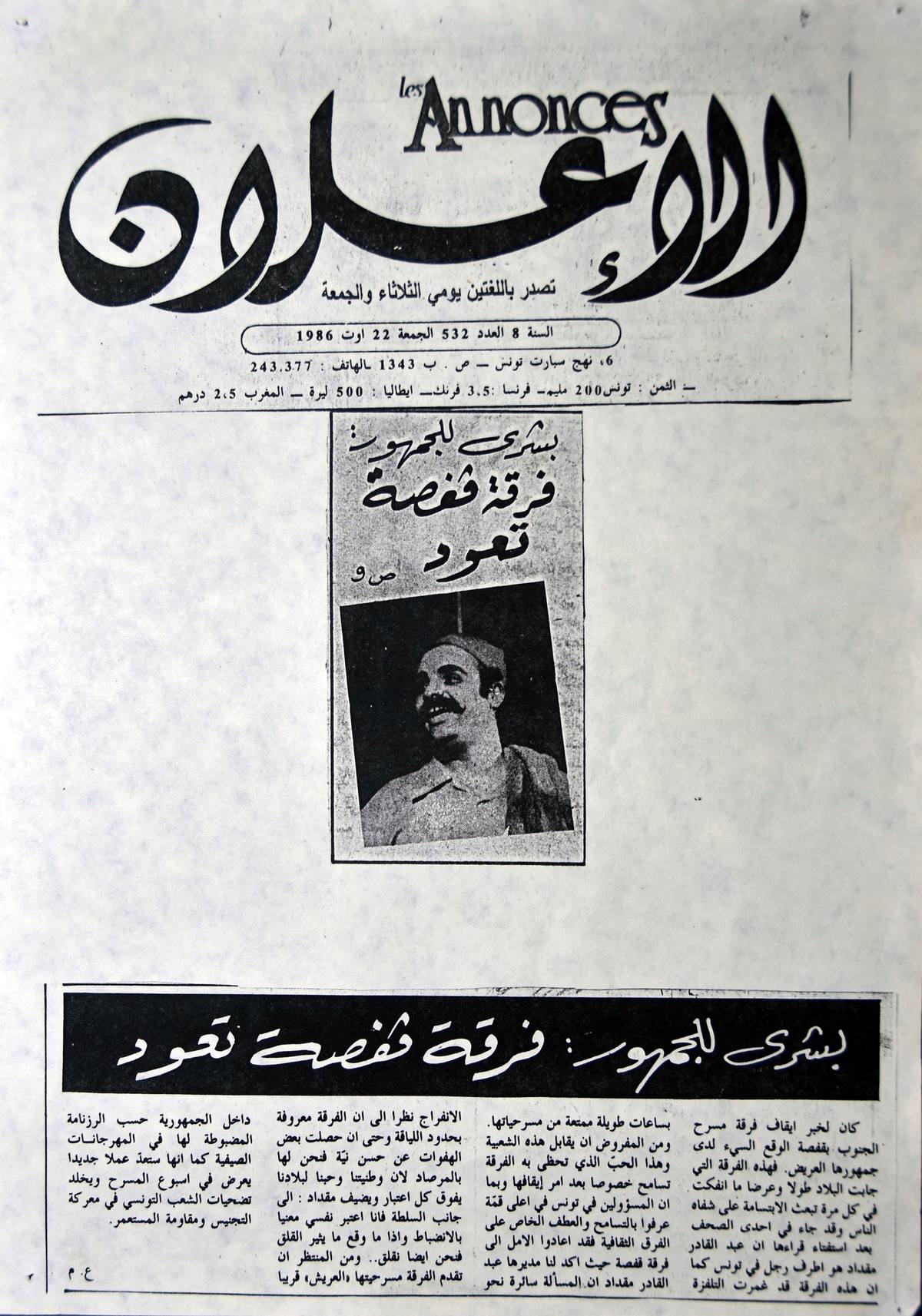
We were frozen, so what were we supposed to do? We worked on Al Jerad on the sly, on the sly.
Latifa Gafsi · on the year of the freeze · in Tunisian Arabic
The troupe resumed its activities after 7 November 1987, the day Zine El Abidine Ben Ali came to power. Hammadi Ammar says the ban was lifted through an intervention by the presidency under Bourguiba, while Latifa Gafsi links the return to the period after 7 November, when a new governor told them, “Go ahead and work for yourselves”, “and the money came back”. Mokdad told Al Bayane on 25 April 1988 that El Arich would go to “every governorate” after having “been banned”, and that “since the seventh of November there is no longer any reason to shun any government institution”. In early July 1988 the open-air theatre in Hammamet was full for the play, as Le Renouveau reported on 9 July 1988, and on 11 July 1988 Al Bayane wrote that El Arich was back “after a two-year absence” and that its “new era” version differed from the 1986 one in acting and direction, while the critic S. Boudhina, in Le Renouveau, faulted Mokdad for “having tried to come out of his shell and put on clothes that do not suit him, namely Politics with a capital ‘P’”. Hammadi Ammar recalls that Alimi attended its performance at the opening of Tunisian Theatre Week, and when journalists at the Ibn Rachiq cultural centre asked him about the text, he replied: “Don’t ask me about the text… that isn’t the text any more, you can ask the lads from the Gafsa troupe.”
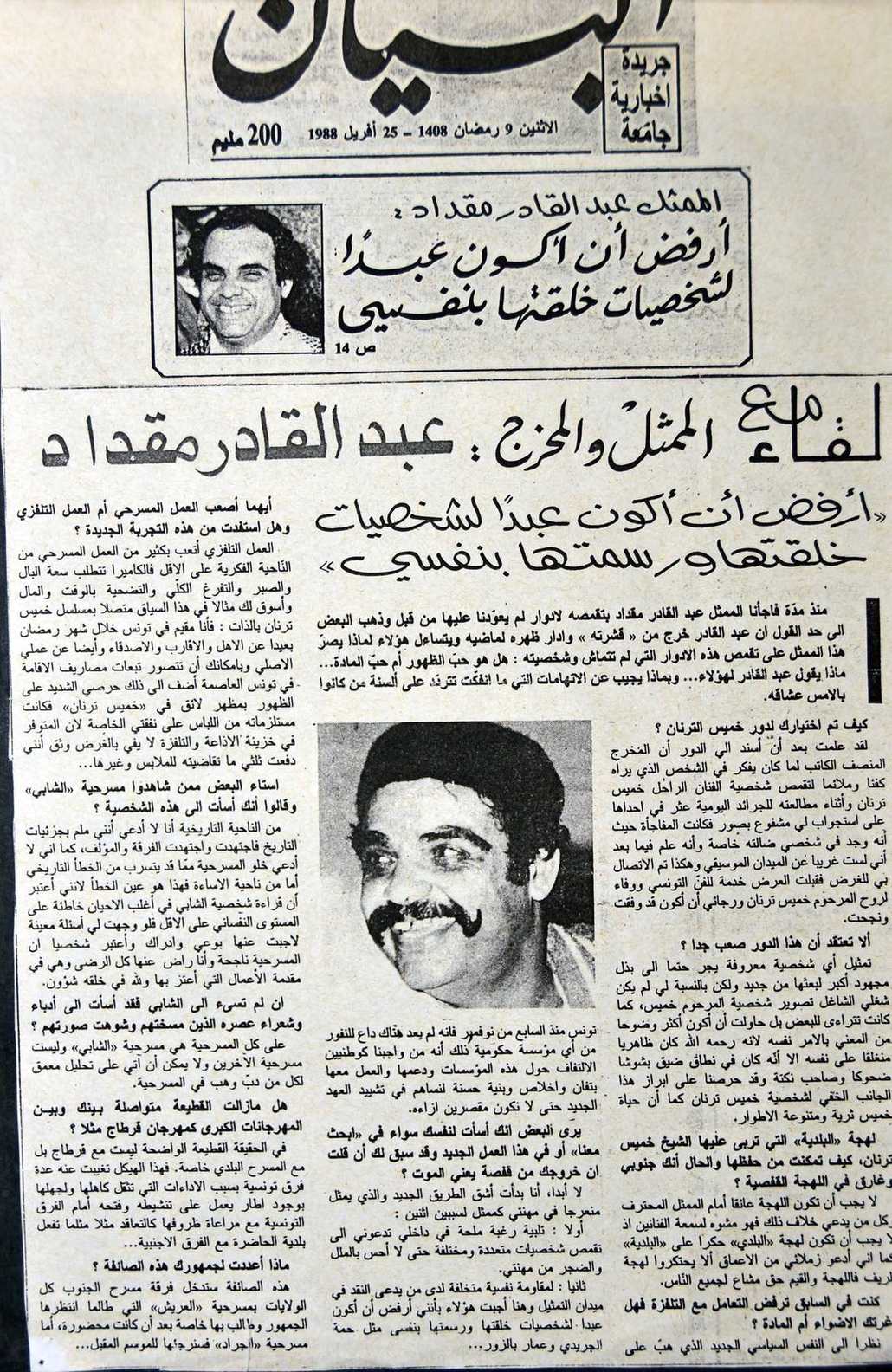
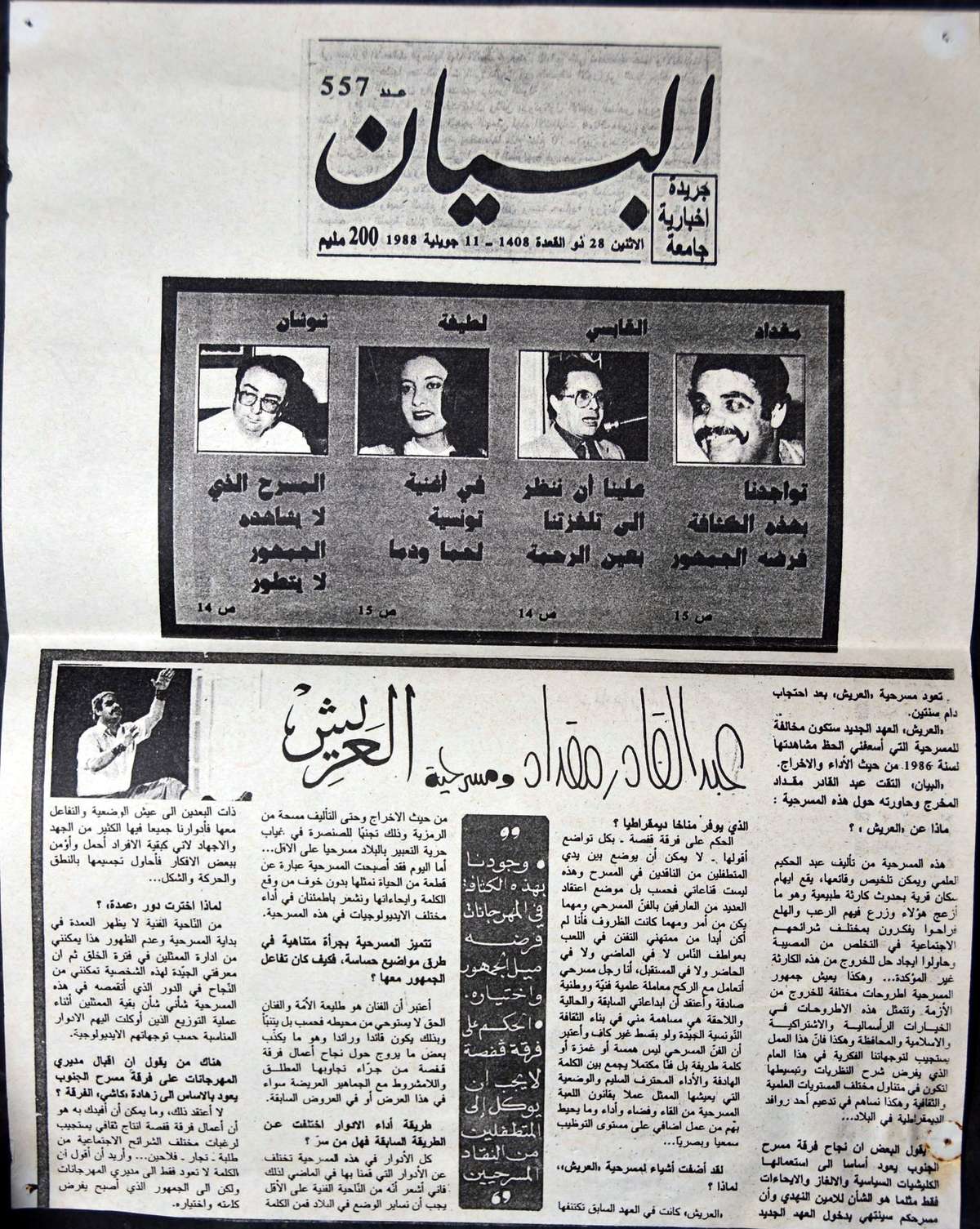
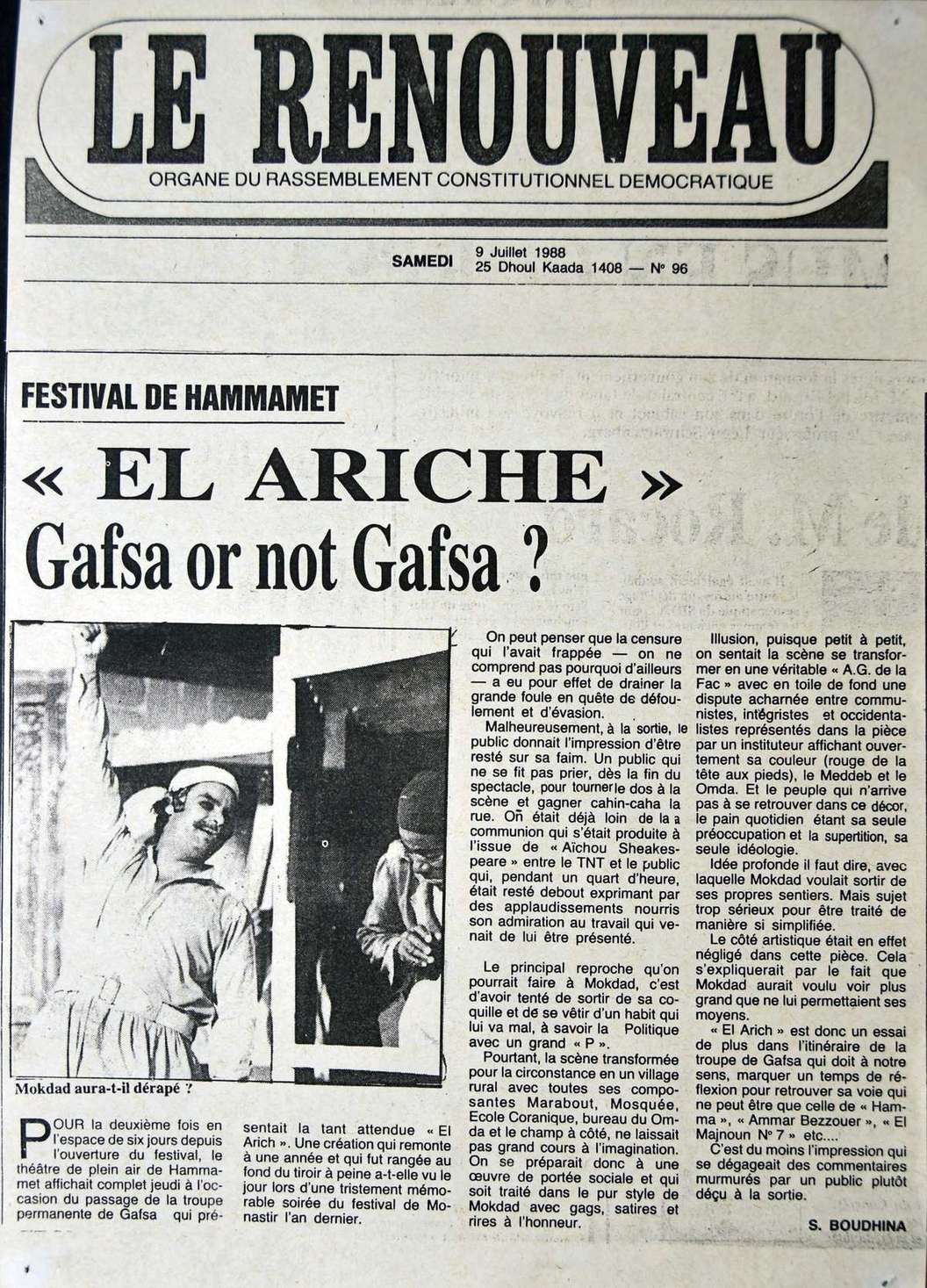
Thirty years on, Moncef Beldi reads the play symbolically: the betrothed girl is Tunisia, and competing for her hand are the meddeb with his religious thinking, the teacher with his left-wing thinking, the omda with his capitalist thinking, and others, “and then came the crisis, the explosion, that is, the revolution”. He addresses a word to the author: “Abdelhakim Alimi, I salute him on this occasion, and I say to him: thank you for foreseeing another future for Tunisia, and here we are in it.”
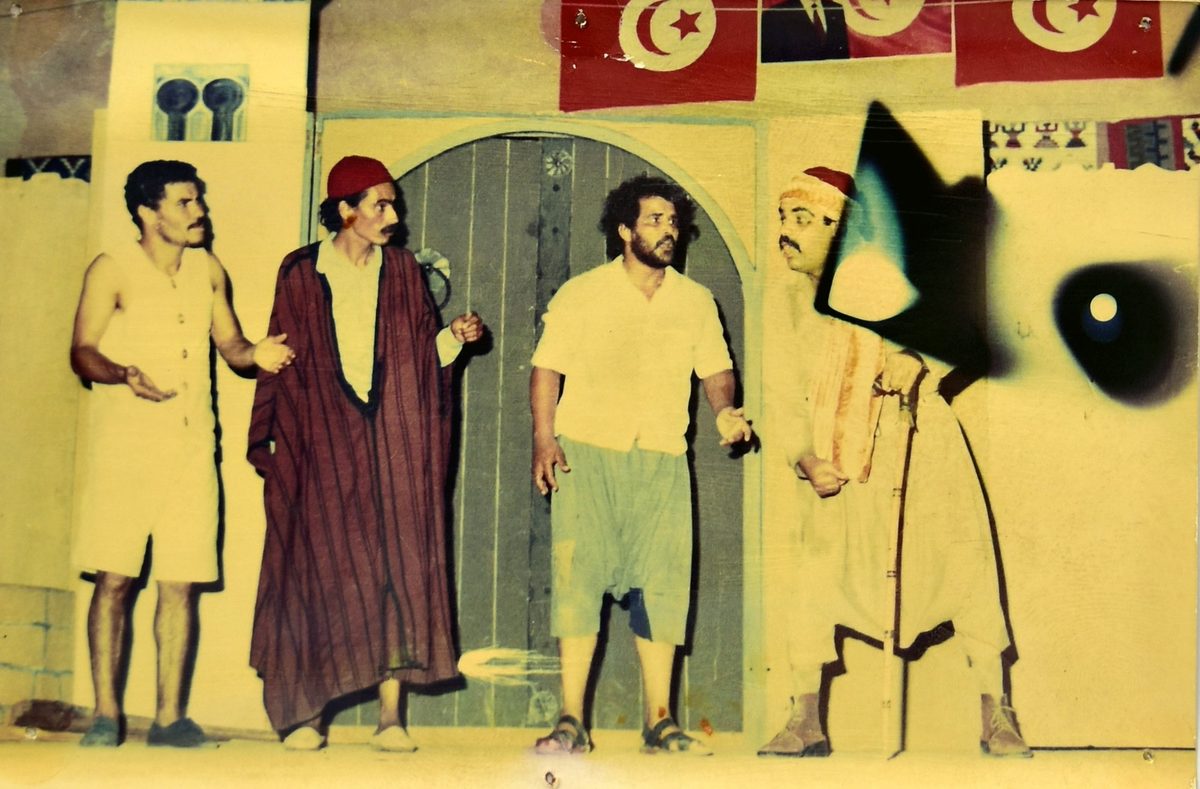
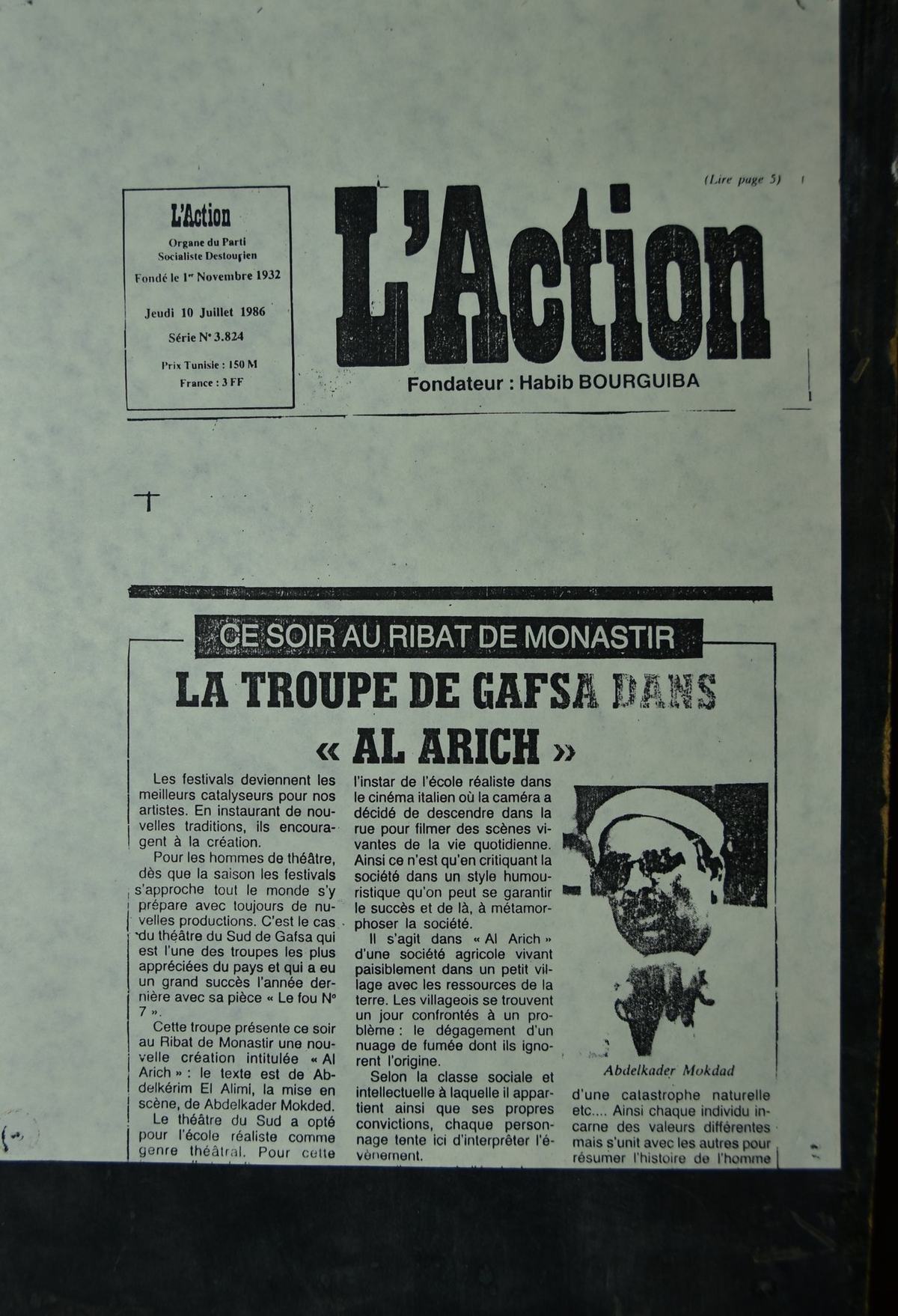
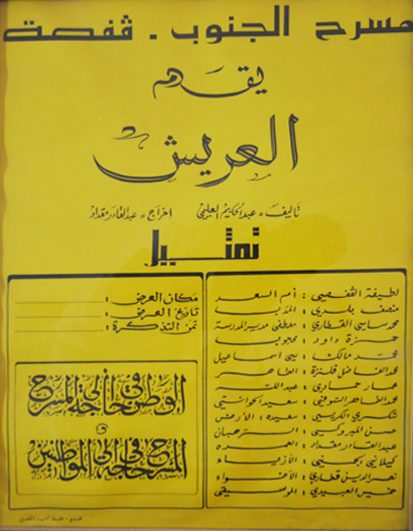
Two readings of one experience
Accounts differ on how to judge the period under Abdelkader Mokdad. For Fadhel Jaibi, the troupe “let the success of El Barni wel Atra go to its head”: it kept only “the husk” and turned into “a cloning operation” that banked on “easy laughs”. The “biggest lesson” that should have been drawn, he says, is that “you must never be the spectator’s hostage”: “Filling the house doesn’t mean people know how to act and know how to get something across.” Jalila Baccar says the troupe’s director “claimed a kind of power for himself”, whereas “the act of theatre can only be collective”, and she warns against sliding into populism:
If you go along with the audience, stroke them the right way and all that, you can slip into a kind of populism… That doesn’t mean all of Gafsa’s plays were like that.
Jalila Baccar · actress with the troupe (1973–1975) · in Tunisian Arabic
Baccar also points to “an objective fact”: the Gafsa troupe’s plays were recorded by Tunisian television, while those of the Nouveau Théâtre and the independent companies were not. “I’m not passing judgement, but I do wonder.” Against this stands Gattari’s account of the administration refusing three times to record El Majnoun n° 7, and Mokdad’s own complaint in Al Bayane (30 January 1984) about television’s “reservations”. Mohamed Ammar Chaabnia says that parting with people who “were pillars”, such as Lazhar Missaoui, Moncef Beldi and Mohamed Hlaissi, “lowered the standing” of the troupe, because they contributed to the stage writing and not just to the acting. He wishes Mokdad had sometimes let someone else direct a production, “because a single style ends up boring you”, and says that, taken up with his television work, Mokdad later “did not push himself much”.
The disagreement is nothing new: the press itself fought it out throughout the 1980s. Between “a masterpiece among the masterpieces of Tunisian theatre” in Al Akhbar (July 1985) and “El Arich on the throne” in Echourouk (July 1986), Al Anouar Ettounsia wrote of “excessive clowning” and Annahar of “the trap of comedy”; Al Amal (July 1987) hoped the troupe would not settle for “reviving old successes”, and Le Renouveau (July 1988) felt it should “pause for reflection”. In Assabah on 29 December 1989, Mohsen Zaghlami wrote that the Gafsa troupe “continues to challenge the figures of the innovative current with the popular success of its plays”, that its winning card “is the audience”, and placed it in “the conservative or traditional current”, as opposed to the Nouveau Théâtre, Théâtre Phou and El Teatro.
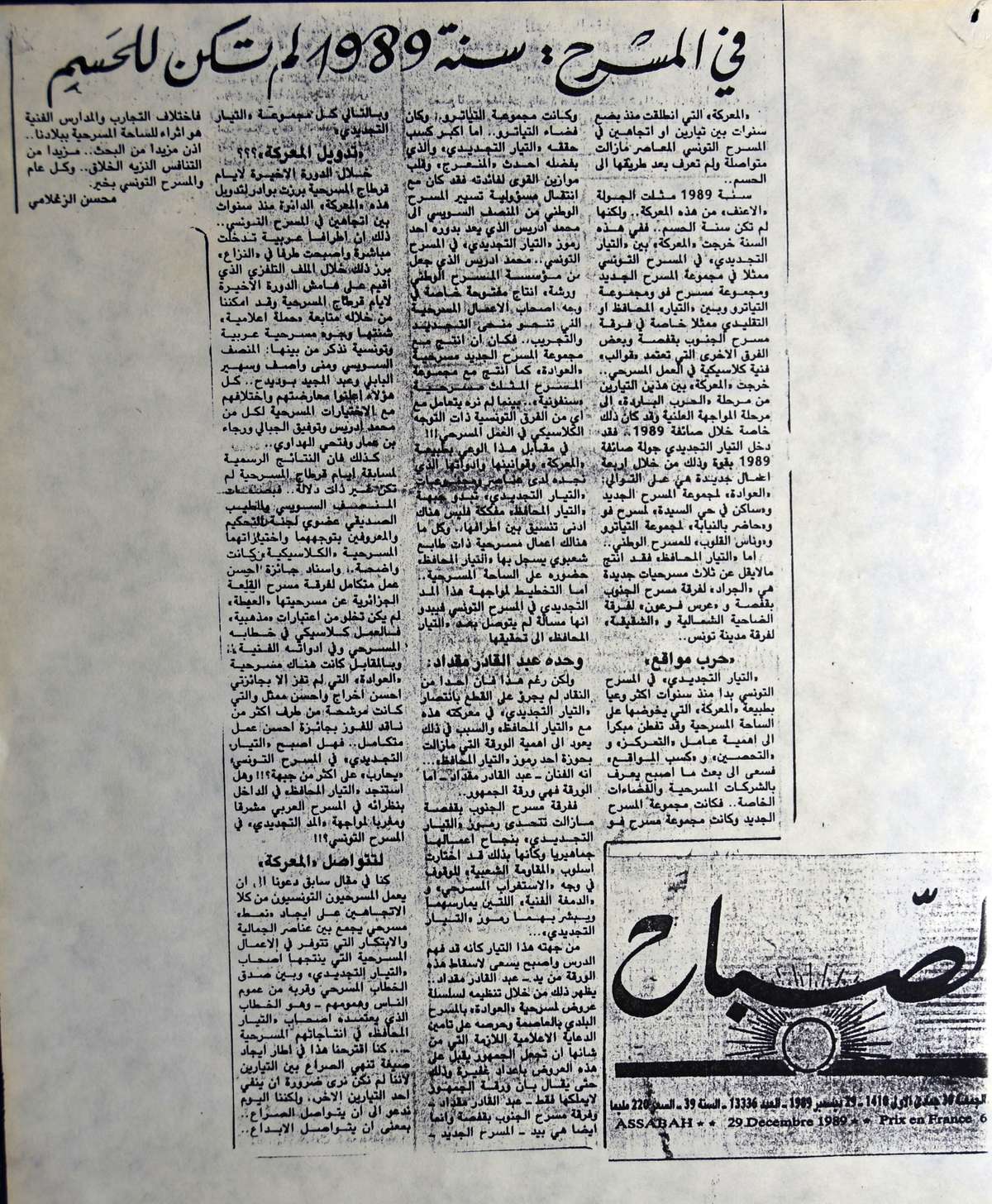
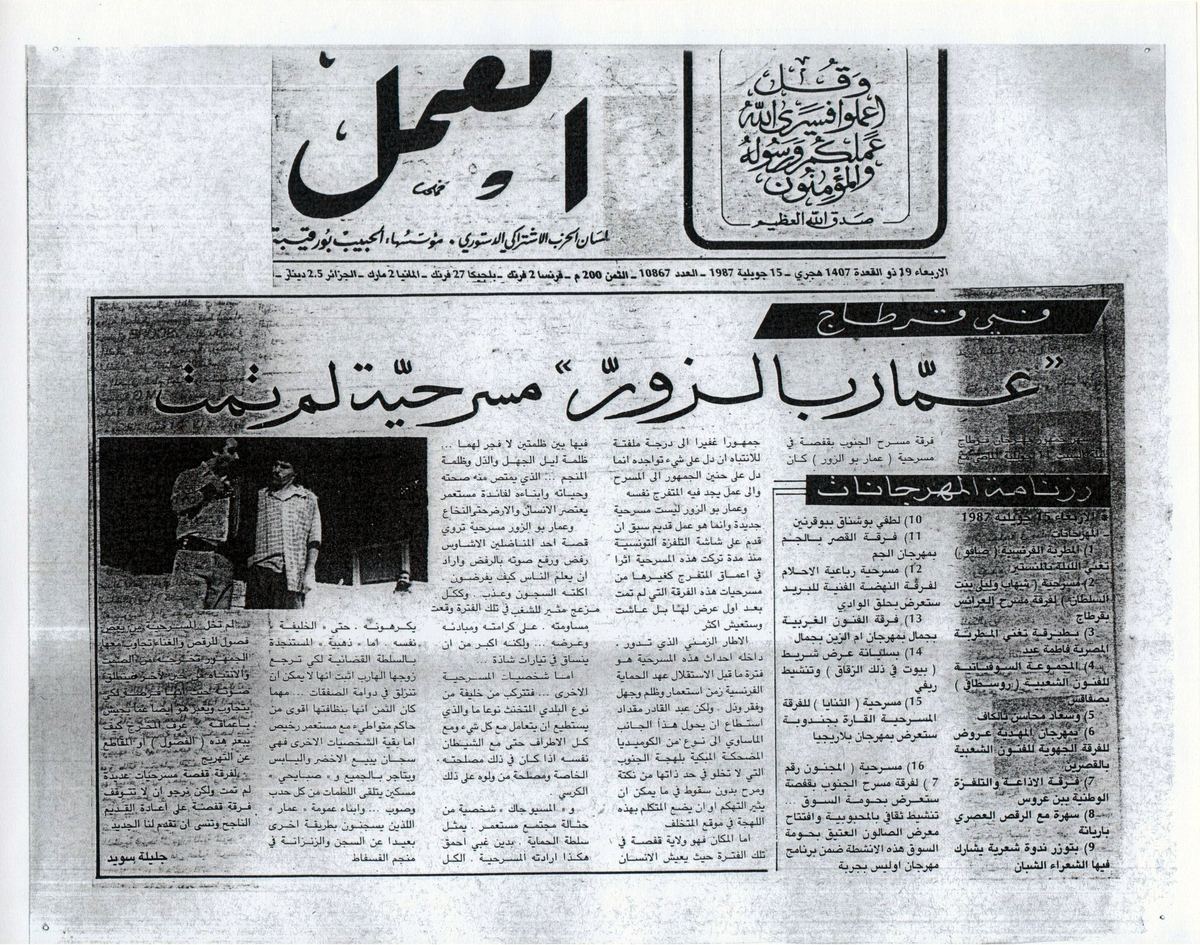
Ahmed Amer sees it differently: Mokdad “built on the success of Hamma El Jeridi and opened up even further to the region”, which led to Firan Eddamous, about the mines, and then Ammar Bouzouer. The most important thing he did, in Amer’s view, was to work with writers who “carry the concerns of the region”:
Abdelkader Mokdad gave the troupe an identity… that it belongs to the Gafsa region, and that it has to open up to the issues and concerns of the region.
Ahmed Amer (died 2016) · author of Hamma El Jeridi, Essouk and Al Jerad · in Arabic
Ahmed Amer adds that Mokdad “trained the actors” and passed his method on to them, “to the point where they too started getting into the text and adding to it”: they moved “from being a mere performer to being a creative actor”. But he also says he advised Mokdad to “develop within the form you’re in, don’t take on another one”. Latifa Gafsi speaks of a “school” built on writing workshops and training courses: “It was with Abdelkader Mokdad that I was trained.” To those who say the troupe did not evolve, she replies: “That’s not true. Maybe it evolved, it changed”; the troupe wrote “made to measure” for eight members and cobbled its costumes together, it was not a centre with a budget and a set designer. Gattari says the style “already existed in the troupe” from El Barni wel Atra onwards and that Mokdad “followed that path”, but that the troupe “developed technically” and the work remained collective: “It wasn’t one person steering the ship.” For Hammadi Ammar, the secret of its success lay in “good management” and “a good director of actors”, with no other director ever taking his place. Moncef Beldi regards Mokdad as “one of the brightest figures in this journey”, because he “carried on with determination, strength and seriousness” after the founders left; those who criticise his development forget, he says, that this was “a man who had the administration and the burden of the administration”. He had told Al Ousbou Al Moussawar (14–20 November 1986) that Mokdad was “the driving force and the captain” and that he could not imagine the troupe without him. For all his reservations about the directing, Chaabnia says:
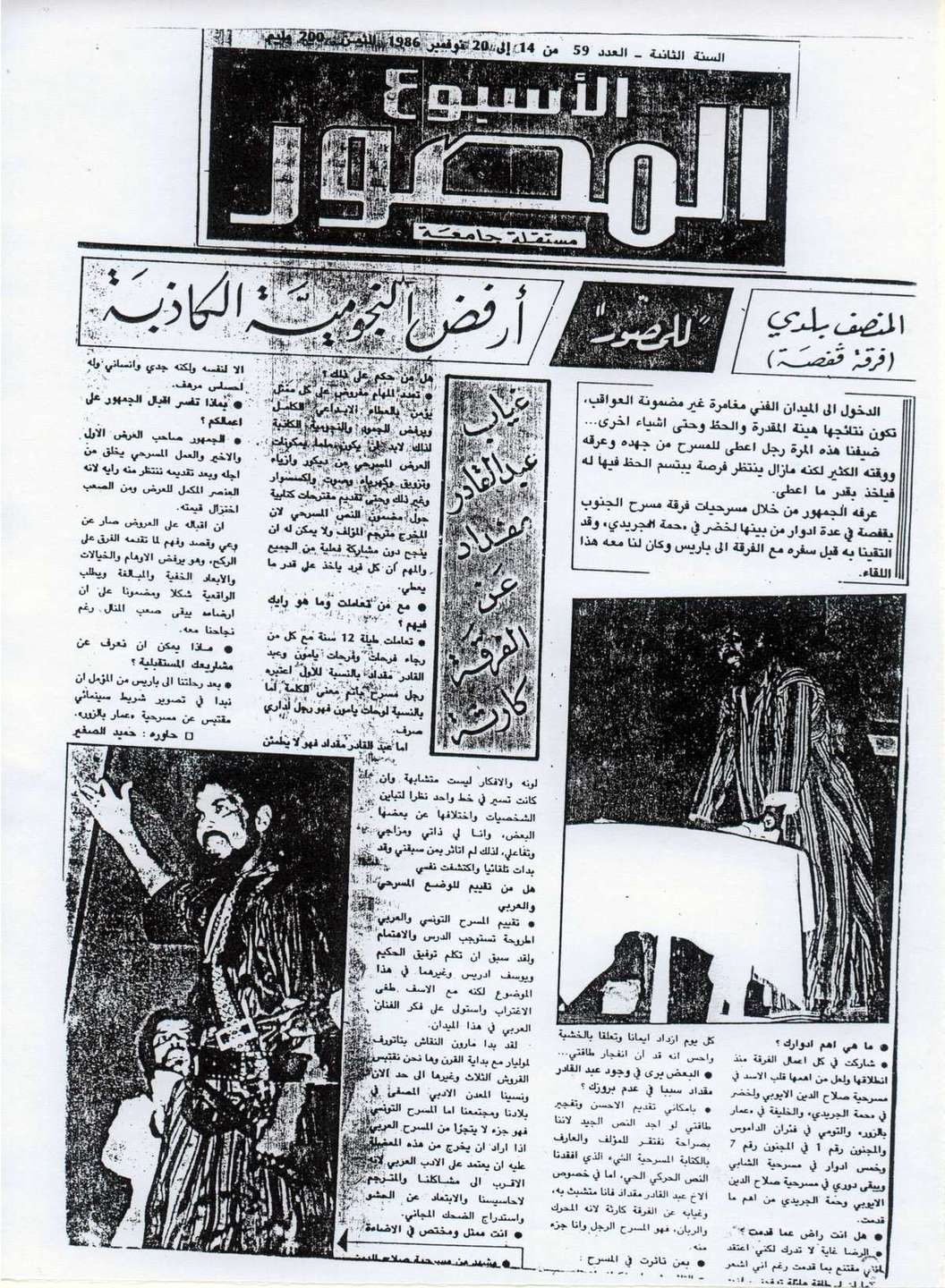
Abdelkader gave to Tunisian theatre, and he could have given more.
Mohamed Ammar Chaabnia · in Arabic
Chokri Smaoui puts the disagreement in proportion: Mokdad “was heavily influenced” by the El Barni wel Atra model and followed its pattern, with “departures” such as Saheb El Kalam, Chebbi and Salah Eddine; “the verdict of artistic criticism is one thing, but in terms of audiences, nobody can doubt the success”. Mokdad defended his choices in numerous press interviews. “There is no secret, only genuine passion and serious study,” he told Al Bayane on 30 January 1984, and he told Al I’lane on 25 July 1986:
“We address the audience and regard it as aware and mature.”
Abdelkader Mokdad, Al I’lane, 25 July 1986To Al Bayane, on 11 July 1988: “Judging the Gafsa troupe should not be left to interlopers among the critics.” Then to Al I’lane, 21–27 July 1989: “The audience has changed and can no longer be taken for fools”, and “I have not closed the door to creative talent”. To La Presse Magazine, in an undated interview probably published around the summer of 1988, since it mentions forty performances of El Arich “this summer”, he said: “Realism is my method”; the troupe’s actors had been “trained on the job”, and he described himself as “very disciplined, a little harsh, not much inclined to joking”. Lazhar Missaoui, who left the troupe after Hamma El Jeridi, sees Mokdad as “an excellent actor” who shines when someone else directs him, “as happened in El Barni wel Atra”.
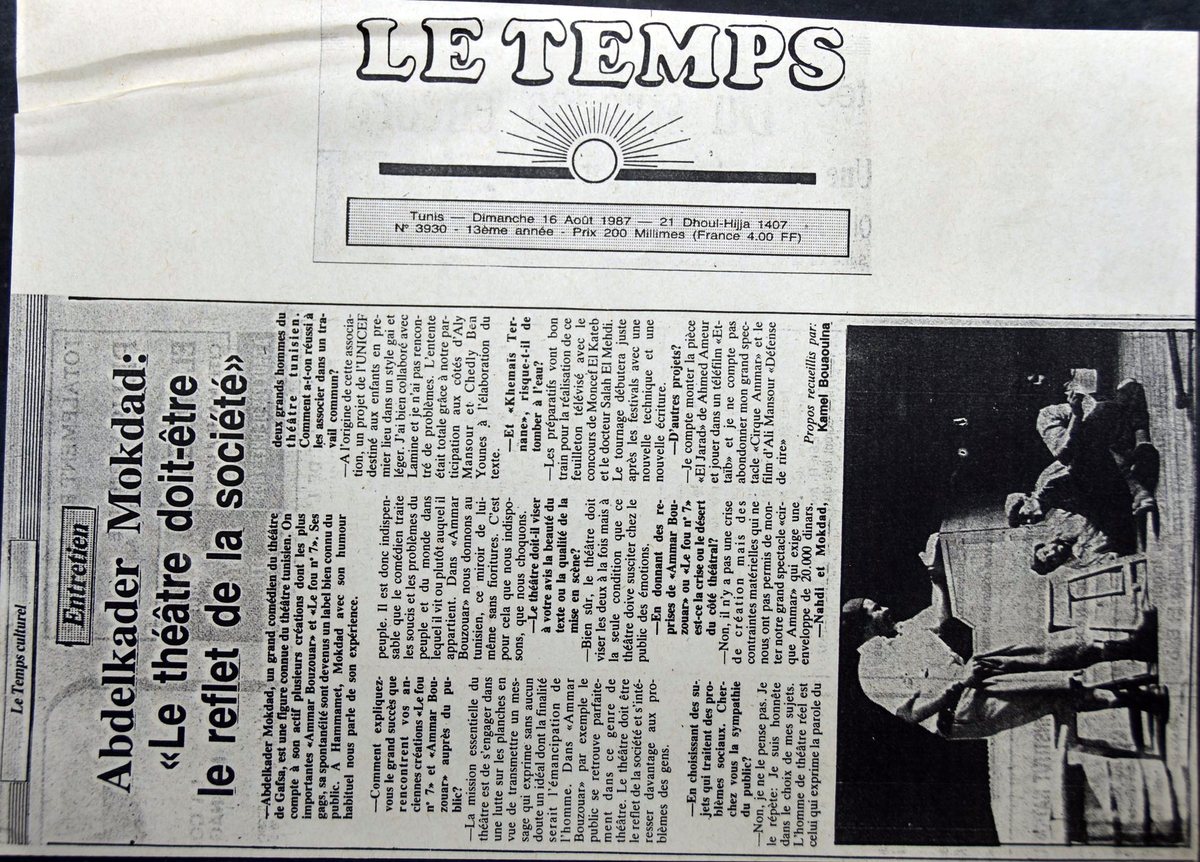
Mokdad in his own words to the press (1976–1992)
- 9 April 1976, Echaab: “We laugh, in our theatre and in our everyday lives.”
- 10 January 1977, Dialogue: “We make realist theatre.”
- 30 January 1984, Al Bayane: “The censor’s scissors are necessary in some cases and unjust in others.”
- March 1985, Al Qal’a: “Priority always goes to the content of the message, not its form.”
- 25 July 1986, Al I’lane: “We address the audience and regard it as aware and mature.”
- 16 August 1987, Le Temps: “In ‘Ammar Bouzouar’ we give the Tunisian this mirror of himself, without frills.”
- 25 April 1988, Al Bayane: “I refuse to be a slave to characters I created and drew myself, such as Hamma El Jeridi and Ammar Bouzouer.”
- 21–27 July 1989, Al I’lane: “For us, Al Jerad marks a new turning point in the life of the troupe.”
- 30 August – 5 September 1992, Al Anouar Ettounsia: “For the record, we were the first to use these amplifiers in Tunisian theatre.”
1989–1992From troupe to centre
On 2 July 1989, Ahmed Amer’s Al Jerad premiered at the opening of the 18th Monastir International Festival, at the Ribat of Harthema, before playing El Jem the next day, according to Essahafa on the opening day, and Dougga on 5 July, according to the schedule of opening nights published in Al I’lane (23–29 June 1989). It went on to open the festivals of Ben Arous, Ezzahra and Sidi Bouzid and was due to close those of El Metouia, Gabès and Nabeul, according to an undated clipping from the summer of 1989, from a magazine whose name does not appear, headlined “Al Jerad invades every festival”. On the morning of the opening (2 July 1989), La Presse had written that the play did not reconstruct the locust invasion Tunisia had suffered the previous year, but portrayed the farmers of the Jerid during the date harvest, and that Mokdad was promising a show “with no gratuitous gags”, choreographed by Julie Krivohlava. Mokdad told Al I’lane (21–27 July 1989) that the play marked “a new turning point in the life of the troupe”: physical preparation, then rhythmic dance, then a reading of Ahmed Amer’s text and analysis of the characters, and finally set, costumes and lighting.
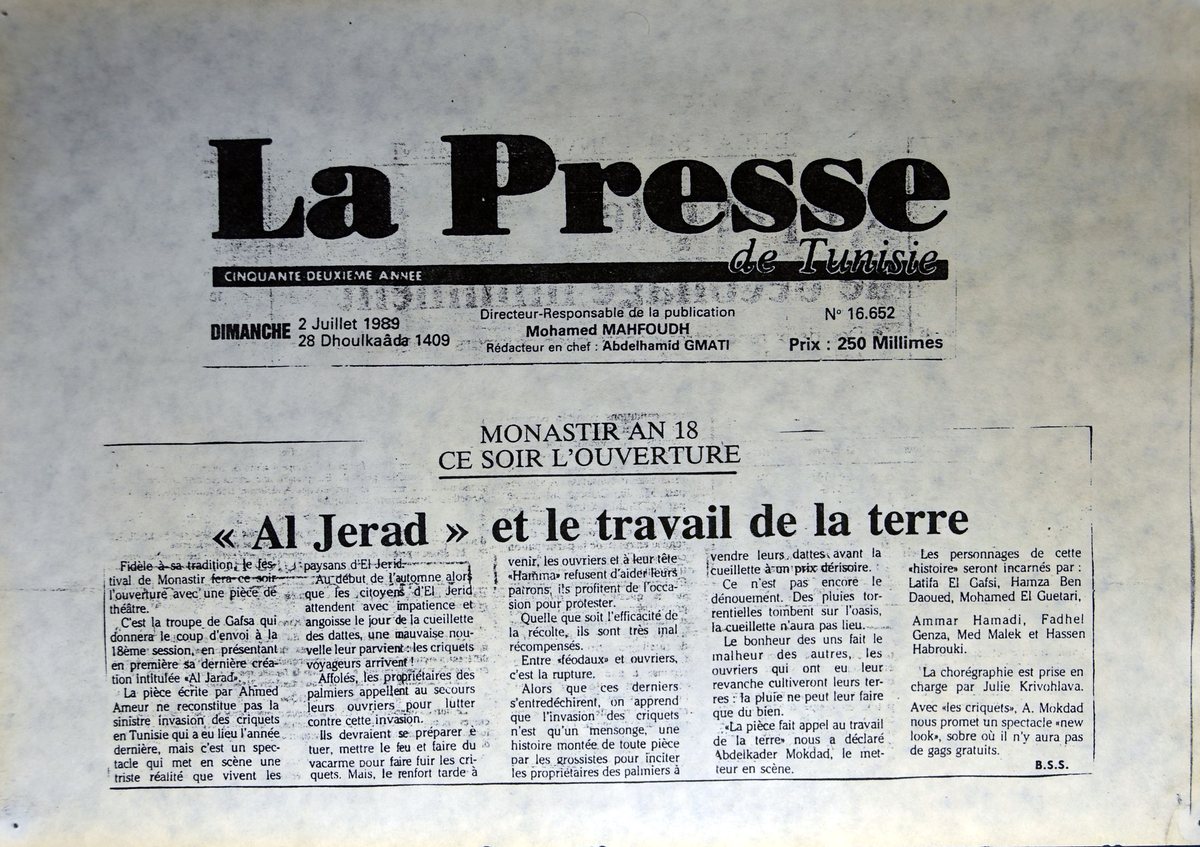
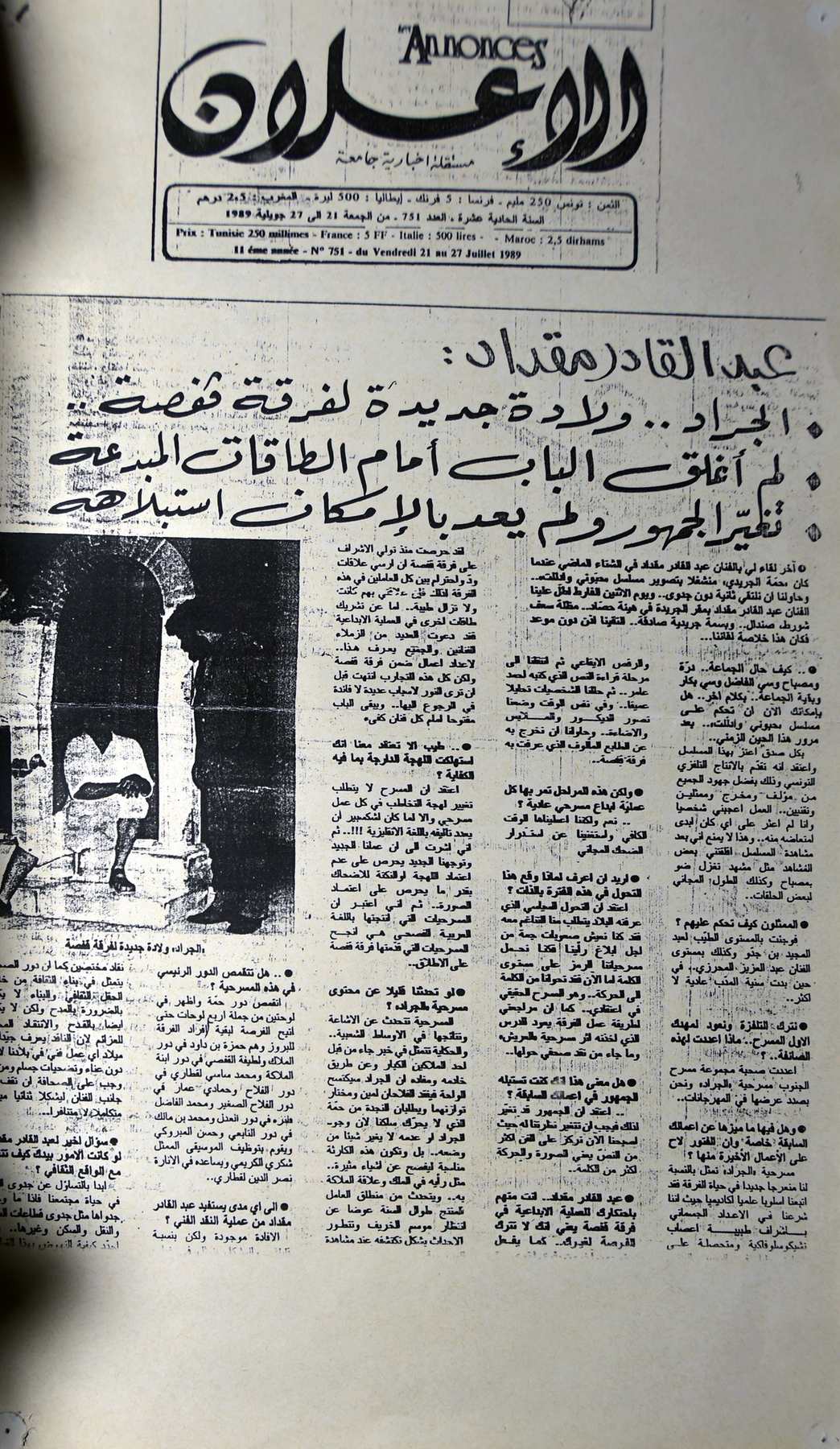
The play is the second part of the Hamma El Jeridi trilogy, after El Boustane, with the third part to be El Ma (“Water”). As summarised by Assabah on 5 July 1989 and again on 9 July, it turns on a rumour spread by a big landowner that locusts are about to sweep over the oasis. The farmers sell their dates and their land “for a pittance”; only Hamma does not believe it. Then the rain comes and spoils the dates obtained by trickery. According to the cast list Mokdad gave Al I’lane (21–27 July 1989), he himself played Hamma in two of the four tableaux; Hamza Ben Daoud played the landowner, Latifa Gafsi Zohra bent Baka, the woman landowner, Gattari the farmer, Hammadi Ammar the young farmer, Fadhel Glenza the notary and Mohamed Malek the henchman, alongside Hassen Mabrouki; the music was by Chokri Krimi and the lighting by Nasreddine Lagtari. In Assabah (5 July), Mohsen Zaghlami saw it as “the play of return and reconciliation: the return of Hamma, and the troupe’s reconciliation with its broad audience”, after “the El Arich experiment, which had changed the face of the troupe to some extent”; the same paper reported on 9 July that the Monastir audience “refused to leave the open-air theatre despite the rain”. Hammadi Ammar recalls one spectator who followed its performances in La Manouba, Hammam-Lif, Carthage and Ben Arous until he knew the text by heart; he himself improvised in it with Gattari every night, because “it’s not the same play he saw yesterday”.
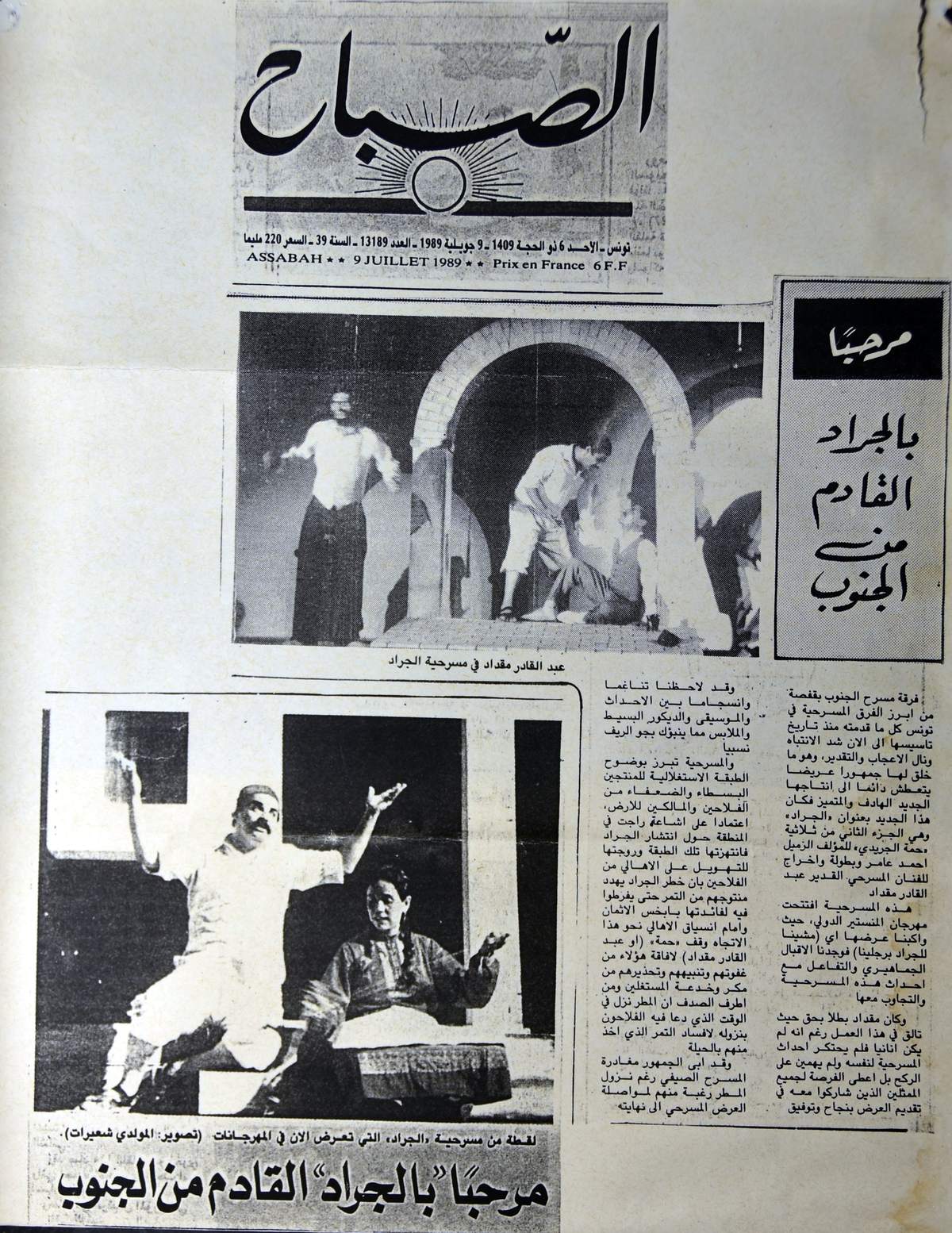
In December 1989, Al Jerad was programmed at the Olive Festival in Kalâa Kebira, as announced by Assabah on 17 November 1989, and then at the Professional Theatre Days in Jendouba on 25 March 1990, according to the programme published by Echourouk on 14 March 1990. Around 1990, according to Gattari, he himself directed Ali Baba for children, a text Abderrahmane El Abnoudi had written for the troupe in 1974 and which had sat in a drawer for sixteen years; he designed its set and “wrote more than El Abnoudi had written”. Hammadi Ammar dates it to 1991, under the title Ali Baba and the Forty Thieves. Smaoui sees Al Jerad as “the last of the line” and describes the years 1988 to 1992 as a “transitional period”: since the creation of the National Theatre in 1983, there had been plans to turn the permanent troupes into centres for dramatic arts. According to Hammadi Ammar, the “new system” arrived in 1991 “with the dissolution of the regional troupe and the creation of centres for dramatic arts”, and the troupe became the centre’s “theatre production unit”.
The troupe then became the “Centre d’art théâtral de Gafsa”. The poster for Jweb Msouguer, Lotfi Ammari’s 1992 play, bears the new name: “Centre d’art théâtral de Gafsa — the Théâtre du Sud presents”. In an interview conducted in Degache by its correspondent Mabrouk Sellami, Mokdad told Al Anouar Ettounsia (30 August – 5 September 1992) that the play’s first title was Ziyara fujaiya (“Surprise Visit”) and that it tells the story of a penniless traveller who puts up at a village hotel; the officials take him for a government envoy sent to inspect their affairs, and he joins them in a “game of illusion”, uncovering “a great many secrets” until he drives the regional official mad. According to Smaoui, it is adapted from a play from the world repertoire that he does not name, and it “represents the move from a permanent troupe to a centre for dramatic and scenic arts”, as though Mokdad had “foreseen” the change. It was performed more than fifty times in its first summer, according to Al Anouar Ettounsia (4–10 October 1992), at more than forty festivals, according to Mir’at Al Wasat, including Monastir, El Borj in Gafsa and Sidi Bouzid. Echourouk wrote on 30 September 1992 that the national radio and television broadcaster had recorded it, in a television version directed by Salem Ben Amor, and Al Anouar Ettounsia, a few days later, thought it likely to be the first production shown in its new programme “Play of the Month”.
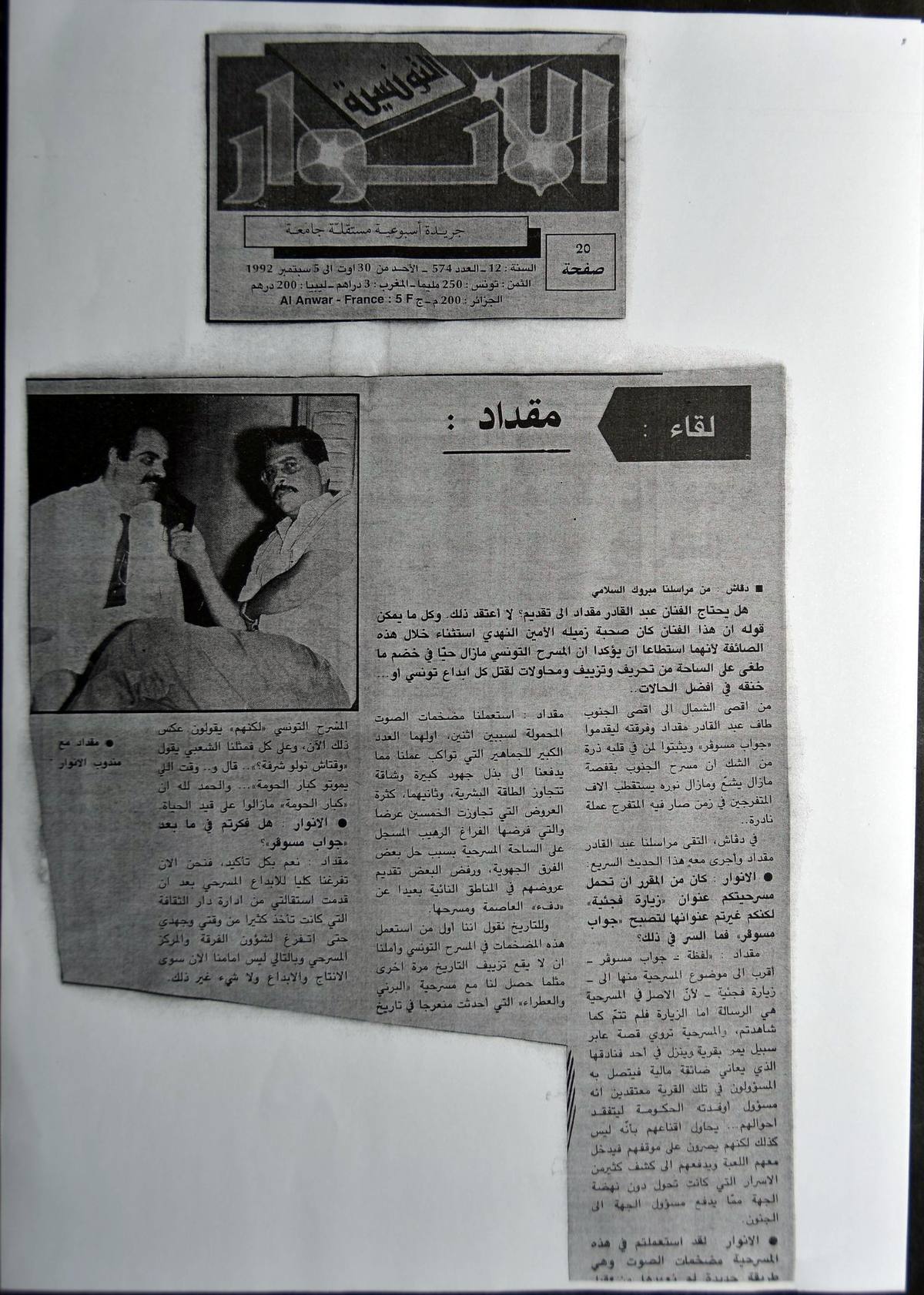
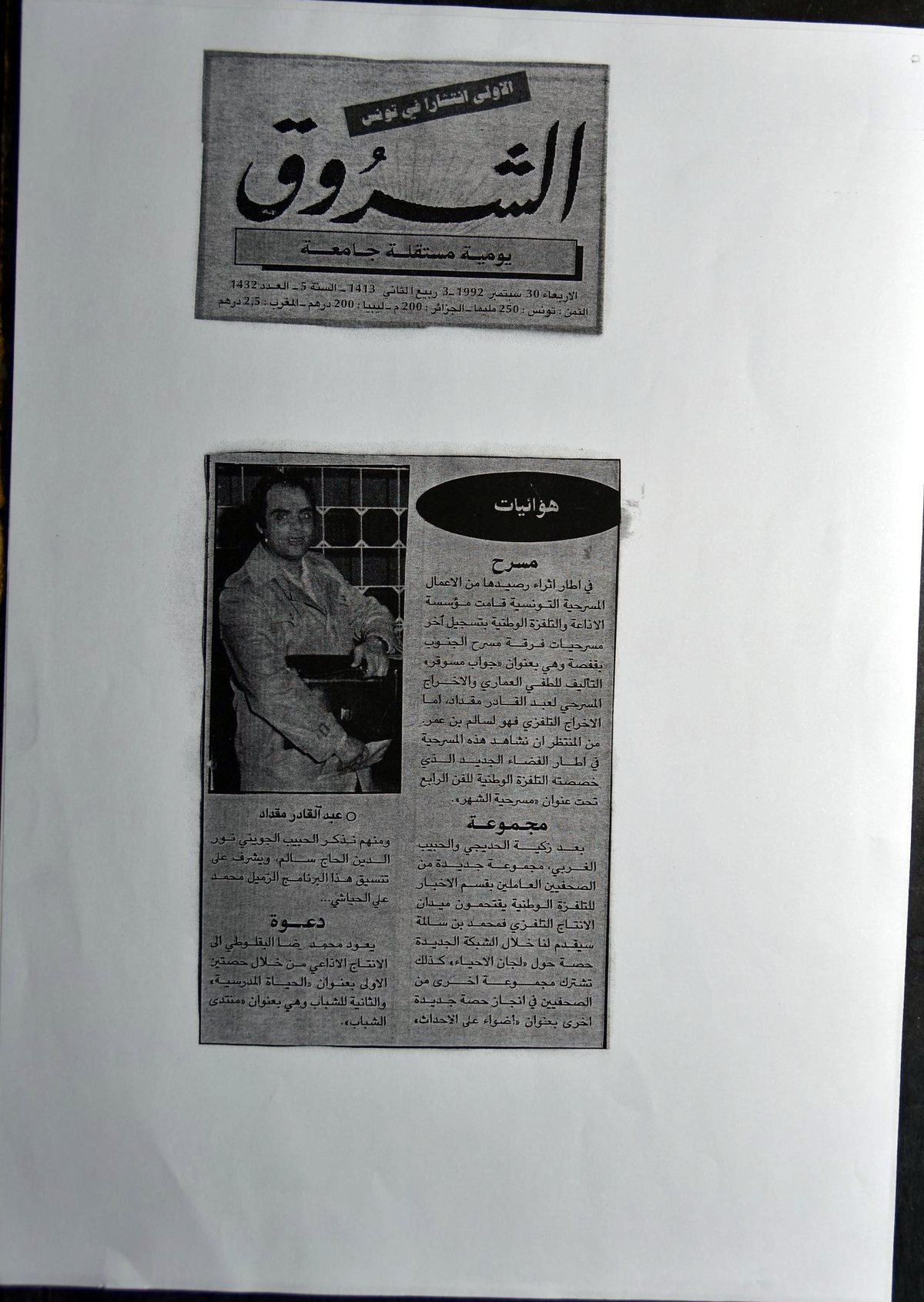
In the same interview, Mokdad said he had resigned as director of the house of culture to devote himself “entirely to theatrical creation”, and that the troupe had been the first in Tunisia to use portable sound amplifiers on stage, because of the size of its audiences and the number of its performances. Mir’at Al Wasat, in an interview with Mokdad in 1992 (the date is rubbed out on the clipping), described Jweb Msouguer as “the first work of the Centre d’art théâtral de Gafsa, which was created this year”, and quoted him: “We make sure there is no individual hero, so that collective heroism can take its place.” Hammadi Ammar says it was his last work “within the old Théâtre du Sud troupe” and that he left in 1994; Gattari says the troupe’s account stayed in the name of the “Théâtre du Sud de Gafsa” for years after the change. In Al Hurriya on 8 September 1992, Mohamed Frigui wrote that the ministry’s theatre department was seeing “serious momentum”, with the creation of “regional centres” and the adoption of “purchases” of finished works in place of advance subsidies.
The 1992 name was a provisional one. In 1993 the Gafsa Centre for Dramatic and Scenic Arts was officially created, according to the Ministry of Cultural Affairs list as published in the press in 2023, together with the Le Kef centre, as part of the restructuring of the theatre sector and the dissolution of the regional troupes in the early 1990s. We did not find the founding text itself. As for an actor’s pay in those years, two witnesses mention it: 2,500 millimes per performance according to Hammadi Ammar (1982–1984) and Moncef Beldi, who says the theatre workers’ union raised it for a time to 25 dinars before it went back to its former level. Hammadi Ammar insists that nobody in the troupe was ever left “without pocket money” in the seventeen years he spent there, except in the year of the freeze recalled by Latifa Gafsi.
The economics of a regional troupe, in sourced figures
- 1972: a start-up budget of about 2,000 dinars from emergency funds (Bousma), and a cheque for two thousand dinars from the Company after a visit by the minister Chedly Ayari (Farhat).
- 1973: a presidential grant of five thousand dinars (Bousma), used to buy a Land Rover (Farhat).
- 1975: a contract for a beginner actress at twenty dinars a month and five hundred millimes per performance (Latifa Gafsi).
- 1980: “the equivalent of 120 performances” since the troupe’s founding (Al Bayane, 4 August 1980).
- 1985: 48 performances at summer festivals, of which “those that were funded did not exceed twenty” (Mokdad, Assabah, 23 March 1985).
- 1987–1988: “about a hundred performances a year”, “a thousand dinars per performance, transport and food (500 dinars) included”, and “our troupe is not rolling in money” (Mokdad, La Presse Magazine, undated, around summer 1988); the “Cirque Ammar” project needs 20,000 dinars (Le Temps, 16 August 1987).
- 1980s: 40 to 45 performances every summer, and “financial independence” (Chokri Smaoui).
- 1992: more than 50 performances of Jweb Msouguer in a single summer (Al Anouar Ettounsia, 4–10 October 1992).
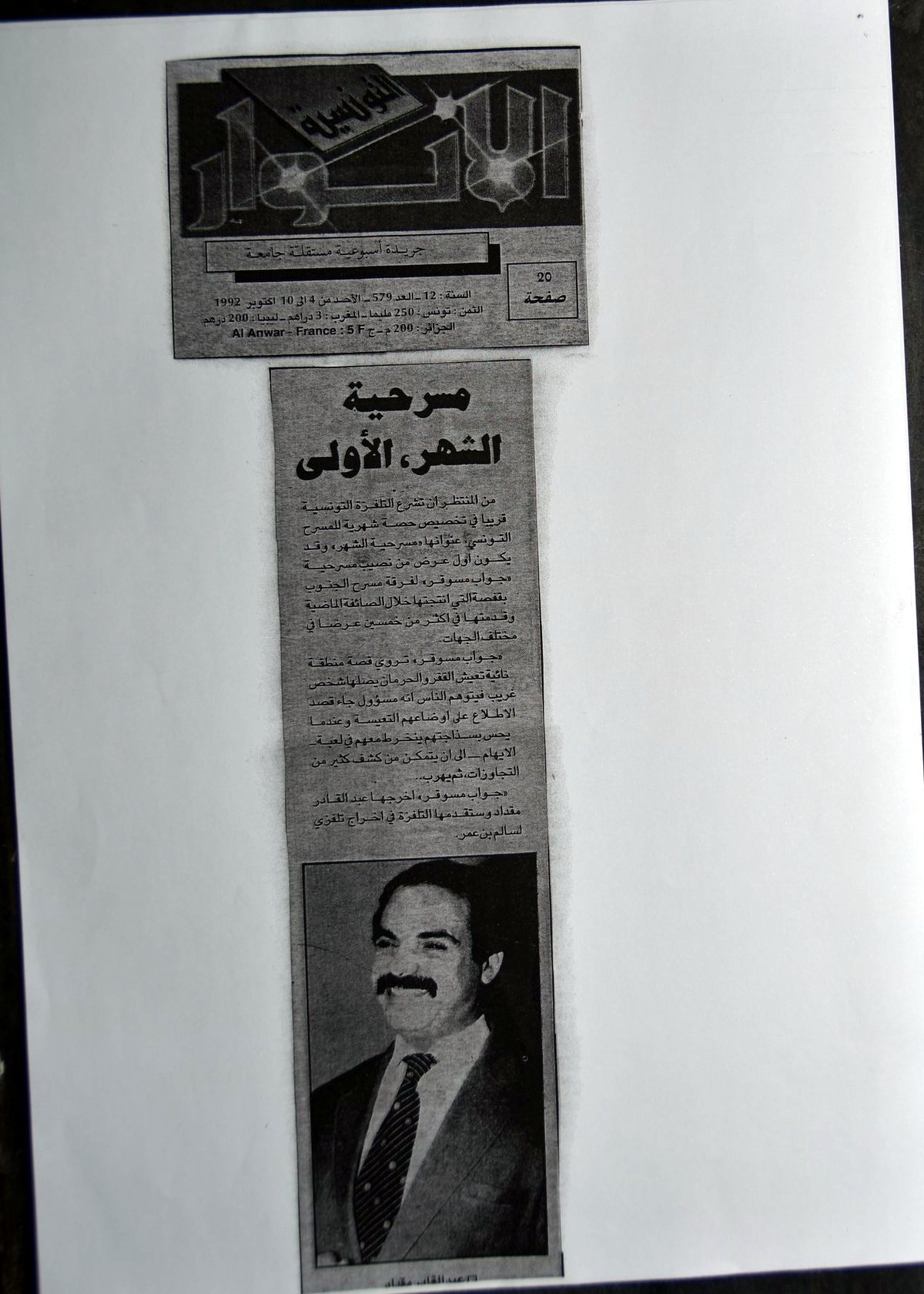
The only troupe that achieved… its financial independence… summer shows at the festivals, no fewer than 40–45 shows.
Chokri Smaoui · in Tunisian Arabic
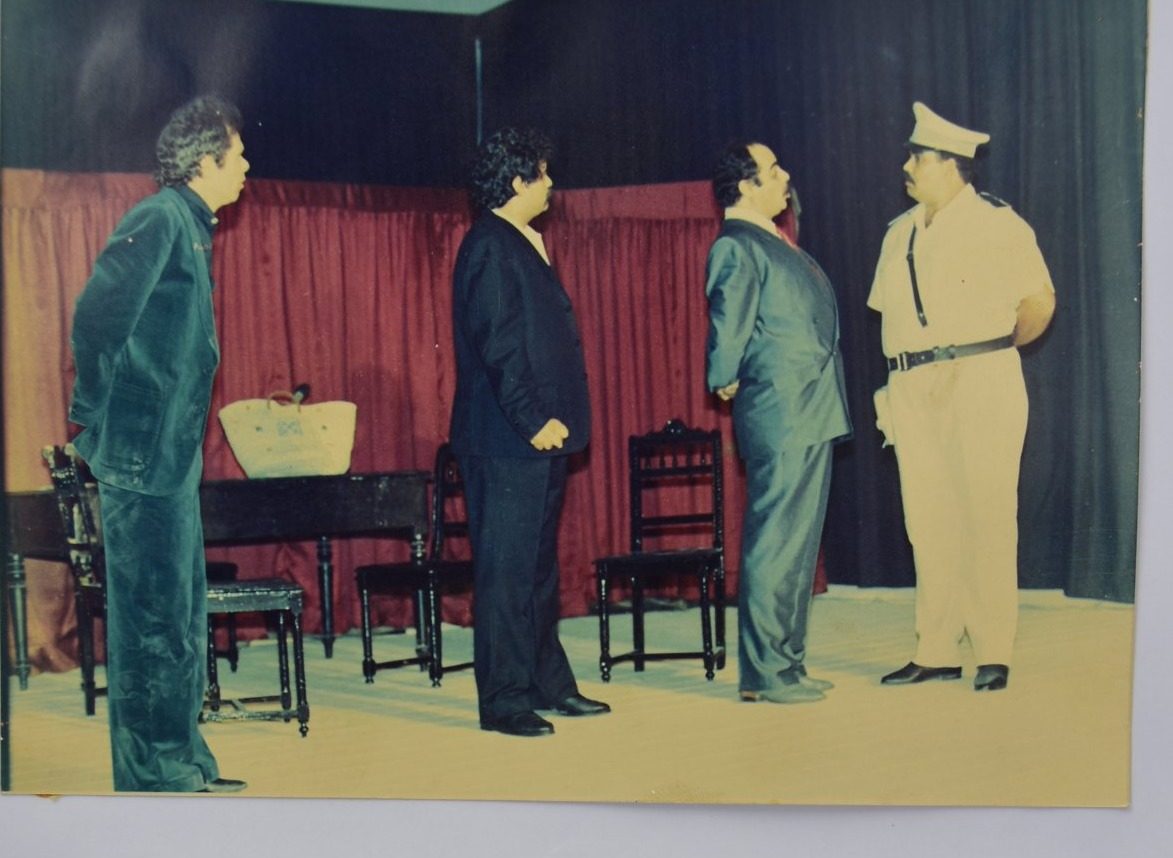
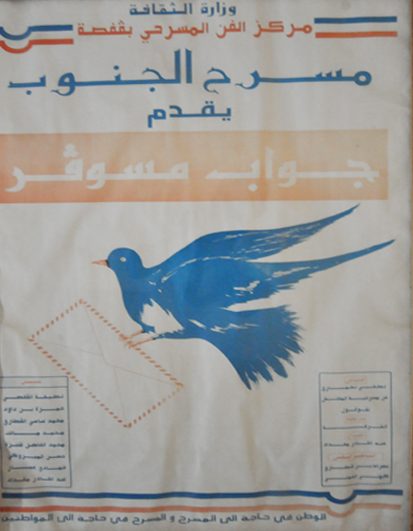
The centre today
The Gafsa Centre for Dramatic and Scenic Arts is still in existence. An institution under the Ministry of Cultural Affairs, it is one of 25 regional centres created between 1993 and 2021. Abdelkader Mokdad ran it until his retirement. It produces plays and organises the “Gafsa Live Performance Festival”, which honoured Fadhel Jaibi in 2016 and Latifa Gafsi in 2017. The centre’s productions mentioned by Ahmed Amer and Latifa Gafsi include Klab fouk essoutouh (“Dogs on the Roofs”), Alloulou El Hajjam (“Alloulou the Barber”) and Ors Haroun (“Haroun’s Wedding”) by Abdelhakim Alimi, Oued Errabii and Ouhibbouka ya chaab (“I Love You, O People”) by Mohamed Ammar Chaabnia, and later Abdeljabbar hall el ktab (“Abdeljabbar Opened the Book”) by Ahmed Amer. According to its author, the last of these was programmed at the Carthage Theatre Days at the request of the culture minister of the day, despite his own reservations, and was “the play that drew the biggest crowds”.
Yet these centres operate, as the directors of several of them said in statements to the press in 2023, without a statute defining their remit, and with budgets paid out as grants. Latifa Gafsi said in a press interview in 2017 that the core of the troupe “stayed on at the centre” without permanent posts. In her testimony she compares the two eras: “The centre is a state body with big funding, it’s not like a troupe”; it brings in a costume designer, a set designer and a choreographer, and it has taken in amateurs and actors from outside Gafsa, whereas the troupe patched its costumes together from the leftovers of earlier productions. Ahmed Amer says “we can’t compare” the centre with the Théâtre du Sud troupe, which was “more productive and more distinctive”, because “the rhythms have changed”, and he hopes “a new, youthful spirit will come in and develop theatrical discourse”. Hammadi Ammar has a message for those running it today: “Look after that institution, it’s an asset for the region.”
Several careers grew out of the troupe. Jaibi, Jaziri, Baccar, Ben Amor and Driss went on to the Nouveau Théâtre and then to the National Theatre; Latifa Gafsi to television from 1987, with training courses in Germany and Italy, she says; Gattari to directing; Hammadi Ammar stayed on stage until 1994, then turned to television and film after his own theatre venture faltered in 1997; Moncef Beldi to television directing and songwriting, a path that, according to Ahmed Amer, “it was his training within the troupe that allowed him to pursue”; and Mokdad ran the centre and directed further productions for it until he retired. Gattari notes that many graduation dissertations by students of the Centre for Dramatic Art in Tunis were written on the Gafsa troupe’s “popular theatrical form”.
What is left for Gafsa?
Lazhar Missaoui, who was seventy when his testimony was recorded in 2016, says people still recognise him forty years on: “Someone who’s forty tells the other one: look, that’s the one who used to act… The good thing, the thing that lasts, is what stays in people’s memory.” Gattari says the troupe “created a theatre audience” and “drew people into the theatres”, that its plays were “in demand from the public like no others”, whereas today “often the only person in the auditorium is the auditorium’s caretaker”. Chokri Smaoui, an intellectual and theatre activist from Gafsa, describes what the troupe meant to the people of the region:
It’s the mirror, the Théâtre du Sud troupe of Gafsa, the mirror of this city and this governorate.
Chokri Smaoui (died 2021) · intellectual and theatre activist from Gafsa · in Arabic
Smaoui adds that people from Gafsa were proud “to go to Sousse in the summer, or to Tunis, Carthage, La Goulette, and find the Gafsa troupe there”, that its plays “remain etched in the Tunisian spectator’s memory” and are known to “all the generations that have come one after another”: it was “one of the finest periods for the city of Gafsa”. For Ahmed Amer, Gafsa is “a city rooted in theatre”, which had troupes before the Théâtre du Sud, and theatre people from the capital are glad to perform there because its audience is “sharp, serious in its debates, and does not flatter”. But he rejects the “ya hasra”, the lament for the good old days: “Things have to move on, we mustn’t stay stuck in the same rut.”
Gafsa, thanks to the Southern troupe, the whole world knows it now.
Tahar Bousma · in Tunisian Arabic
Fadhel Jaibi answers the question by acknowledging a debt: “I’m speaking in their name, in the name of the sleepless nights we spent staying up, squabbling and arguing for a better theatre… That’s why I owe Gafsa.” What was built there “served me to the utmost” at the Nouveau Théâtre and at Familia. Yet he refuses to reduce it to regionalism: “That only someone from Gafsa can serve Gafsa, and only someone from Sousse can serve Sousse, I’m against that… Souissi served Le Kef well, and he isn’t from Le Kef.” He calls for “people who know how to work with people in Gafsa and outside Gafsa, and who will lay the foundations of a theatre project like the one we laid in the 1970s”. Jalila Baccar says that what she learned in Gafsa, collective work, stayed with her “at the Nouveau Théâtre and at Familia”, and that starting from the local can reach “the universal, humanity as a whole… but Gafsa isn’t hanging in mid-air, Gafsa is in a particular place”.
“Back then there was no money, but it was all soul, theatre was all soul,” says Hammadi Ammar, for whom the troupe’s strength lay in the fact that “it was one: if one of us fell ill, we all fell ill; if one of us was happy, we were all happy”. For Moncef Beldi, Hamma El Jeridi, Ammar Bouzouer and Firan Eddamous “are here now and here to stay”, because they did not close a case but left “an open case for the audience itself to deal with”. Mohamed Ammar Chaabnia points out that Firan Eddamous was broadcast only once, in 1977, and is kept in the national television archive: “If it were shown today, it might attract even more interest.” As for Latifa Gafsi, the first woman from Gafsa to go on stage with the troupe, who had stones thrown at her when she started out, what mattered most to her was “to manage one day to plant in the minds of Gafsa’s women and Gafsa’s men: acting and art are something noble, let your daughters come. And I really did manage it”, to the point that one father brought his daughter to the centre: “Please, let her work with you.”
It has gone down in history, and it will stay in history, and nobody will ever erase it.
Latifa Gafsi · in Tunisian Arabic
In December 2019, forty-seven years after that night in the secondary-school canteen, the 21st Carthage Theatre Days paid tribute to the Théâtre du Sud troupe of Gafsa, as the press reported on the day.
What we were unable to verify
- The month of founding in 1972: June (Ahmed Amer), September (Beldi), 2 August (a single press account, in 2019). No founding document.
- Where Hamma El Jeridi was performed for Bourguiba: Gafsa according to five witnesses, Nefta according to Ahmed Amer. We did not find the date of the visit.
- Performance numbers: 743 or 860 for Ammar Bouzouer, more than 500 for Hamma El Jeridi, 122 for Firan Eddamous, all from witnesses; Al Bayane (4 August 1980) gives 120 performances for the whole troupe up to that date. The figures do not tally.
- When Mokdad took over as director: September 1975 (Beldi), “since last January” (Echaab, 9 April 1976), and “eleven years under my direction” in Assabah (23 March 1985), i.e. since 1974.
- The year Latifa Gafsi joined: 1975 according to the archive, 1974 according to a press interview she gave in 2017.
- The 1993 founding text of the centre: not found in the Official Gazette; the date comes from the Ministry of Cultural Affairs list, and the name “Centre d’art théâtral” in 1992 was provisional.
- The year the testimonies were recorded: the film is dated 2016, and Ahmed Amer died in April 2016, so some recordings may date from 2015.
The places
- Canteen of the Gafsa secondary school: venue of the first performance of Jha, in 1972.
- The tin hall and the governorate meeting room: the first rehearsal spaces after the fire at the house of culture.
- Ibn Rachiq house of culture (Tunis): premiere of Hamma El Jeridi in March 1976; run by Raja Farhat from 1975.
- Tunis Municipal Theatre: recording of Jha and premiere of Firan Eddamous in November 1976.
- Restaurant of the Hotel Jugurtha, Gafsa: Gafsa premiere of Firan Eddamous, for lack of a hall.
- Hammamet open-air theatre: El Majnoun n° 7 on 11 July 1985 and El Arich in 1988.
- Ribat of Monastir: El Arich halted on 10 July 1986; Al Jerad opened the festival on 2 July 1989.
- Paul Bailliart Cultural Centre, Massy: Ammar Bouzouer on 10 October 1986.
The troupe’s productions, 1972–1992: a reference table
Years and names are as recorded on the posters and dated clippings in the troupe archive or, where no document exists, as recounted by witnesses. An empty cell means the information is not in the archive.
| Play | Year | Writer | Director | Milestones |
|---|---|---|---|---|
| Jha and the Bewildered East | 1972 | Mohamed Raja Farhat, after Goldoni | Fadhel Jaziri (according to Lazhar Missaoui) | First production; banned, then cleared |
| Sirat Mohamed Ali El Hammi | 1973 | Raja Farhat | — | Carthage International Festival 1973 |
| El Barni wel Atra | 1973–1974 | Raja Farhat, after an Italian text | Fadhel Jaibi (according to witnesses) | Tour of Algeria and Morocco |
| El Jazia El Hilalia | 1974 | — | — | Hammamet International Festival 1974 |
| Hamma El Jeridi | 1976 | Ahmed Amer and Abdelkader Mokdad | Abdelkader Mokdad | Ibn Rachiq, March 1976; broadcast on television in 1976 and 1981 |
| Firan Eddamous | 1976 | Mohamed Ammar Chaabnia | Abdelkader Mokdad | Municipal Theatre, November 1976; broadcast 3 January 1977 |
| Ammar Bouzouer | 1978 | Ahmed Mokhtar Hadi | Abdelkader Mokdad | France, October 1986 |
| Saheb El Kalam | 1978–1979 | Hassen Hamada | Abdelkader Mokdad | First play in Standard Arabic; after the events of 26 January 1978 (according to Smaoui) |
| Essouk | c. 1980 | Ahmed Amer | Abdelkader Mokdad | |
| Chebbi | 1982 | Bechir Kahouaji | Abdelkader Mokdad | |
| Salah Eddine El Ayoubi | 1983–1984 | — | Abdelkader Mokdad | |
| El Majnoun No. 7 | 1985 | Abdelkader Mokdad and Rachid Mansouri | Abdelkader Mokdad | Carthage Theatre Days 1985 |
| El Arich | 1986 | Abdelhakim Alimi | Abdelkader Mokdad | Stopped in Monastir on 10 July 1986; returned in 1988 |
| Al Jerad | 1989 | Ahmed Amer | Abdelkader Mokdad | Opened the Monastir Festival on 2 July 1989, then five other festivals |
| Ali Baba (for children) | c. 1990 | Abderrahmane El Abnoudi (1974 text) | Mohamed Sassi Gattari | According to witnesses |
| Jweb Msouguer | 1992 | Lotfi Ammari | Abdelkader Mokdad | First production of the Gafsa Centre for Theatre Arts |
Read also Nibras programme, episode 1 – Theatre between memory and experience (in Arabic)
Read also 33rd Regional Festival of Theatre Clubs (in Arabic)
The faces behind the testimonies
Tahar BousmaGovernor of Gafsa, 1971–1972Raja FarhatThe troupe’s first directorFadhel JaibiOne of the foundersJalila BaccarActress, 1973–1975Lazhar MissaouiActor, 1972–1976Moncef BeldiActor until 1986Latifa GafsiActress since 1975Mohamed Sassi GattariActor since 1975Hammadi AmmarActor, 1980–1994Ahmed AmerWriter · died 2016Mohamed Ammar ChaabniaWriter · died 2023Chokri SmaouiIntellectual · died 2021Abdelkader Mokdad has stayed out of the media since retiring from the theatre after 2011, so we have relied on his statements published in the Tunisian press between 1976 and 1992.
This dossier was reviewed by Dr Nizar Saidi, a researcher in cultural studies.
Sources and references
The numbers correspond to the links in the body of the dossier. The clippings, posters and documents cited are held in the troupe archive; the filmed testimonies are held in the documentary’s archive.
- Testimony of Tahar Bousma, recorded in 2016 for the documentary “The Southern Theatre of Gafsa 1972–1992” (directed by Ahmed Akkouni, camera and editing by Aymen Zawali), files MVI_0808–MVI_0816.
- Testimony of Fadhel Jaibi, recorded in 2016 for the documentary “The Southern Theatre of Gafsa 1972–1992” (directed by Ahmed Akkouni, camera and editing by Aymen Zawali), files MVI_3544–MVI_3549.
- Testimony of Ahmed Amer, recorded in 2016 for the documentary “The Southern Theatre of Gafsa 1972–1992” (directed by Ahmed Akkouni, camera and editing by Aymen Zawali), files MVI_3514–MVI_3517.
- Testimony of Chokri Smaoui, recorded in 2016 for the documentary “The Southern Theatre of Gafsa 1972–1992” (directed by Ahmed Akkouni, camera and editing by Aymen Zawali), files MVI_5618–MVI_5620.
- Testimony of Mohamed Ammar Chaabnia, recorded in 2016 for the documentary “The Southern Theatre of Gafsa 1972–1992” (directed by Ahmed Akkouni, camera and editing by Aymen Zawali), files MVI_9731–MVI_9737.
- Testimony of Moncef Beldi, recorded in 2016 for the documentary “The Southern Theatre of Gafsa 1972–1992” (directed by Ahmed Akkouni, camera and editing by Aymen Zawali), files MVI_3493–MVI_3497.
- Testimony of Jalila Baccar, recorded in 2016 for the documentary “The Southern Theatre of Gafsa 1972–1992” (directed by Ahmed Akkouni, camera and editing by Aymen Zawali), files MVI_6613–MVI_6614.
- Testimony of Hammadi Ammar, recorded in 2016 for the documentary “The Southern Theatre of Gafsa 1972–1992” (directed by Ahmed Akkouni, camera and editing by Aymen Zawali), files MVI_1204–MVI_1209.
- Testimony of Mohamed Raja Farhat, recorded in 2016 for the documentary “The Southern Theatre of Gafsa 1972–1992” (directed by Ahmed Akkouni, camera and editing by Aymen Zawali), files MVI_2555–MVI_2562.
- Testimony of Lazhar Missaoui, recorded in 2016 for the documentary “The Southern Theatre of Gafsa 1972–1992” (directed by Ahmed Akkouni, camera and editing by Aymen Zawali), files MVI_1200–MVI_1203.
- Testimony of Latifa Gafsi, recorded in 2016 for the documentary “The Southern Theatre of Gafsa 1972–1992” (directed by Ahmed Akkouni, camera and editing by Aymen Zawali), files MVI_9150–MVI_9157.
- Testimony of Mohamed Sassi Gattari, recorded in 2016 for the documentary “The Southern Theatre of Gafsa 1972–1992” (directed by Ahmed Akkouni, camera and editing by Aymen Zawali), files MVI_9745–MVI_9780.
- Undated clipping from a “Theatre” column (newspaper name not visible; c. 1975, since it states that the troupe “has existed for no more than three years”), no headline, beginning: “فرقة مسرح الجنوب بقفصة” [“The Théâtre du Sud troupe of Gafsa”], signature not clearly legible. Troupe archive. ↩ 1 2 3 4 5
- La Presse, undated clipping (c. 1975): “Le temps des… migrations” [“The age of… migrations”], cartoon. Troupe archive. ↩
- Dialogue, 8 and 15 December 1975 (dates handwritten on the clipping): “Au temps du Bey” [“In the days of the Bey”] and “Théâtre – Reprise” [“Theatre – Revival”]. Troupe archive. ↩ 1 2
- Biladi, year 2, no. 79, 5–11 January 1976, p. 23, “Art Corner” column: “حمة الجريدي وردود فعل الجريد” [“Hamma El Jeridi and the reactions of the Jerid”], signed “ع – ش” (A. Ch.). Troupe archive. ↩
- Assabah, Tuesday 16 March 1976, p. 18, “Thought and Art” column: “حمة الجريدي صوت جديد لفرقة قفصة” [“Hamma El Jeridi, a new voice for the Gafsa troupe”], Mohamed Ammar Chaabnia. Troupe archive. ↩ 1 2
- Le Temps, Tuesday 23 March 1976, p. 16, “Le Temps culturel” column: “Le Théâtre du Sud – Hamma Jéridi : Si le Jérid m’était conté…” [“The Théâtre du Sud – Hamma Jeridi: tales of the Jerid…”]. Troupe archive. ↩ 1 2 3 4 5
- Echaab (Echaab Ethaqafi), Friday 9 April 1976, p. 21: “مع مخرج مسرحية حمة الجريدي: المسرح بين الأزمة والهدف” [“With the director of Hamma El Jeridi: theatre between crisis and purpose”]. Troupe archive. ↩ 1 2 3 4 5 6
- Assabah, Sunday 6 June 1976, no. 8787: “النية الطيبة في الفن لا تكفي!” [“Good intentions are not enough in art!”]. Troupe archive. ↩
- Biladi, 8–14 November 1976, p. 22: “فئران الداموس” [“Rats of the Mine Galleries”] (correction). Troupe archive. ↩
- Echaab Ethaqafi, Friday 12 November 1976: “فئران الداموس” [“Rats of the Mine Galleries”], Mohamed Laich Gouti. Troupe archive. ↩
- Assabah, Thursday 25 November 1976, p. 18, “Thought and Art” column: “فيران الداموس تكشف عن حياة عمال المناجم” [“Firan Eddamous reveals the life of the miners”], Mohamed Ben Rejeb. Troupe archive. ↩ 1 2 3 4
- French-language newspaper (name not visible on the clipping), 25 November 1976, “lettres, arts, spectacles” column: “Théâtre : ‘Firan Eddamous’ de Gafsa : les mines et les mineurs… et des problèmes à peine effleurés !” [“Theatre: Gafsa’s ‘Firan Eddamous’: the mines and the miners… and problems barely touched upon!”], A. Messaoudi. Troupe archive. ↩
- La Gazette du Sud, 21 December 1976: “Rencontré à Kerkennah — Mokdad Abdelkader, directeur de la troupe de Gafsa, nous parle de sa nouvelle pièce : ‘Les rats des mines’” [“Met in Kerkennah: Mokdad Abdelkader, director of the Gafsa troupe, tells us about his new play, ‘Rats of the Mine Galleries’”] (only the headline survives). Troupe archive. ↩
- Dialogue, no. 123, 10 January 1977, p. 69: “Abdelkader Mokdad, directeur de la Troupe régionale de théâtre du Sud : Nous faisons un théâtre réaliste” [“Abdelkader Mokdad, director of the Southern Regional Theatre Troupe: we make realist theatre”]. Troupe archive. ↩ 1 2 3 4
- Al Idhaa wa Ettalfaza magazine, undated clipping (c. 1980): “في حمام الأنف: معالجة نقدية واعية للواقع” [“In Hammam-Lif: a clear-eyed critical treatment of reality”]. Troupe archive. ↩
- Al Bayane, Monday 4 August 1980, p. 11: “في البلفدير: مسرحية السوق لفرقة قفصة — فشل الفكر أمام المادة” [“At the Belvédère, the Gafsa troupe’s Essouk: the failure of thought in the face of matter”], Khaled Chebbi. Troupe archive. ↩ 1 2 3 4 5
- Al Amal, Sunday 10 May 1981: “برامج الأسبوع — مسرحية الاثنين: حمة الجريدي” [“This week’s programmes — Monday’s play: Hamma El Jeridi”]. Troupe archive. ↩
- “Tounes Ennoujoum” (“Tunisia of the Stars”) column, probably from Al I’lane, 30 July – 5 August 1982, p. 16: “عبد القادر مقداد يعود” [“Abdelkader Mokdad returns”]. Troupe archive. ↩
- Al I’lane, no. 204, undated (c. 1982): “لقاء مع محمد الطاهر السوفي — المسيو جاك، المسيو ديسكوس، عبد الكريم المؤدب” [“Meeting Mohamed Tahar Soufi: Monsieur Jacques, Monsieur Discos, Abdelkrim El Moueddeb”], interview by Taoufik Ahmed. Troupe archive. ↩ 1 2
- Al Bayane, 9–15 January 1984, pp. 12–13, “On Bridges of Paper” column: “مع الممثل المخرج عبد القادر مقداد” [“With the actor and director Abdelkader Mokdad”] (interview based on readers’ questions, part one), Hassen and Saber. Troupe archive. ↩ 1 2 3
- Al Bayane, Monday 30 January 1984, pp. 12–13, “On Bridges of Paper” column: “مع الممثل والمخرج عبد القادر مقداد: مقص الرقيب ضروري في بعض الحالات… وظلوم في حالات أخرى” [“With the actor and director Abdelkader Mokdad: the censor’s scissors are necessary in some cases… and unjust in others”], Hassen and Saber. Troupe archive. ↩ 1 2 3 4 5
- Le Temps, Wednesday 15 August 1984: “‘Ammar Bouzouar’ au festival de Boukornine — Un spectacle divertissant” [“‘Ammar Bouzouar’ at the Boukornine festival: an entertaining show”], Hamadi Abassi. Troupe archive. ↩ 1 2 3
- Al Qal’a magazine, March 1985, p. 35: “حوار صريح مع عبد القادر مقداد / عمار بو الزور” [“A frank conversation with Abdelkader Mokdad / Ammar Bouzouer”], Jamel Cherchane [?]. Troupe archive. ↩ 1 2
- Assabah, 23 March 1985, no. 11644, “Thought and Art” column: “مسرح الجنوب بقفصة بحاضره لا بماضيه” [“The Théâtre du Sud of Gafsa, judged by its present, not its past”] (reply by Abdelkader Mokdad). Troupe archive. ↩ 1 2 3 4
- Al Akhbar, Saturday 20 and Sunday 21 July 1985, no. 67: “فرقة مسرح الجنوب والمجنون” [“The Théâtre du Sud troupe and El Majnoun”], Youssef Ouesifi. Troupe archive. ↩ 1 2 3
- Assada, Sunday 25 May 1986, no. 71: “العريشة في فرقة قفصة” [“El Aricha at the Gafsa troupe”]. Troupe archive. ↩ 1 2
- Al I’lane, Tuesday 17 June 1986, no. 517, p. 10: “شريط عمار بالزور — عبد القادر مقداد يتحدث” [“The film Ammar Bouzouer: Abdelkader Mokdad speaks”], Tayeb Mili. Troupe archive. ↩
- Assabah, Saturday 21 June 1986, no. 12034: “مسرح الجنوب بقفصة: العريش الذي سيغطي المدن” [“The Théâtre du Sud of Gafsa: El Arich, the arbour that will cover the towns”], Mohamed Chaabnia. Troupe archive. ↩ 1 2
- Le Temps, Friday 4 July 1986, no. 3580: “Tabarka : ‘El Arich’ par le Théâtre du Sud de Gafsa” [“Tabarka: ‘El Arich’ by the Théâtre du Sud of Gafsa”]. Troupe archive. ↩
- L’Action, Thursday 10 July 1986: “Ce soir au Ribat de Monastir — La troupe de Gafsa dans ‘Al Arich’” [“Tonight at the Ribat of Monastir: the Gafsa troupe in ‘Al Arich’”]. Troupe archive. ↩
- Echourouk, Tuesday 15 July 1986: “العريش على العرش” [“El Arich on the throne”]. Troupe archive. ↩ 1 2
- Al Akhbar, Saturday 19 July 1986, no. 119: “نجاح كبير لمسرحية العريش” [“Great success for the play El Arich”]. Troupe archive. ↩ 1 2
- Al Anouar Ettounsia, 20–26 July 1986, no. 257: “العريش عمل ناجح لولا التهريج” [“El Arich, a successful work but for the clowning”]. Troupe archive. ↩ 1 2 3 4
- Al I’lane, Friday 25 July 1986, no. 528: “مسرحيات أوقفت في عزّ المهرجانات!” [“Plays stopped at the height of the festival season!”]. Troupe archive. ↩ 1 2 3 4 5
- Al I’lane, Friday 22 August 1986, no. 532: “بشرى للجمهور: فرقة قفصة تعود” [“Good news for audiences: the Gafsa troupe is back”], signed “ع.م” [?]. Troupe archive. ↩ 1 2
- Annahar, 3–9 September 1986, no. 32: “العريش بين هزلية الواقع وواقعية الهزل” [“El Arich, between the comedy of reality and the reality of comedy”], Nejib Maaroufi. Troupe archive. ↩ 1 2 3
- Al Ousbou Al Moussawar, 17–23 October 1986, no. 55: “مسيو جاك للمصور: أتمنى أن ألاقي ربي وأنا على خشبة المسرح” [“Monsieur Jacques to Al Moussawar: I hope to meet my Lord while on stage”], interview by Hamid Sghaier. Troupe archive. ↩
- Al Anouar Ettounsia, Sunday 2 November 1986: “أسبوع المسرح: 100 عرض… وعدة نقاط استفهام” [“Theatre Week: 100 performances… and several question marks”]. Troupe archive. ↩ 1 2
- Assabah, Wednesday 5 November 1986, no. 12351: “مسرح الجنوب بقفصة يعرض في فرنسا ويمنح الشعار الرسمي لإحدى مدنها” [“The Théâtre du Sud of Gafsa performs in France and receives the official emblem of one of its towns”], Mohamed Chaabnia. Troupe archive. ↩
- Al Ousbou Al Moussawar, 14–20 November 1986, no. 59: “المنصف بلدي (فرقة قفصة): أرفض النجومية الكاذبة” [“Moncef Beldi (Gafsa troupe): I reject false stardom”], interview by Hamid Sghaier. Troupe archive. ↩ 1 2 3 4
- Al Amal, Wednesday 15 July 1987, no. 10867: “في قرطاج: عمار بالزور مسرحية لم تمت” [“At Carthage: Ammar Bouzouer, a play that has not died”], Jalila Souid (the same issue carries the festival calendar). Troupe archive. ↩ 1 2 3
- Le Temps, Sunday 16 August 1987, no. 3930: “Entretien — Abdelkader Mokdad : ‘Le théâtre doit être le reflet de la société’” [“Interview: Abdelkader Mokdad, ‘Theatre must be the mirror of society’”], Kamel Bouaouina. Troupe archive. ↩ 1 2 3
- Al Bayane, Monday 25 April 1988: “لقاء مع الممثل والمخرج عبد القادر مقداد: أرفض أن أكون عبدا لشخصيات خلقتها ورسمتها بنفسي” [“Meeting the actor and director Abdelkader Mokdad: I refuse to be a slave to characters I created and drew myself”]. Troupe archive. ↩ 1 2 3
- Le Renouveau, Saturday 9 July 1988, no. 96: “Festival de Hammamet — ‘El Ariche’ : Gafsa or not Gafsa ?” [“Hammamet Festival: ‘El Ariche’, Gafsa or not Gafsa?”], S. Boudhina. Troupe archive. ↩ 1 2 3
- Al Bayane, Monday 11 July 1988, no. 557, p. 15: “عبد القادر مقداد ومسرحية العريش” [“Abdelkader Mokdad and the play El Arich”]. Troupe archive. ↩ 1 2 3
- Assada, undated clipping (probably summer 1988): “فرقة مسرح الجنوب بقفصة: عمل جديد ودعوة معلقة” [“The Théâtre du Sud troupe of Gafsa: a new production and an invitation on hold”]. Troupe archive. ↩
- La Presse Magazine, undated interview (c. summer 1988), pp. 7–10: “Interview — Abdelkader Mokdad”, conducted by M. Moumen. Troupe archive. ↩ 1 2
- Al I’lane, 23–29 June 1989, no. 747: “مهرجانات: كل التفاصيل عن مواعيد وعروض الافتتاح” [“Festivals: full details of dates and opening shows”]. Troupe archive. ↩
- La Presse, Sunday 2 July 1989, no. 16,652: “Monastir an 18 — Ce soir l’ouverture — ‘Al Jerad’ et le travail de la terre” [“Monastir, year 18: opening tonight, ‘Al Jerad’ and working the land”], B.S.S. Troupe archive. ↩
- Essahafa, p. 19, opening day of the 18th Monastir Festival (2 July 1989 by inference; date not visible): “اليوم افتتاح المهرجان الدولي بالمنستير” [“The Monastir International Festival opens today”], Mohamed Hamdoun, and the column “اخترنا لكم: مسرحية الجراد” [“Our pick: the play Al Jerad”]. Troupe archive. ↩
- Assabah, Wednesday 5 July 1989, no. 13185: “مسرح: الجراد عندما تنخر الإشاعة كيان المجتمع” [“Theatre: Al Jerad, when rumour eats away at the fabric of society”], Mohsen Zaghlami. Troupe archive. ↩ 1 2
- Assabah, Sunday 9 July 1989, no. 13189: “مرحبا بالجراد القادم من الجنوب” [“Welcome to the locusts from the South”], photographs by Mouldi Chairat. Troupe archive. ↩ 1 2
- Al I’lane, 21–27 July 1989, no. 751: “عبد القادر مقداد: الجراد.. ولادة جديدة لفرقة قفصة” [“Abdelkader Mokdad: Al Jerad… a rebirth for the Gafsa troupe”]. Troupe archive. ↩ 1 2 3 4
- Unidentified magazine, p. 36, “Festivals” column, summer 1989 (undated): “مسرحية برزت من فرقة قفصة — الجراد يغزو كل المهرجانات” [“A standout play from the Gafsa troupe: Al Jerad invades every festival”]. Troupe archive. ↩
- Assabah, Friday 17 November 1989, no. 13300: “القلعة الكبرى في انتظار مهرجان الزيتونة” [“Kalaa Kebira awaits the Olive Festival”]. Troupe archive. ↩
- Assabah, Friday 29 December 1989, no. 13336: “في المسرح: سنة 1989 لم تكن للحسم” [“In the theatre: 1989 was not a decisive year”], Mohsen Zaghlami. Troupe archive. ↩
- Echourouk, Tuesday 14 March 1990, no. 630: “العوّادة والجراد في جندوبة” [“El Aouada and Al Jerad in Jendouba”]. Troupe archive. ↩
- Al Anouar Ettounsia, 30 August – 5 September 1992, no. 574: “لقاء: مقداد” [“Meeting: Mokdad”], Mabrouk Sellami (Degache). Troupe archive. ↩ 1 2 3
- Al Hurriya (masthead cut off on the clipping; attribution based on the line “organ of the Constitutional Democratic Rally”), Tuesday 8 September 1992, p. 14: “حركيّة جادّة في إدارة المسرح ولكن!” [“Serious momentum in theatre administration, but!”], Mohamed Frigui. Troupe archive. ↩
- Echourouk, Wednesday 30 September 1992, no. 1432, “هوائيات” [“Antennas”] column. Troupe archive. ↩
- Al Anouar Ettounsia, 4–10 October 1992, no. 579: “مسرحية الشهر، الأولى” [“Play of the month, the first”]. Troupe archive. ↩ 1 2 3
- Mir’at Al Wasat, 1992 (date line rubbed out on the clipping): “عبد القادر مقداد — مدير فرقة مسرح الجنوب بقفصة” [“Abdelkader Mokdad, director of the Théâtre du Sud troupe of Gafsa”]. Troupe archive. ↩ 1 2
- Poster for Sirat Mohamed Ali El Hammi, 10th Carthage International Festival, 1973. Troupe archive. ↩
- Poster for El Jazia El Hilalia, Hammamet International Festival, 1974. Troupe archive. ↩
- Poster for Hamma El Jeridi (undated): written by Abdelkader Mokdad and Ahmed Amer, directed by Mokdad. Troupe archive. ↩
- Poster for Firan Eddamous (undated): written by Mohamed Ammar Chaabnia, directed by Abdelkader Mokdad, with the cast list. Troupe archive. ↩ 1 2
- Certificate of participation for El Majnoun No. 7 at the 2nd Carthage Theatre Days, 1985, Ministry of Cultural Affairs and Tunisian National Theatre. Troupe archive. ↩
- Certificate of honour from the cultural association of the municipality of Robbah [?], El Oued province (Algeria), 31 December 1985, no. 85/03. Troupe archive. ↩
- Roll of honour from the president of the People’s Municipal Assembly and the festivities committee of the municipality of Debila (El Oued province, Algeria), 3rd cultural festival, 31 December 1985 – 2 January 1986. Troupe archive. ↩
- info Massy (weekly municipal bulletin of the town of Massy), no. 38, 26 September 1986: “Ammar Bouzouer — Théâtre”. Troupe archive. ↩
- Leaflet for the performance of Ammar Bouzouer, Paul-Bailliart cultural centre, Massy (France), Friday 10 October [1986]. Troupe archive. ↩ 1 2
- Handwritten attestation by the director of the Carrefour de la Différence, Paris, 12 October 1986. Troupe archive. ↩
- Poster for Jweb Msouguer, Gafsa Centre for Theatre Arts – Théâtre du Sud, 1992. Troupe archive. ↩
- Television recordings of five plays (El Barni wel Atra, 1974; Hamma El Jeridi, 1976; Chebbi; El Arich, 1986; Jweb Msouguer, 1992), Tunisian Radio and Television, copies held in the troupe archive. Troupe archive. ↩
- Mohamed Raja Farhat, “جحا والشرق الحائر” and “البرني والعطراء” [Jha and the Bewildered East; El Barni wel Atra], Tunis, Sinmar (1984 according to Arabic Wikipedia; we found no library record confirming it). [link] ↩
- Abdelhalim Messaoudi, “بورقيبة والمسرح” [Bourguiba and the Theatre] (book mentioned by Mohamed Raja Farhat in his testimony; we have not seen its publication details). ↩
- La Presse, “Fadhel Jaziri : L’artiste aux mille éclats !” [“Fadhel Jaziri: the artist of a thousand sparks!”], 25 August 2025. [link] ↩
- elcinema.com, entry for the play Hamma El Jeridi (database; its dates are unreliable). [link] ↩
- Babnet, closing of the 4th Gafsa Festival of Live Performance, 13 May 2016. [link] ↩
- Le Maghreb (daily), Mahmoud Lahmadi, interview with Latifa Gafsi, 10 May 2017. [link] ↩ 1 2 3
- Ultra Tunisia, Yosra Chikhaoui, “مسرح قفصة.. ذاكرة وذكريات” [“Gafsa’s theatre… memory and memories”], 21 December 2019 (tribute to the troupe at the 21st Carthage Theatre Days). [link] ↩ 1 2 3
- Tuniscope, 29 April 2021, citing Latifa Gafsi (Abdelkader Mokdad ran the centre until his retirement). ↩
- Assabah News, “واقع مراكز الفنون الدرامية والركحية..” [“The state of the centres for dramatic and scenic arts…”], 2023 (Ministry of Cultural Affairs list of the dates on which the regional centres were created). [link] ↩ 1 2 3
This article was prepared with the help of artificial intelligence tools for in-depth research, for detecting false information and for generating the illustrative images, under the supervision of the editorial team.